
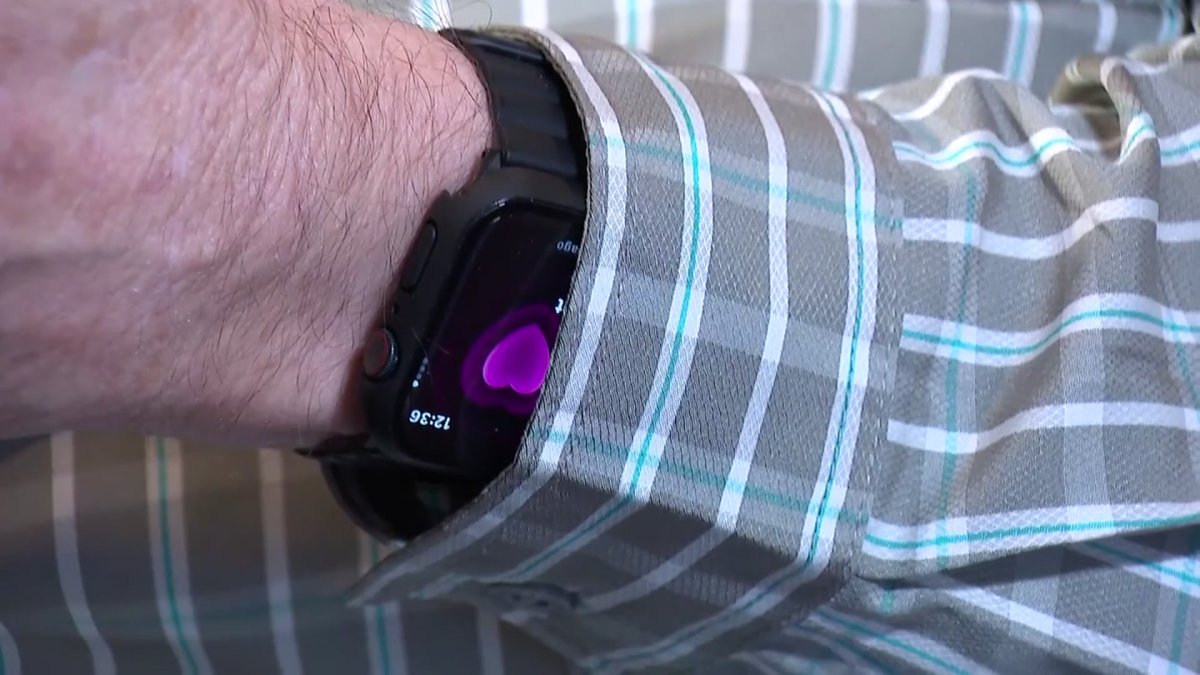
A North Texas man says a simple notification on his smart watch may have saved his life.
What started as a routine fitness tracker alert turned into a shocking diagnosis and a life-saving procedure.
For years, Brad Jackson of Plano has worn his Apple Watch to track his walks and runs.
He never expected what happened last summer.
“I had my watch go off. I looked at it. It said, you got a pulse of 32. I thought, ‘Okay, maybe it’s a malfunction.’ So I waited, and it did it again,” said Jackson.
32 beats per minute is considered dangerously low, a condition known as bradycardia, but Jackson says he felt normal.
He didn’t give it much thought, since his heart rate quickly returned to normal, but a few weeks later, his watch once again alerted him to a dangerously low pulse.
This time, his heart rate stayed around 33 bpm for several days, and Jackson says his body felt weak.
“I just didn’t feel right. I couldn’t feel good any hour of the day,” said Jackson.
His symptoms, plus the alerts from his watch prompted him to seek medical attention.
“The doctor did an EKG,” says Jackson. “He said the EKG shows you need a pacemaker.”
“I had a drop-jawed experience. I could not believe what I heard,” said Jackson.
Within days, doctors implanted a pacemaker to regulate his heartbeat.
His experience is part of the reason why industry experts say 2026 will see the biggest shift yet from fitness tracking to medical-grade intelligence.
Research shared by the American Heart Association shows how artificial intelligence can be used to detect structural heart problems using a single-lead ECG captured by the electrical heart sensor on the back and digital crown of a smartwatch.
It says smartwatches with single-lead ECG sensors paired with an AI tool such as the one developed for this study could help make screening for structural heart disease easier and more accessible to everyone.
Even though Brad credits his watch for saving his life, he knows it was ultimately his choice not to ignore the alerts, which is why he encourages everyone to do the same.
“Looks can be deceiving. You think you’re fine. Everybody sees you, and you seem like you’re fine, and your watch is telling you you’re not fine. So that, to me, was an eye opener,” said Jackson.
Doctors say wearable devices are not a substitute for medical care, but they can be a powerful tool in alerting people to potential problems.