
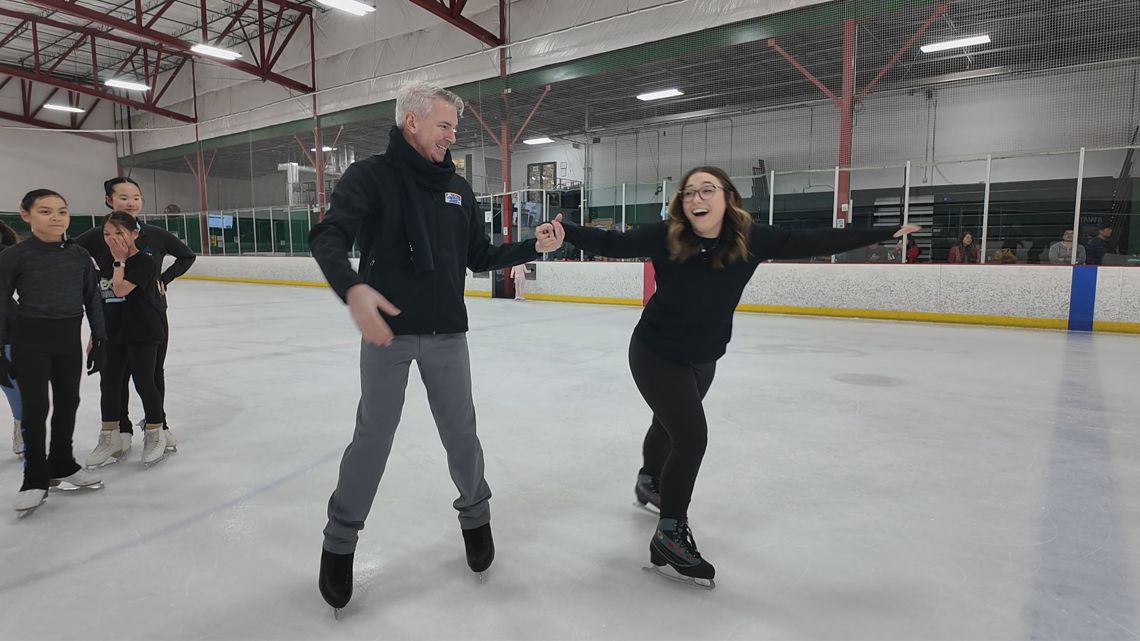
The Olympics have a funny way of raising confidence and making their sport look easy. So KCEN’s Sydney Wicker put her skills to the test with the AFSC.
AUSTIN, Texas — Watching figure skating during the Olympics has become one of my favorite traditions. The jumps look effortless. The spins look smooth. The choreography feels almost weightless.
Seeing Alysa Liu’s gold medal free skate left me in awe.
And like so many people watching from the couch, I’ve had the same thought pop into my head year after year: “I could probably do that.”
So I decided to find out.
RELATED: “It’s going to be the new sport of Texas” | Local figure skaters chase Olympic dreams
I laced up a pair of skates and stepped onto the ice with the Austin Figure Skating Club. An organization that celebrated it’s 50th anniversary in 2025 and has attracted over 400 skaters to the club. Current Olympic figure skater and Texas native, Amber Glenn has even competed in previous years of the Skate Austin Bluebonnet open which is hosted evert spring.
I made it five feet, I realized something important: This sport is hard.
Before I even pushed off the wall, I asked the real experts for advice — the young skaters who glide across the rink like it’s second nature.
Six-year-old Norika Kimura said, “If you’re not so good with skating, you should start slow.”
“I think you need to hold the wall so you don’t fall,” seven-year-old Lillyanna Hereford added.
And perhaps the most honest warning of all: six-year-old Taehee Duong said, “That means you might fall a lot.”
With sectional champion Christopher Chapa guiding me, I learned the basics — how to stop, which includes moving your skates to look like a pizza. I also learned how to bend my knees so I wouldn’t crash straight down, and how to attempt skating backward without panicking.
To my surprise, I didn’t fall. But I was learning from Austin’s best.
I learned some choreography on the ice, which is a mix of dance styles on the ice. Suddenly I was thinking about arms, turns, rhythm — all while trying not to lose my balance.
Then came the spins. With assistance? Not terrible. Without assistance? Let’s just say there was a lot more wobbling than elegance.
And finally — a jump. Or at least, the beginning of one. Not quite a triple axel. But we all start somewhere.
By the end of the session, my feet hurt, my legs were tired and I had a brand-new appreciation for every skater I’ve ever watched on television.
What looks effortless is anything but. Behind every glide across the ice are years of repetition, falls, bruises, early mornings and relentless practice.
The Austin Figure Skating Club isn’t just building routines — they’re building resilience. Confidence. Discipline. And future Olympians.
And if there’s one thing I learned, it’s this: The next time I’m watching the Olympics and think, “I could do that” — I’ll remember the wall.
To learn more about the Austin Figure Skating Club click here.