
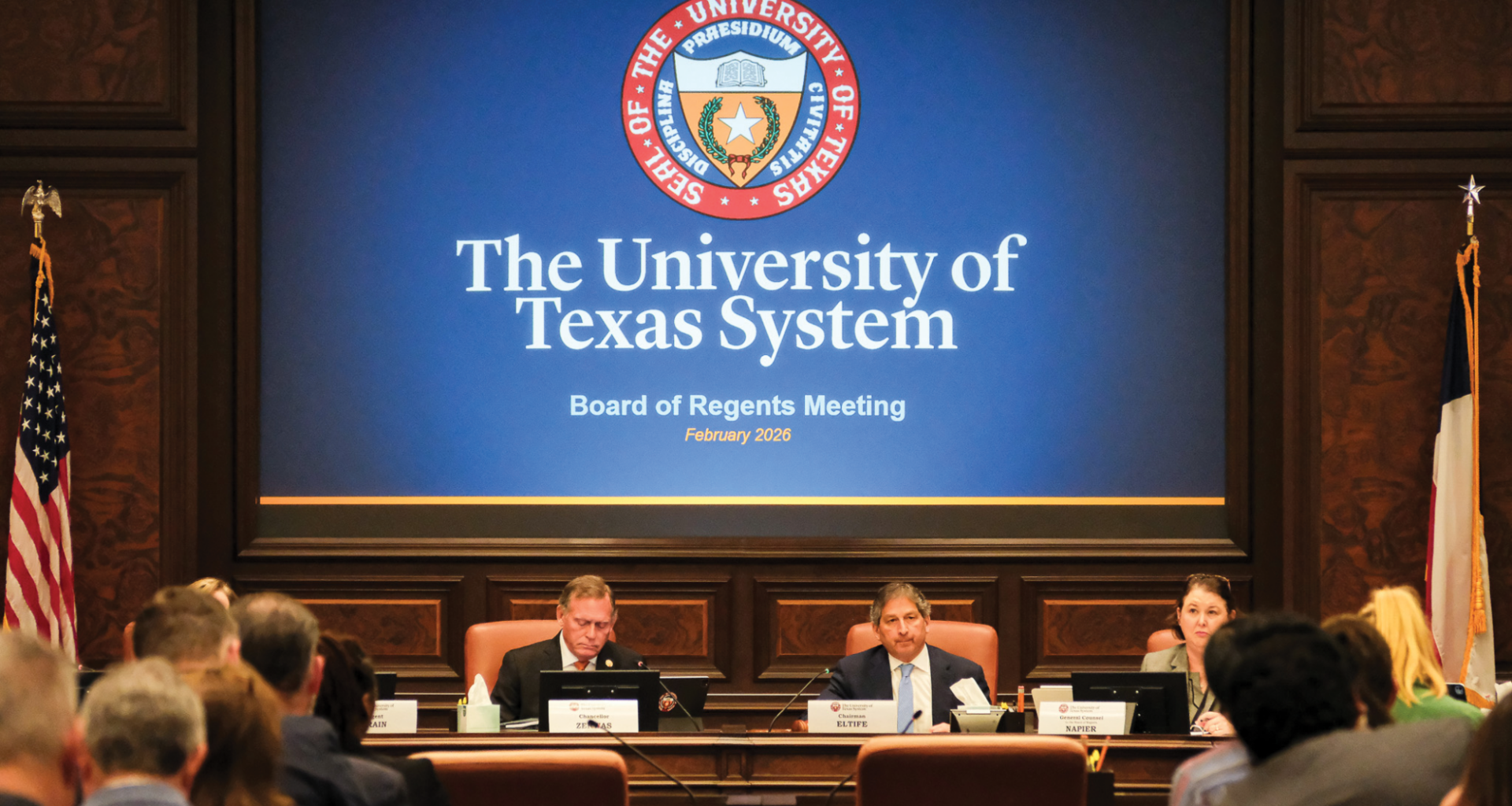
The UT System Board of Regents unanimously approved a policy regulating “controversial topics” in the classroom during its meetings on Wednesday and Thursday. Additionally, the board approved a new computing school which merges three existing academic programs.
The controversial topics policy prohibits faculty from discussing “unrelated controversial or contested matters” in the classroom. The policy also states instructors cannot “coerce, indoctrinate, harass, or belittle students, especially in addressing controversial subjects.” It is currently unclear how the policy will be enforced.
Chairman Kevin Eltife said the UT System “Expectations of Academic Integrity and Standards for Teaching Controversial Topics” policy ensures the “highest level of integrity and quality from those faculty entrusted to teach.”
Peter Onyisi, a physics professor at UT, speaking as a private citizen, said although the words “controversial” and “contested” are constantly repeated in the policy, they are not defined, which “fails to recognize the shared responsibilities of students and administrators … placing the (responsibility) entirely on instructors.”
David Gray Widder, assistant professor in the School of Information, speaking as a private citizen, said restricting what students can and can’t learn will “diminish” the value of a UT degree because “some professors may opt to self-censor.”
The board’s policy is similar to UT’s Texas Statement on Academic Integrity released last November, which included guidelines about academic responsibility “to foster classroom cultures of trust in which all students feel free to voice their questions and beliefs.” According to a University spokesperson, the November statement was only guidance, not direct policy.
Ten faculty, alumni, students and community members testified against the policy at the meeting. Eltife supported University administrators, stating he and the speakers should just “agree to disagree.”
“We have the utmost faith and confidence in President Davis and Provost Inboden,” Eltife said. “We’re proud of them … they’re carrying out the priorities of this board.”
The board also approved a new School of Computing, which will merge the Department of Computer Science, Department of Statistics and Data Sciences and the School of Information, now housed within the College of Natural Sciences. The new school will focus on fields including artificial intelligence and computing research, according to a University press release. This move follows the University’s consolidation of seven ethnic and gender studies majors in the College of Liberal Arts last week.
Plans for the new computing school were first announced in an email sent to community members in the School of Information and the College of Natural Sciences on Nov. 14, drawing concerns from students about what the consolidation means for their academic futures.
“No student should ever have to find out through a mass email that the department they moved across the country for is being eliminated,” graduate student Sydney Wilson said at the meeting. “That’s unacceptable.”
The reorganization will not require new funding, according to the Board of Regents agenda. Current degree programs and certificates will remain intact, as these changes are “strictly organizational,” according to the agenda.
“I am confident this school will help expand what we can accomplish for Texans and the world,” President Jim Davis wrote in a University-wide email on Thursday. “It is an important step forward that strengthens our leadership at the frontiers of science.”
Additionally, the board approved a $22 million increase in funding for repairs on Ernest Cockrell Jr. Hall’s seventh and eighth floors. The project, initially approved in April 2024, will renovate approximately 26,620 square feet of the ECJ to modernize labs and improve space efficiency.