
Bexar County has launched a new pilot that changes how some mental health-related 911 calls are handled, allowing civilian-led crisis teams to respond without a sheriff’s deputy when there is no immediate threat to safety.
The pilot program began this month and applies to mental health calls where no crime is in progress and there is no indication that a person in crisis poses a danger to themselves or others, says Bexar County Sheriff Javier Salazar.
“We’re actually looking at ways of lessening the chances that these people will end up wearing handcuffs,” Salazar said. “Typically, they’d dispatch a patrol officer out there, and well, this patrol officer has got to do something because somebody called. So many times, that person would end up in handcuffs.”
The effort is being tested without a set end date and is currently in what Salazar described as a data-gathering phase. If it proves effective, he said, the approach could be formalized into policy.
“If I had to make a prediction, I think it’s going to go well for us,” Salazar said. “I think this will end up becoming the new normal around here.”
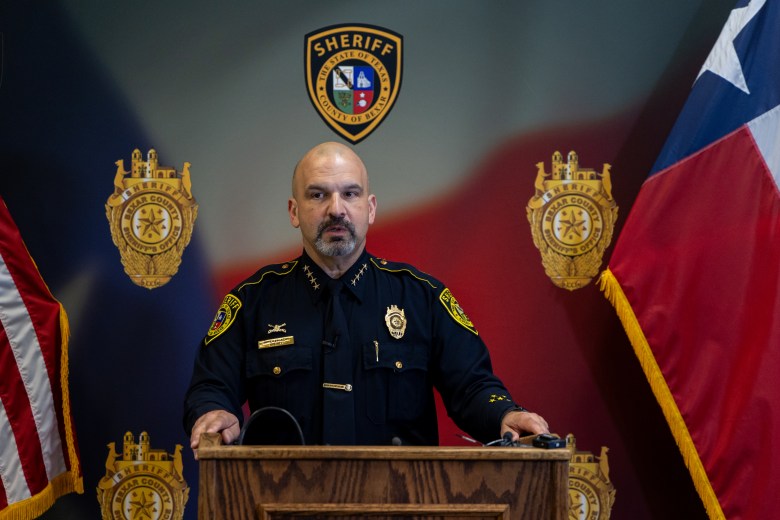 Sheriff Javier Salazar speaks a press conferece at the Bexar County Sheriffs Office headquarters on Sept. 9, 2025. Credit: Diego Medel / San Antonio Report
Under the pilot, dispatchers route certain calls directly to the county’s Specialized Multidisciplinary Alternate Response Team, known as SMART.
The sheriff’s office said the overall triage process for incoming calls has not changed. Dispatchers still assess each call based on available information. What is different is who is assigned once a call is determined to be noncriminal and nonviolent.
Calls involving a crime in progress, weapons or an imminent safety risk continue to receive a law enforcement response. Deputies can also be added later if conditions change on scene.
Salazar said the pilot is intended to better match resources to the nature of the call, based on lessons learned from past responses.
“We’re not going to send you this tool that has proven to not work in years past when I have this other tool that I can send,” he said.
Salazar said the approach was informed by models used by law enforcement offices in California, where patrol deputies are no longer dispatched to certain mental health calls. Rather than sending no response at all, Bexar County is testing whether civilian mental health teams can serve as the initial — and in some cases only — responders.
SMART has operated in Bexar County since 2020 and serves unincorporated areas and the county’s suburban cities. Teams include a licensed mental health clinician, a paramedic and a specially trained deputy.
In 2025, SMART responded to 2,445 mental health calls, according to county data. Of those calls, 1,050 were resolved on scene, while 610 resulted in transport to a behavioral health facility, outpatient clinic or hospital. The remaining calls were either canceled after details changed or involved individuals who could not be located.
The sheriff’s office has nine deputies assigned full time to SMART, which operates with two teams covering the county around the clock. The new pilot does not eliminate SMART’s collaboration with deputies.
The county pilot follows a year of expanded results from San Antonio’s Community Outreach and Resiliency Effort (SA CORE) program, a city-run multidisciplinary mental health response that pairs a police officer with a paramedic and clinician.
After expanding to three teams operating 24 hours a day, SA CORE logged 5,567 responses in fiscal year 2025, according to city data presented at a Jan. 20 public safety committee meeting. Only one arrest occurred during those responses.
City officials have noted, however, that patrol officers still handled the majority of mental health-related 911 calls, often because specialized teams were unavailable or a faster response was required.
County officials and mental health leaders say the pilot reflects a broader effort to reduce law enforcement involvement in behavioral health crises when no criminal activity is present.
Jelynne LeBlanc-Jamison, president and CEO of the Center for Health Care Services — the county’s mental health authority and a partner in both the SMART and CORE programs — said coordination between crisis services and law enforcement has improved over the years but remains fragmented.
 The Center for Health Care Services President and CEO Jelynne LeBlanc-Jamison speaks at a press conference following the City Council Public Safety Committee meeting Tuesday, Jan. 20, 2026. Credit: Diego Medel / San Antonio Report
CHCS operates a 24/7 crisis hotline that receives thousands of calls each month, while the sheriff’s office tracks mental health-related 911 calls separately. Those systems do not currently share data, LeBlanc said.
“Hopefully through technology, we’ll have the ability to either share those databases or at least be present in each other’s database. Where to the sheriffs point, if a call comes in and there’s no need for law enforcement, no one’s in danger of themselves or hurting someone else,” LeBlanc-Jamison said. “It may be our mobile Outreach team, or our all-civilian team is deployed to assess those individuals.”
The pilot follows a broader effort at both the county and city level to push for the development of a jail diversion and recovery system.
“Innovation is not new to both organizations, we’ve been there before,” she said. “Bexar County was a leader in diversion some 20 years ago. We’ve lost our market position, so hopefully we’ll regain it in the coming years.”