
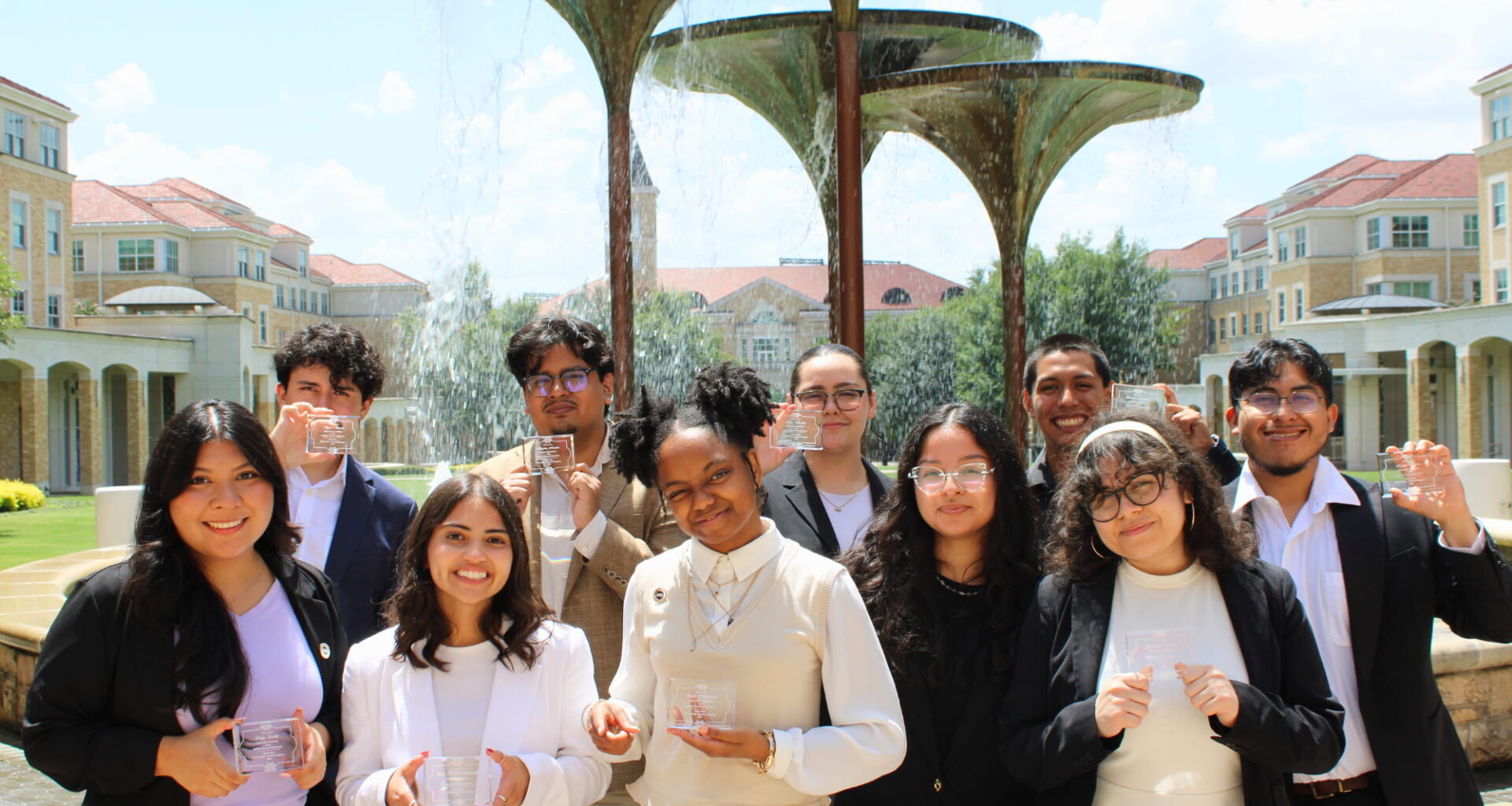
Each time Sharon Arthur sits through Ph.D. interviews she makes the same observation.
She is the only Black woman in the room.
“I’ve heard that the higher you go up, the less you see of yourself,” Arthur said.
Arthur graduated from Texas Christian University with a bachelor’s in psychology and now works as a clinical assistant while applying to graduate programs. The isolation Arthur describes drives the mission of TCU’s Ronald E. McNair Postbaccalaureate Achievement Program, a federally funded TRIO support service ensuring students like her don’t vanish from academia’s upper tiers. Rather than an acronym, TRIO refers to what were originally three — now eight — federal programs designed to increase access to higher education for economically disadvantaged students.
First established in 1989, McNair prepares first-generation and underrepresented students for doctoral studies through research training and graduate school guidance. TCU was one of 14 universities to receive the novel grant, according to a 1991 edition of the TCU Daily Skiff.
First-generation students account for around 19% of TCU’s undergraduates, according to fall 2025 census data from Laurie Harris, director of institutional research.
‘Hidden curriculum’
For many of those students, arriving at TCU means navigating systems without guidance, leaving them to decipher what program director LaTrina Parker Hall calls the “hidden curriculum.”
“We tell them where they can go. We give them resources. We give them a playbook,” Hall said.
Karla Fuentes Maldonado, a Fort Worth native and TCU senior double-majoring in psychology and social work, commutes 30 minutes to campus. Housing costs near TCU were out of her budget. Unlike some of her peers, her parents don’t pay for her education.
“I’ve made friends, but it’s not the same, you know, in terms of talking about our experiences,” Maldonado said.
McNair became the first place Maldonado found peers who understood those experiences.
“That’s the first space I’ve been in where I’ve really been with people who come from similar backgrounds as me,” Maldonado said.
Arthur, like Maldonado, found a sense of community through the McNair program.
“You have people next to you that look like you and are also wanting to pursue similar things,” Arthur said. “It would’ve been daunting without it.”
Hayden Nguyen was 21 when he arrived in Houston from Vietnam in 2018. He didn’t know English and relied on Google and YouTube to navigate an American university system entirely foreign to him.
Nguyen, who graduated from TCU in 2024, described the challenge as isolating.
“I had to navigate it a lot by myself,” Nguyen said.
McNair’s three-mentor model, pairing scholars with a returning McNair student, a doctoral student and a faculty member gave Nguyen what he couldn’t find elsewhere on campus.
For other first-gen students, the barriers are different. TCU senior Gabriella Campos leaned on her mom who attended the university but never graduated. Still, the feeling of not belonging crept in as Campos sat in core classes.
“Whenever it comes to those classes like communication or an arts class, I would feel like, ‘OK, I’m the only Hispanic here. I’m probably the only first-gen here. I’m just so out of place,’” Campos said.
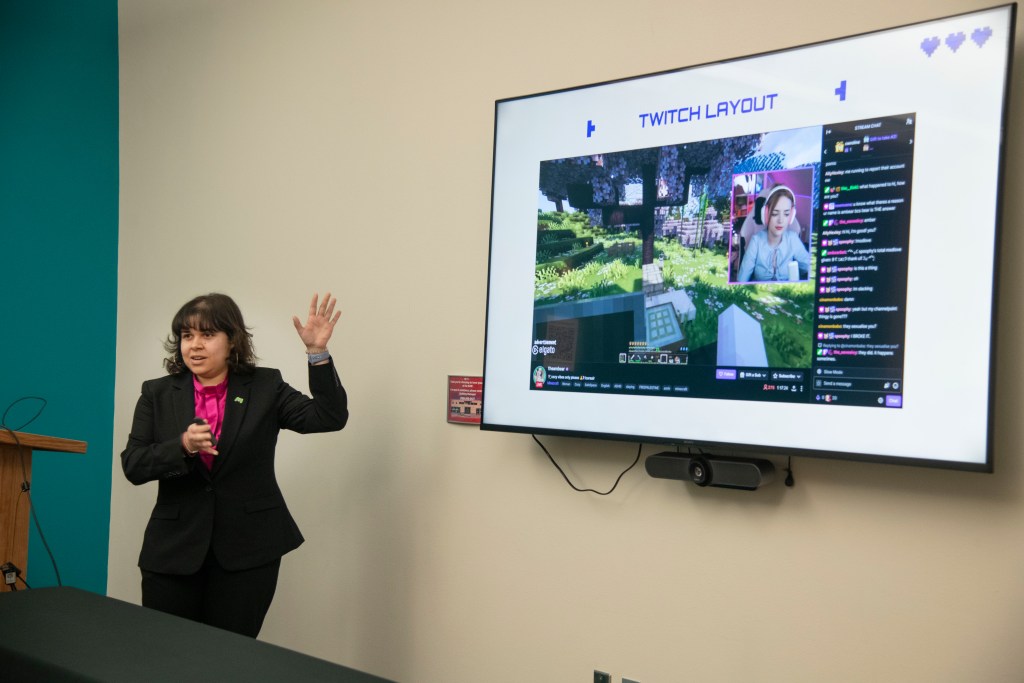 Gabriella Campos presents her research on generative AI’s role in cyberattacks at the McNair Scholars Research Conference at the University of New Mexico in Albuquerque. (Courtesy | Gabriella Campos)
McNair gave her a space where she did belong. Campos, who arrived with plans to graduate and enter the workforce, now works as a research assistant, teaching assistant and is applying to seven master’s degree programs this semester.
“I definitely did not come to TCU thinking I want to do more school,” Campos said. “My mindset was: get a degree, get a job, get out.”
The research experience
McNair scholars conduct research under faculty guidance, present their findings at national conferences and receive comprehensive application support including fee waivers for graduate school applications. The program at TCU currently serves 22 scholars.
Maldonado’s research examined existential isolation in veterans, a topic she connects directly to her childhood as a kid watching military service reshape her father and family. Her survey of veterans found higher existential isolation correlated with increased depression, anxiety and worse physical health.
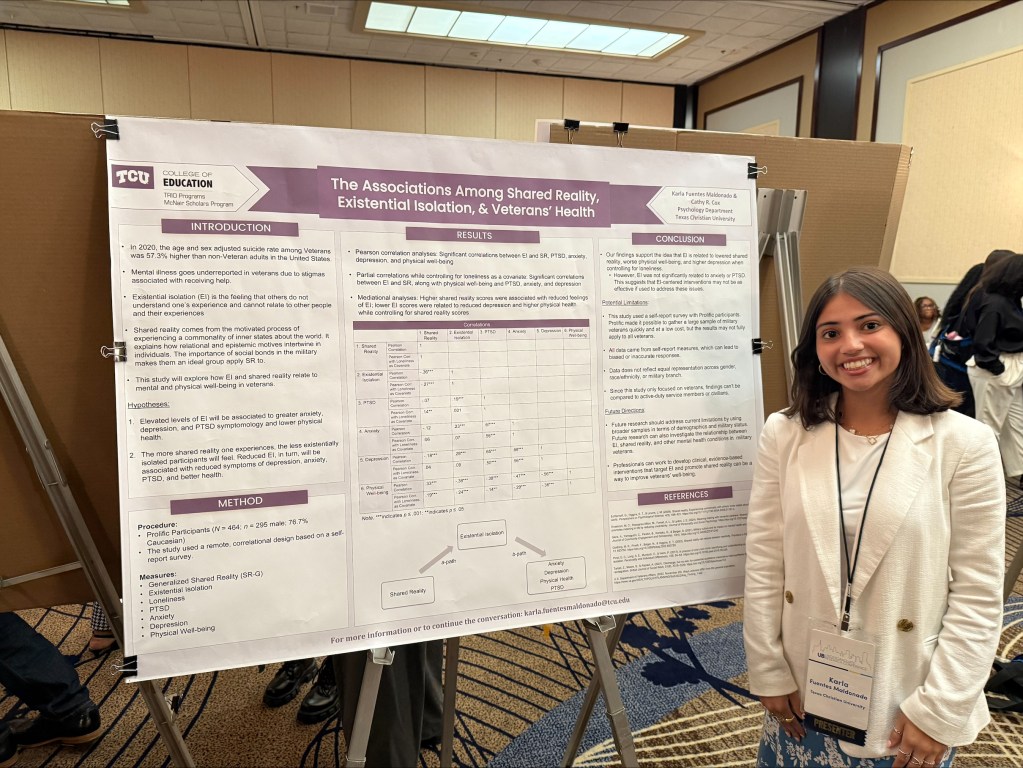 Gabriella Campos presents her research on generative AI’s role in cyberattacks at the McNair Scholars Research Conference at the University of New Mexico in Albuquerque. (Courtesy | Gabriella Campos)
Arthur’s research examined the relationship between race, family dynamics and discrimination on self-esteem and occupational performance. She presented her findings at the University of New Mexico McNair conference.
“It’s nice being in a room where everyone is wanting to pursue higher education, and it’s all first-generation minority individuals,” Arthur said. “The sky is your limit.”
Nguyen’s research exposed food insecurity among first-generation students at TCU, documenting through six interviews how the university’s meal assistance program remained largely unknown.
McNair also waived application fees when Nguyen applied to 15 graduate schools. He ultimately chose the University of Michigan for his master’s in higher education and now works as a hall director at the University of Florida.
At risk
The program faced uncertainty last fall when federal TRIO funding came under scrutiny.
The Trump administration withheld McNair funding throughout August and September 2025 as part of a broader freeze of TRIO grant funding. While the Department of Education is not legally required to release funding until Sept. 30, institutions had historically received grant notifications by mid-summer.
Nineteen McNair programs nationwide lost funding entirely.
As of January 2026, 197 McNair programs operate at universities nationwide, serving 5,403 students — down from 216 programs serving 5,935 students in January 2025.
For Maldonado, a senior preparing graduate school applications, the threat was immediate and personal.
“I remember crying to my mom, and I was like, ‘I don’t know how to apply to these graduate schools now,’” Maldonado said, recalling how most graduate school applications cost $60 to $100 and experts recommend applying to 10 to 20 schools.
Hall held emergency meetings for scholars and led advocacy efforts. TCU secured funding through the end of 2026.
“First-gen, lesser income students have always been the last to receive the support that they need,” Hall said. “The fight is not over and we’ll be ready again.”
Arthur is taking a gap year. She is conducting eating disorder research while preparing Ph.D. applications at the University of Texas Southwestern Medical Center.
Arthur still walks into rooms where she stands apart, she said. But, thanks to McNair, she knows she belongs.
“Without Upward Bound and without McNair, I don’t think I would’ve made it this far,” Arthur said. “Now all I’m about is research.”
Nicole Williams Quezada is a reporting fellow for the Fort Worth Report. Contact her at nicole.williams@fortworthreport.org.
At the Fort Worth Report, news decisions are made independently of our board members and financial supporters. Read more about our editorial independence policy here.
This <a target=”_blank” href=”https://fortworthreport.org/2026/02/21/mcnair-program-at-tcu-opens-doors-for-first-generation-scholars/”>article</a> first appeared on <a target=”_blank” href=”https://fortworthreport.org”>Fort Worth Report</a> and is republished here under a <a target=”_blank” href=”https://creativecommons.org/licenses/by-nd/4.0/”>Creative Commons Attribution-NoDerivatives 4.0 International License</a>.<img src=”https://i0.wp.com/fortworthreport.org/wp-content/uploads/2021/04/cropped-favicon.png?resize=150%2C150&quality=80&ssl=1″ style=”width:1em;height:1em;margin-left:10px;”>
<img id=”republication-tracker-tool-source” src=”https://fortworthreport.org/?republication-pixel=true&post=417355&ga4=2820184429″ style=”width:1px;height:1px;”><script> PARSELY = { autotrack: false, onload: function() { PARSELY.beacon.trackPageView({ url: “https://fortworthreport.org/2026/02/21/mcnair-program-at-tcu-opens-doors-for-first-generation-scholars/”, urlref: window.location.href }); } } </script> <script id=”parsely-cfg” src=”//cdn.parsely.com/keys/fortworthreport.org/p.js”></script>