
It’s starting to look like Tarrant County Judge Tim O’Hare and Republican commissioners want county business conducted with as little comment and dissent as possible — even from commissioners themselves.
In three-plus years in office, O’Hare has been on a crusade against public comment at commissioners’ now-monthly meetings. His most recent rules go too far. Speaking time was effectively reduced, depending on how many people sign up to exercise their constitutional rights.
The changes also limit subjects for which commissioners — who answer to the voters, in case O’Hare has forgotten about representative democracy — can request briefings from county staff. This conveniently includes law enforcement investigations, criminal prosecutions and potential civil litigation.
If you wanted to expressly design a policy to shut down discussion at the court about deaths in the jail and Sheriff Bill Waybourn’s mismanagement of it, you couldn’t be more on the nose.
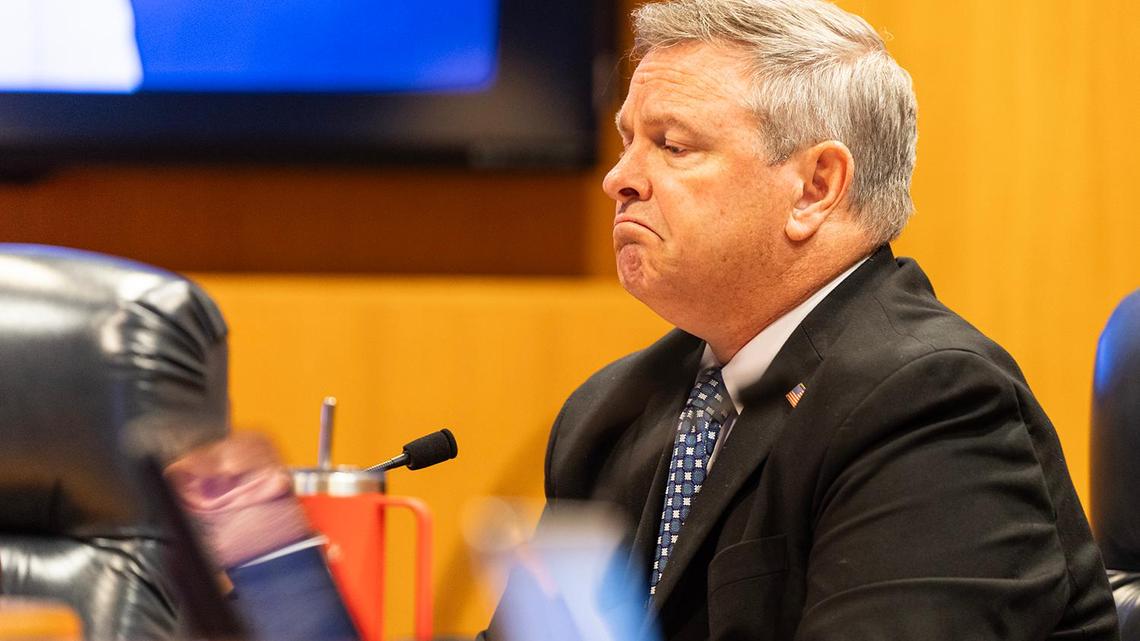
Tim O’Hare, the Tarrant County Judge, listens to lawyer Joe Nixon address the questions regarding the proposed redistricting of the county during a Commissioners Court Meeting at the Tarrant County Administration Building in Fort Worth on Tuesday, May 6, 2025. Chris Torres ctorres@star-telegram.com
O’Hare couches all this in the need to maintain decorum. And it’s true that county meetings could get loud as progressive activists showed up to rail against immigration enforcement and other concerns. Some people inappropriately interrupted proceedings or refused to observe time limits.
But it was also because some citizens had the temerity to applaud viewpoints they agree with. Rather than deal directly with those responsible, O’Hare saw an opening to close off his ears from criticism.
He gave the game away at the Feb. 10 meeting in which commissioners voted on the new rules.
“Free speech does not mean anyone can cause whatever chaos, say whatever foul-mouth thing, do whatever agitation, do whatever disrupting or campaign at a government business meeting,” O’Hare said. “It has never meant that, nor does it mean you can speak at a business meeting an unlimited amount of time on every issue you choose to do.”
He’s not wrong, but note the disdain for citizens — his bosses — who dare to have an opinion about more than one piece of the sprawling county government. For O’Hare, Commissioners Court sessions are meetings to do his business. Not yours.
Decorum is important, but so is freedom to criticize elected leaders
No one likes to hear themselves and their ideas denigrated, especially when they put in long hours and, for the most part, are trying to make better policy as they see it. And let’s not pretend that every commenter is right or pure of heart. It’s generally a lot of the same people, and a tiny number when weighed against an entire constituency.
Part of the deal of getting elected, though, is that you literally sit there and take it. Limits and decorum rules are appropriate, and for everyone’s sake, they should be enforced. The county’s approach, which has included banning speakers for relatively minor violations, leans harder toward rigid rules than honoring the spirit of redress of grievances. (That phrase is in the First Amendment, Judge.)
The Fort Worth City Council recently moved to curtail public feedback and, after complaints, members realized they went too far. Don’t hold your breath waiting for O’Hare to similarly admit a mistake.
If anything, he doubles down. O’Hare went after a couple of speakers who dared to express their opinions in the meeting room after the judge declared a recess. O’Hare professes to be a limited-government conservative and yet applies his power to a room he has vacated while his panel is not doing the business he says cannot be interrupted.
Disrupting public order won’t persuade voters to side with progressives
Progressive activists are not doing themselves any favors with some outbursts. Disrupting the public order is not popular, and too much ruckus can close ears and minds to the very arguments one is trying to make. Some merely want to insult, not persuade. O’Hare knows this, and he counts on winning points with his supporters for standing up to a “liberal mob.”
Republican Commissioners Manny Ramirez and Matt Krause are more reasonable and generally conduct their business with the attitude of a public servant, not an officious overseer. They should stand up to O’Hare — in private, if necessary — and convince him that policies are easier to sell when everyone gets a say.
Waybourn could make matters better, too. He’s never shy about asserting the independence of his office when, say, a Democratic commissioner wants him to appear to talk about the jail. He should leverage his independence in this situation, as well, offering his deputies clearer instructions about what kind of citations are appropriate when the rules are violated.
We’ll give you a head start, Sheriff: No one should be banned for a year for chanting in an emptying room.
BEHIND THE STORY MORE Hey, who writes these editorials?
Editorials are the positions of the Editorial Board, which serves as the Fort Worth Star-Telegram’s institutional voice. The members of the board are: Cynthia M. Allen, columnist; Steve Coffman, editor and president; Bud Kennedy, columnist; and Ryan J. Rusak, opinion editor. Most editorials are written by Rusak. Editorials are unsigned because they represent the board’s consensus positions, not necessarily the views of individual writers.
Read more by clicking the arrow in the upper right.
How are topics and positions chosen?
The Editorial Board meets regularly to discuss issues in the news and what points should be made in editorials. We strive to build a consensus to produce the strongest editorials possible, but when we differ, we put matters to a vote.
The board aims to be consistent with stances it has taken in the past but usually engages in a fresh discussion based on new developments and different perspectives.
We focus on local and state news, though we will also weigh in on national issues with an eye toward their impact on Texas or the Dallas-Fort Worth area.
How are these different from news articles or signed columns?
News reporters strive to keep their opinions out of what they write. They have no input on the Editorial Board’s stances. The board consults their reporting and expertise but does its own research for editorials.
Signed columns by writers such as Allen, Kennedy and Rusak contain the writer’s personal opinions.
How can I respond to an editorial, suggest a topic or ask a question?
Related Stories from Fort Worth Star-Telegram