
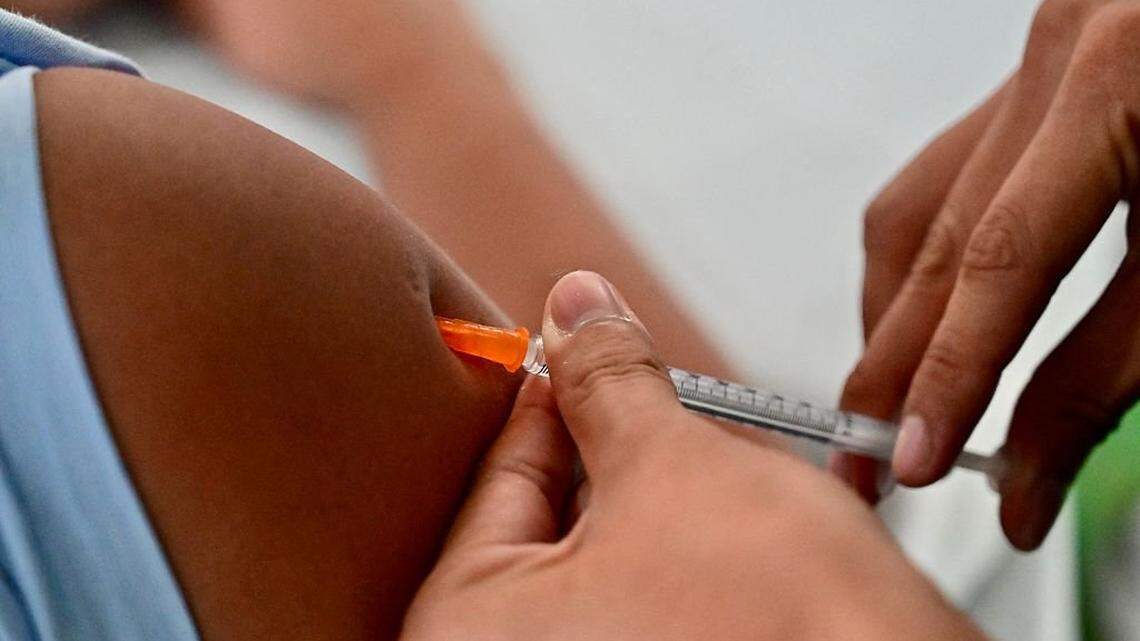
A nurse from the Ecuadorean Ministry of Health vaccinates a person against whooping cough in Guayaquil, Ecuador on May 8, 2025. (Photo by MARCOS PIN / AFP) (Photo by MARCOS PIN/AFP via Getty Images)
MARCOS PIN
AFP via Getty Images
Texas reported more cases of whooping cough last year than anytime in the last 66 years, according to provisional data from the state health department.
This peak comes as vaccination rates among children continue to decline.
There were 4,120 cases of whooping cough in 2025, according to provisional data from the Department of State Health Services. That’s the most cases since 2013, when the state reported 3,985 cases. The 2013 peak was the most cases since 1959, said Lara Anton, spokesperson for the state health department.
The rate of Texas kindergartners up-to-date on their DTaP vaccines, which protect against diphtheria and tetanus as well as whooping cough, dropped from almost 97% to 93% between 2019 and 2024, according to state data.
Whooping cough is caused by bacteria known as pertussis. The bacteria cause an annoying illness in most healthy adults, and is sometimes known as the “100 day cough” for the length of time the illness persists. But in young children, the disease can be quite serious. One in three infants it infects need to be hospitalized, according to the U.S. Centers for Disease Control and Prevention. About 1% of infants die from complications of the disease.
“The younger you are, the more at risk you are for a severe infection with pertussis,” said Dr. Robert Frenck, a professor of pediatrics in the division of infectious diseases at Cincinnati Children’s Hospital, adding that the bacteria can prevent infants from breathing because it causes so much coughing.
⭐ Our editors also recommend:
Pertussis outbreaks are common in the U.S. because immunity tends to fade about seven to 10 years after you’ve been infected, or about five years after you’ve been vaccinated, said Frenck, who is also the director of the Vaccine Research Center at Cincinnati Children’s Hospital. But outbreaks have become larger and more common as vaccination coverage has dropped in the U.S. and in Texas, said Frenck and Dr. James Cherry, a professor of pediatrics at UCLA.
“If we use the vaccines properly, the way they’re recommended, and in particular, see that pregnant women get vaccinated, you can prevent virtually all deaths [from pertussis],” Cherry said.
In Tarrant County, there were 483 cases of whooping cough reported, according to data from the county health department.
The state health department issued a health alert because of the high number of pertussis cases, the second year in a row the department has done so.
Frenck said he expected outbreaks to continue if vaccination continues to wane throughout the U.S.
“The worst case scenario that we could have in the United States is that we stop vaccinating,” he said.
In addition to outbreaks of pertussis, 2025 saw multiple outbreaks of measles throughout the U.S. Measles is the most contagious vaccine-preventable disease. In Texas, a measles outbreak infected 762 people, and killed two children.
This story was originally published February 20, 2026 at 1:18 PM.
Related Stories from Fort Worth Star-Telegram

Fort Worth Star-Telegram
Ciara McCarthy covers health and wellness as part of the Star-Telegram’s Crossroads Lab. She came to Fort Worth after three years in Victoria, Texas, where she worked at the Victoria Advocate. Ciara is focused on equipping people and communities with information they need to make decisions about their lives and well-being. Please reach out with your questions about public health or the health care system. Email cmccarthy@star-telegram.com or call or text 817-203-4391.