
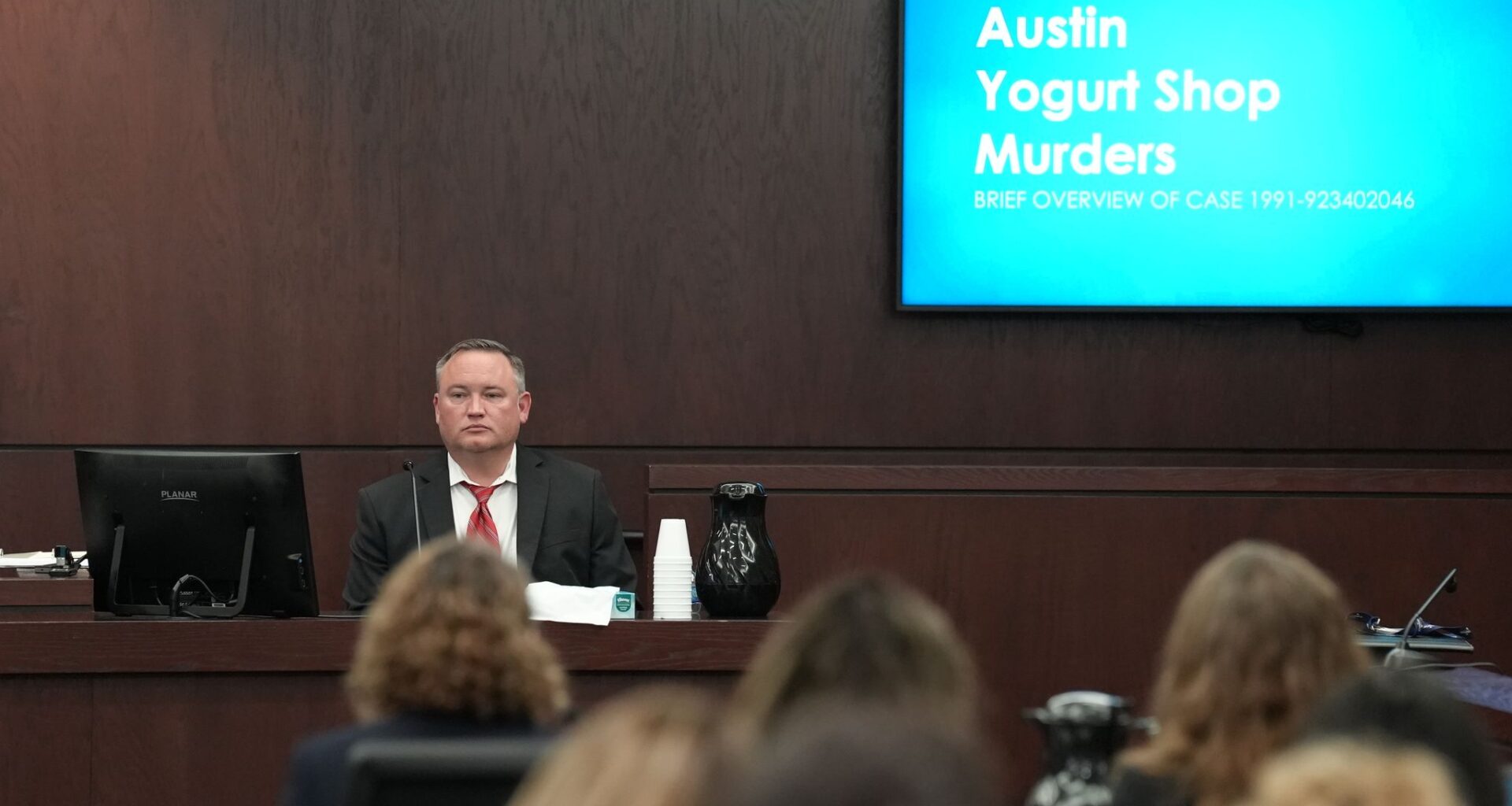
Austin Police Department Cold Case Detective Daniel Jackson arrives at the exoneration hearing for four men wrongfully accused in the 1991 Austin yogurt shop murders at the Blackwell-Thurman Criminal Justice Center in Austin on Thursday, Feb. 19, 2026. Forrest Welborn, Michael Scott, Robert Springsteen and Maurice Pierce, who is deceased, were declared actually innocent during the hearing.
Jay Janner/Austin American-Statesman
The courtroom focus Thursday was on the men who lost decades of their lives.

Maurice Pierce, Robert Springsteen, Michael Scott and Forrest Welborn were formally exonerated in the 1991 yogurt shop murders, their names cleared after more than 30 years of suspicion and legal battles. Much of the hearing centered on the toll the accusations took on them and their families.
Article continues below this ad
Austin Police Department Cold Case Detective Daniel Jackson speaks during an exoneration hearing for the original suspects in the Yogurt Shop murders in aTravis County courtroom on Thursday, Jan. 19, 2026. The judge has formally cleared four men in the decades-old Austin quadruple homicide at the end of a landmark exoneration hearing.
Chris Lamarca/Pool
But the proceeding also pulled back the curtain on a cold case investigation that had largely faded into the background until about five months ago. When Austin cold case detective Dan Jackson took the stand Thursday, he shared several little-known details about the case and the serial killer who was ultimately identified as the sole suspect in the murders of Jennifer Harbison, 17; her sister, Sarah Harbison, 15; Eliza Thomas, 17; and Amy Ayers, 13 inside a I Can’t Believe It’s Yogurt! shop on West Anderson Lane.
Read More: How a new ballistic and DNA techniques cracked the Austin yogurt shop murders cold case
Jackson, who was instrumental in breaking the case, also shared interesting personal details about himself.
Article continues below this ad
Robert Eugene Brashers was a ‘clever’ criminal with a long rap sheet
After advanced DNA and ballistics testing identified Brashers, investigators began reconstructing his criminal history. What emerged, Jackson told the court Thursday, was the portrait of a transient and calculating offender who operated across multiple states and evaded law enforcement for years.
This undated photo provided by the Missouri State Highway Patrol shows Robert Brashers. Authorities said Friday, Oct. 5, 2018 that DNA evidence has identified Brashers as the man who killed three people and raped a girl in the 1990s, even though the suspect killed himself nearly 20 years ago. Investigators say they’ve solved three homicides and a rape case, all from the 1990s, after obtaining DNA by digging up the corpse Brashers. (Missouri State Highway Patrol via AP)
Missouri State Highway Patrol/via AP
Investigators now believe Brashers’ crimes spanned at least 14 years and several states, including:
Article continues below this ad
An attempted sexual assault in Florida 1985, believe to be his earliest offense
A sexual assault and killing in Greenville, South Carolina, in 1990, about 18 months before the Austin murders
A burglary and sexual assault in Memphis, Tennessee, in 1997
A sexual assault and murder in Portageville, Missouri. in 1998
An attempted home invasion and assault in Dyersburg, Tenn. in 1998
A sexual assault and murder in Lexington, Kentrucky in 1998 — a case that later proved pivotal in linking him to the yogurt shop murders.
Although Brashers served two stints in prison in the 1980s and 1990s, Jackson said the man, who died by suicide in 1999, deployed a range of tactics to evade law enforcement.
According to Jackson, the man changed his name, had multiple aliases and birth certificates, traveled in multiple states and “rarely” committed crimes where he lived.
Article continues below this ad
At one point, Jackson said, Brashers even wrote an obituary for himself that he had published in several newspapers.
“He was clever,” Jackson told the court Thursday. “He was able to evade justice for many years.”
Brashers wasn’t on investigators’ radar until last year
Despite thousands of leads over 34 years — including hundreds of tips, dozens of false confessions and extensive DNA testing — Brashers’ name never surfaced during the original investigation.
Article continues below this ad
Read More: Austin yogurt shop murders: A timeline of the long road from cold case to a DNA match
“Robert Eugene Brashers was never in the yogurt shop case files,” Jackson said from the witness stand Thursday.
Given the steps investigators now believe he took to conceal his identity and movements, his absence from the file underscores how effectively he avoided scrutiny.
The right man for the job
After Thursday’s hearing, Dennis Farris — an officer who worked the 1991 crime scene and now serves as president of the Austin Police Retired Officers Association — described Detective Jackson as the “perfect” detective to lead the cold case review.
Article continues below this ad
Jackson’s path to homicide investigator was unconventional. He holds a master’s degree in anthropology and joined the Travis County Medical Examiner’s Office in 2005 as a forensic investigator. Over nine years, he authored more than 4,000 forensic reports and developed expertise in analyzing skeletal remains.
He left the medical examiner’s office in 2014 to join the Austin Police Department, was promoted to detective in 2020 and transferred to the cold case unit in 2022.
On his first day there, he was handed the yogurt shop file.
When beginning his investigation, he said he made a point of not watching videos of the interrogations that led to the false confessions of the men exonerated Thursday.
Article continues below this ad
“I didn’t want to put myself in a position where I had a confirmation bias,” Jackson said.
Three years later, decisions he made about renewed forensic testing would identify a brand new suspect — and bring long-delayed resolution to one of Austin’s most haunting crimes.