
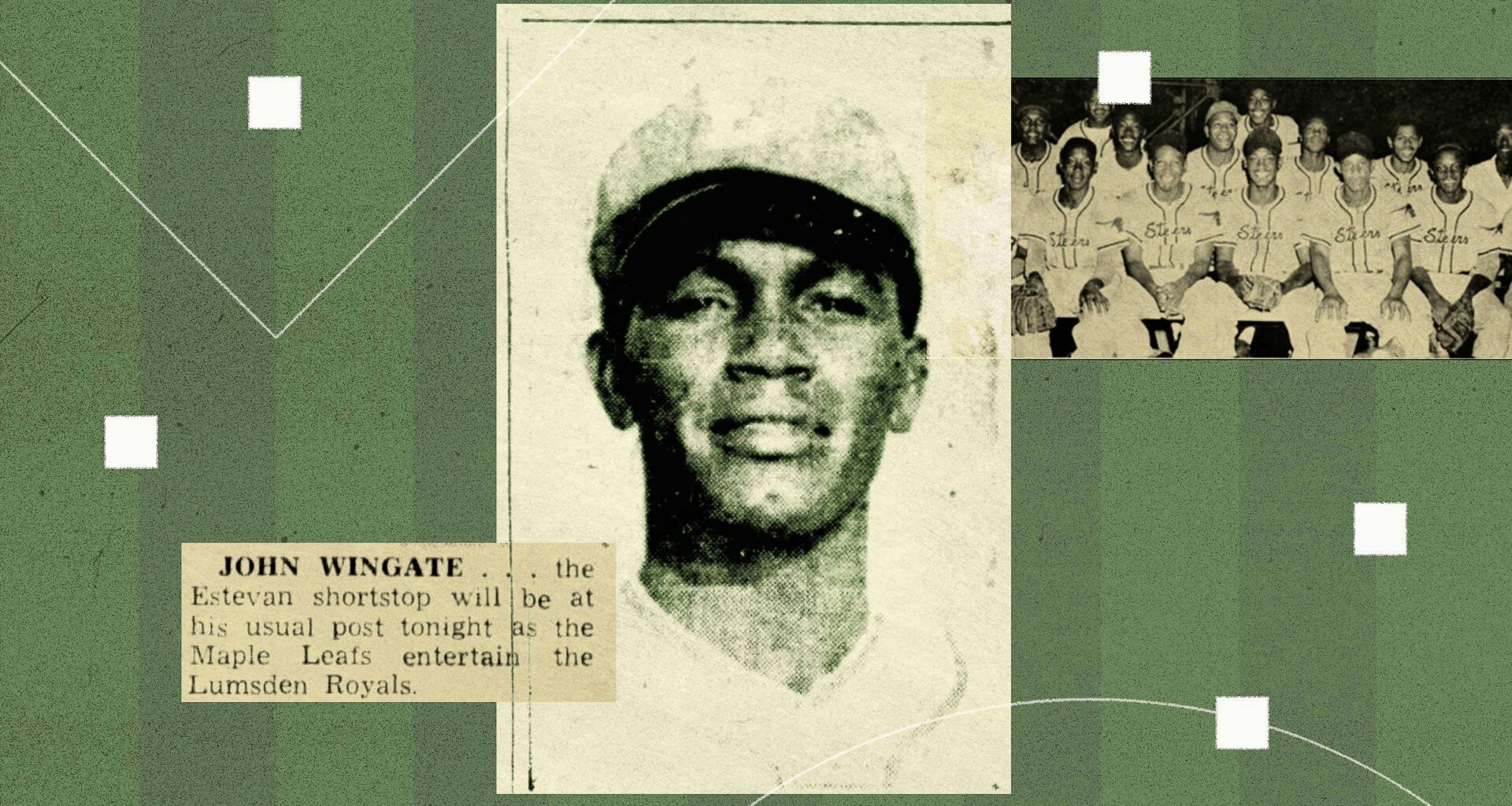
Small-town sports journalists of the early 1950s weren’t in the practice of quoting the athletes they covered—how a receiver felt dropping the game-winning touchdown, if a basketball player knew she’d sink the salient shot when the ball left her hand. Yet in the weeks before the Lamesa Lobos began their 1951 season, in minor-league baseball’s Class C West Texas–New Mexico League, a local newspaper broke form.
John Walker Wingate was sought out for an interview because he was relatively big news. The 23-year-old from Beaumont, a five-foot-eight, 155-pound infielder, was one of two Black players selected to participate in the Lobos spring training following a tryout camp held specifically—and solely—for Black players. At the time, no Black athlete had ever broken the color line in professional, organized baseball in Texas.
In a non-bylined story in the Lamesa Daily Reporter, Wingate—who went by J.W.—was quoted as saying that he was “well acquainted with the problem,” referring to his potential inclusion on the team. He thanked player-manager Jay Haney for giving him and Connie Heard (the other selected Black player) the opportunity to play for the league, which then included teams in Abilene, Amarillo, Borger, Lubbock, and Pampa, as well as Albuquerque and Clovis in New Mexico. “I’ll take whatever comes and do my best not to let it bother me,” Wingate said.
That comment was prescient. Wingate’s tryout got a mixed reception from Texas baseball fans, at best, and the possibility of his joining the league quickly became the subject of heated debate in the press. And the newspaper was equally prescient in speaking to Wingate in the first place: He was the only one out of the original twenty Black prospects who had been invited to the tryout who ended up on the field.
Wingate made his debut for the Lobos on Saturday, April 21—their opening night at home against Albuquerque. Originally slated to start at shortstop, he was pulled from the lineup after reporting to the ballpark ill. But in the bottom of the ninth inning, with two outs, the Lobos sent him in to pinch-hit. Wingate grounded out to first base and ended the game in an 11–7 loss. He made Texas history in the process.
Lamesa is located about sixty miles south of Lubbock, in Dawson County. It’s home today to about eight thousand residents, down from around 11,000 when Wingate took the field. The town pops up occasionally in fiction: It’s the setting for Stephen Graham Jones’s recent hit horror novel I Was a Teenage Slasherand a pit stop for J. R. Ewing on a Dallas episode, and it was mentioned by Billy Bob Thornton on the latest season of Landman. In reality, it claims to be the birthplace of chicken-fried steak, a distinction locals honor with a three-day festival each April.
Lamesa joined minor-league baseball’s West Texas–New Mexico League in 1939, when the town’s lifeblood was cattle, cotton, and oil. Around that time the county seat boasted being “the biggest little baseball city in the world”; it was the smallest of the 33 Texas municipalities that housed minor league ball clubs in 1951.
A 1950 census lists Dawson County’s population as 96 percent white (which it divided into categories of “native” and “foreign-born”) and 5.7 percent Black. The lone Texas county in the league with a higher proportion of Black residents was Lubbock, at nearly 8 percent Black.
Jay Haney, a Dallas native who married a woman from Lamesa, became the Lobos manager that year. During World War II, Haney had served with Black soldiers, and three years after Jackie Robinson integrated the major leagues, he was prepared to add talented Black players to his roster. (The season prior, he added players from the Caribbean to account for those who’d gone to fight in the Korean War.) Haney made his intentions known, and in 1951, the Daily Reporter indicated the town would get behind such a move. “We occasionally get a letter of objection, but the letters supporting the move are more frequent. Apparently skin color makes little difference, and Lamesa fans are willing to give the boys a chance if they can play ball,” wrote reporter Marvin Veal.
In the winter of that year, the club announced a tryout for Black players, to be held on Monday, March 19, three days before the start of spring training.
Two weeks before that tryout, the Daily Reporter published an open letter written by Haney, perhaps in anticipation of further pushback to come—and, in a sense, reflective of attitudes of the time. “We are not trying to rearrange the laws of the South. The Negro will be reminded of this, and at all times must keep his place within his own race,” it read. “He will be warned of the abuse he must expect from the opposing teams and fans. So if he wants to play ball under those conditions, we should be big enough to give him that opportunity.”
Haney continued his hedge by telling Joe Kelly, sports editor of the Lubbock Avalanche-Journal, that his move to integrate the Lobos came as one of the league’s New Mexico teams, the Albuquerque Dukes, proposed the same plan. Owner Cy Faucett had been quoted saying he’d give a Black player the club’s standard five-day tryout. (One Black player ended up being brought to the Dukes spring training and was cut the second day.)
Between the Dukes and the Lobos, tides were clearly shifting, but if at least some fans in Lamesa appeared open to the possibility of having a Black player on their hometown roster, Amarillo sports columnist Harry Gilstrap wasn’t shy about his skepticism. “Why is the Lamesa club chancing this, with the certain knowledge that it will arouse violent objection, perhaps even bitterness, among baseball fans?” Gilstrap wrote in response to Haney’s letter. “Whether there will be general prejudice in this part of the country—and remember, no other baseball league in Texas has made the attempt yet—remains to be seen.”
In the weeks before the tryout, letters flooded into the Lamesa Daily Reporter. One, addressed to Haney, came from a reader in Big Spring: “Myself and others have driven from Big Spring to Lamesa to see games when our team was on the road, but if you employ Negro talent I don’t think your gate will be crowded.” Yet the paper also published a lengthy letter from a female Texas Tech student, who described herself as “what you might call a ‘rebel’ southerner,” endorsing Haney’s intentions: “More power to you for taking up this challenge.”
On the morning of March 19, Lobo Park on the south end of town was packed for the tryout. “Nearly everyone in Lamesa was out at one time or another during the day,” the Daily Reporter stated. The club had anticipated that fifty to sixty aspirant players would show up, but fewer than half of that number reported. Wingate and Heard—the latter, an outfielder from Texas City—stood out, and were invited to the club’s spring training camp, in Ballinger.
We don’t know much about Wingate’s previous playing experience, although it appears his only high-level games prior to the Lobos had been played in 1950, in a Canadian semipro league frequented by Black players. We do know, however, that nine days before Lamesa’s opener, Haney cut both Wingate and Heard.
The Sporting News wrote that Haney said the pair “fell short of the rigid standards he had set for the first Negro players in Organized Ball in Texas.” There was little further elaboration on that decision from Haney. Nor did he later explain why Wingate was added to the final Lobos roster the night before Lamesa’s scheduled opener, which was pushed back a day because of bad weather.
So came Wingate’s debut in late April. He grounded out that first game, but as the early season rolled on, he went on a six-game hitting streak; when he went 3-for-5 with a home run (plus standout fielding) against Abilene on May 2, Abilene Reporter News sports editor Collier Parris wrote that the larger-than-average crowd “gave the colored player a big hand.”
But home attendance in Lamesa at the start of the season was deemed disappointing, and the Daily Reporter noted that some fans blamed Wingate. The Associated Press followed up on that sentiment, and a headline in the Abilene paper blared: “Negroes Hurt Lamesa at Gate.” (Note the plural, which counted two Cuban players on the Lobos’s roster—who coincidentally were dropped from the team the day the article was published.) Lamesa journalist Marvin Deal wrote in response: “Give us some good, hot, summer weather and a good dosage of rain and you’ll see fans start packing the park, Negroes or no Negroes.”
If opponents were offended by Wingate’s presence, he apparently wasn’t targeted at the plate; he was only hit by pitch once. About a month into the season, his batting average was .284, good for sixth among Lamesa’s regulars, and Haney told The Sporting News that Wingate got “along splendidly” with the team. But things took a turn in late May. Over 27 games, Wingate’s batting average fell to .250—in the bottom quarter of league batters—with two home runs and a dozen runs batted in. Soon after breaking Texas baseball’s color line, Wingate was released.
At the time, Haney told the Daily Reporter that Wingate was unlikely to help the team the rest of the season, but his rationale for dropping his player veered in a different direction when interviewed by Abilene’s Parris. “Some of the fans seemed to think Wingate was holding down attendance,” he said. Lamesa’s home crowds had dropped by more than a third, from 1,468 fans per game to just 902. “We weren’t drawing many fans,” Haney said. “So, we let him go.”
Parris didn’t pull any punches in his accompanying column. “Lamesa fans, being sturdy, southern home-towners to whom Negroes mean cotton-pickers, shine boys and car-washers, never did give Wingate a chance,” he wrote. “He happened to shine like a comet in the Abilene park, and was a factor in attracting two of the largest crowds of the season here.”
But 75 years later, Bob Buckel accepts Haney’s contention. Buckel is a 1974 Lamesa High School grad whose longtime journalism career included a stint as editor of his hometown paper; his father Walter, was both a player and executive with the Lobos in the forties and fifties. In small West Texas towns at the time, “a minority of people” would have accepted Black players taking the field, he says.
For the rest of their 1951 season, the Lobos played much better and finished third out of eight teams, with an 81–61 record. Their home attendance, though, didn’t improve. It remained down by almost a third—from 87,438 people in 1950 to 59,283 for the full season.. (Keep in mind that attendance across the minors fell by about 20 percent in 1951, likely due to the ongoing war.)
J.W. Wingate finished out the 1951 season with the Negro American Leagues’s Kansas City Monarchs. Months later, in February 1952, Wingate was one of about two hundred Black players to attend a four-day tryout in Dallas, conducted by the Texas League’s Double-A hometown Eagles. The Dallas Morning News identified Wingate as the “best known quantity” at the tryout. (Among those tryouts, Black pitcher Dave Hoskins would get signed a few months later by the Eagles, breaking the color barrier in Texas’s premier league; the same year, he led the league in wins and his team to a first-place finish.)
Wingate wasn’t signed, though, and he didn’t return to predominantly white baseball until 1954, after a two-year stint in the military. He went on to play, in 1955, with teams in the Class B Big State League: Texas City, Tyler, and Port Arthur. In an organized baseball career that spanned six clubs over parts of three seasons, his lifetime batting average was .257, with four homers and 62 RBIs.
Shayee Wingate, of Beaumont, says his grandfather, who died in 2015, didn’t share much about his baseball career. The two lived together for a few months almost thirty years ago, when Shayee, now 49, was going through some personal struggles. “He helped me get back on my feet,” Shayee says. His grandfather, known locally as “the beer man,” worked as a Coors sales rep. “My uncle said he started a trucking company, one of the first run by a Black man in this area.”
Lamesa dropped out of the league after the 1952 season. The “biggest little baseball city in the world” briefly enjoyed its final taste of minor-league membership late in 1957, when it took over Midland’s club in the Class B Southwestern League for the season’s final weeks.
The city has changed in some ways since then, but not all. Today Lamesa High’s Golden Tornadoes—known around town as the Tors and Lady Tors—are the biggest game in town, no matter the season. The area’s economic profile now includes renewable energy, silica mining, and even a winery. Its demographics have shifted too: As of 2020 Lamesa’s population was 69 percent Hispanic, 27 percent white, and percent Black.
A few history books detail Haney’s efforts to integrate the Lobos (Gaylon H. White’s Left on Base in the Bush Leagues, Toby Smith’s Bush League Boys). But J.W. Wingate isn’t a member of the Texas Sports Hall of Fame. He isn’t a member of the Texas Black Sports Hall of Fame either. C. Paul Rogers III, a longtime SMU law professor who has chaired Dallas–Fort Worth’s chapter of the Society for American Baseball Research for 28 years, isn’t surprised by the low profile of Wingate’s achievement. “It occurred in a small West Texas town and lasted only six weeks,” he says.
But perhaps Wingate’s accomplishments have been minimized not because they lack importance, but because they lack prominence in the record: A triumph waiting to be discovered. “I am not familiar with the name,” says Carol Huntley Little, who’s affiliated with the Texas Black Sports Hall of Fame. “It sounds like he should at least be nominated.” There’s a start.
When you buy a book using a link on this page, a portion of your purchase goes to independent bookstores and Texas Monthly receives a commission. Thank you for supporting our journalism.
Read Next