
Texas State Head Coach Terrence Johnson talks to his team as the Bobcats create to play the Texas A&M San Antonio Jaguars at Strahan Arena in San Marcos, Nov. 5, 2025.
Sara Diggins/Austin American-Statesman
According to the NCAA demographics database, Black head coaches in college basketball are underrepresented, relative to the player base.

About 67% of Division I men’s head coaches and 61% of Division I women’s head coaches are white. In comparison, 33% of women’s head coaches and 27% of men’s head coaches are Black. In a sport where 50% of male student-athletes and 39% of female student-athletes are Black, the disparity stands out.
Article continues below this ad
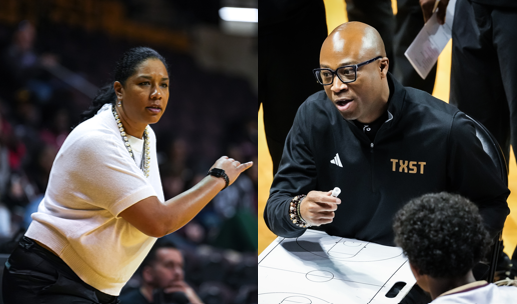
Texas State women’s basketball coach Zenarae Antoine (left) and men’s basketball coach Terrence Johnson seen in a collage.
Austin American-Statesman
Texas State head basketball coach Zenarae Antoine takes the court ahead of the game against Troy at Strahan Arena on Saturday, Jan. 17, 2026 in San Marcos, Texas.
Aaron E. Martinez/Austin American-Statesman
Texas State, unlike the other Division I universities in Texas, has two Black basketball coaches, with Terrence Johnson leading the men and Zenarae Antoine coaching the women. As they talked to the American-Statesman about Black History Month, both said they use their positions to give other Black coaches a chance to reach their goals, just as they have.
“It’s about giving opportunity,” Johnson said.
MORE: Texas State basketball beats Troy for best win of the season
Article continues below this ad
Breaking the mold
When young coaches first get in the game, they need to find their niche, Antoine said. Without experience, most don’t have much to offer from a schematic standpoint. So they show their worth in other ways. Antoine and Johnson each said that Black assistants tend to be hired in specific roles, and recruiting tends to be one of the fields into which they are pigeon-holed. Even if they excel, coaching is about much more than talking to players and creating relationships.
Johnson, 47, said Black people have no problems being hired for these specialized jobs. But being a head coach requires experience in many other facets, and breaking the mold of being seen as only a recruiter can be difficult.
Article continues below this ad
“They can be in a situation where that is their primary,” Antoine said. “So they’re not able to develop their basketball game, an understanding of not just the X’s and O’s, but the ins and outs of how to run a program.”
Texas State head coach Zenarae Antoine disputes a call with an official during the game against Troy at Strahan Arena on Saturday, Jan. 17, 2026 in San Marcos, Texas.
Aaron E. Martinez/Austin American-Statesman
Antoine, 51, said she began her journey working under Tom Collen, a women’s coach at Louisville and Arkansas. Collen had no qualms about giving her different kinds of responsibilities within the program, which Antoine said she appreciated.
Whether it was helping to run plays, sitting in on marketing meetings or working on player development, Antoine said Collen trusted her and fostered growth, which prepared her for her role at Texas State. She has coached the Bobcats for 15 years and is the program’s all-time leader in coaching victories and was the 2023 Sun Belt coach of the year.
Article continues below this ad
Much like her mentor, Antoine tries to prepare members of her staff so that when their time does come, they’re just as ready for their opportunity as she was.
“He was one of the first coaches at the then-Power Five level who was very comfortable in turning over the reins … to a coach who was very capable, but who didn’t necessarily look like him,” Antoine said. “Others, and myself, included.”
Passing the torch
Johnson isn’t Texas State’s first Black men’s basketball coach. That honor goes to Celester Collier, who Johnson said sits across from him at court level during games in Strahan Arena. Johnson recognizes that he wouldn’t be where he is now without Collier, and he said he’s “blessed to be walking in his shadow.”
Article continues below this ad
When the Bobcats were transitioning to Division I competition in 1984, Collier was hired to lead the men’s team. Harry Larrabee replaced Collier following the 1985-86 season, after Collier posted an overall record of 12-42 in two years. Collier didn’t get a shot to play out his contract, an opportunity that was afforded to Johnson.
Texas State Bobcats head coach Terrence Johnson stands on the sidelines as Texas State men’s basketball takes on Troy at Strahan Arena in San Marcos Wednesday,Feb. 11, 2026.
Mikala Compton/Austin American-Statesman
“I’m representing this Bobcat community… but I’m also representing him, and him paving the way as the first African American coach and me being the second.”
It’s part of why Johnson advocates for other Black assistants who have come up with him to get a head coaching job. He mentioned Texas assistant Ulric Maligi, Kentucky assistant Alvin Brooks and Arkansas associate head coach Chin Coleman as men who are ready to take the next step in their careers.
Article continues below this ad
Johnson sees each of them as deserving based on their merit, not their race. But as someone who has thrived because of the Black Americans who came before him, he said he feels an obligation to hopefully pass the torch onto the next generation. Black History Month is a time to remember and honor the past, but crafting a better future requires action, not just in February — the whole year.
“We have a responsibility to share that and keep it going,” Johnson said. “I don’t want it to be something that it’s a ‘month,’ and it’s just a month in words, not in action.”