
FORT WORTH — Well, that was a bad idea.
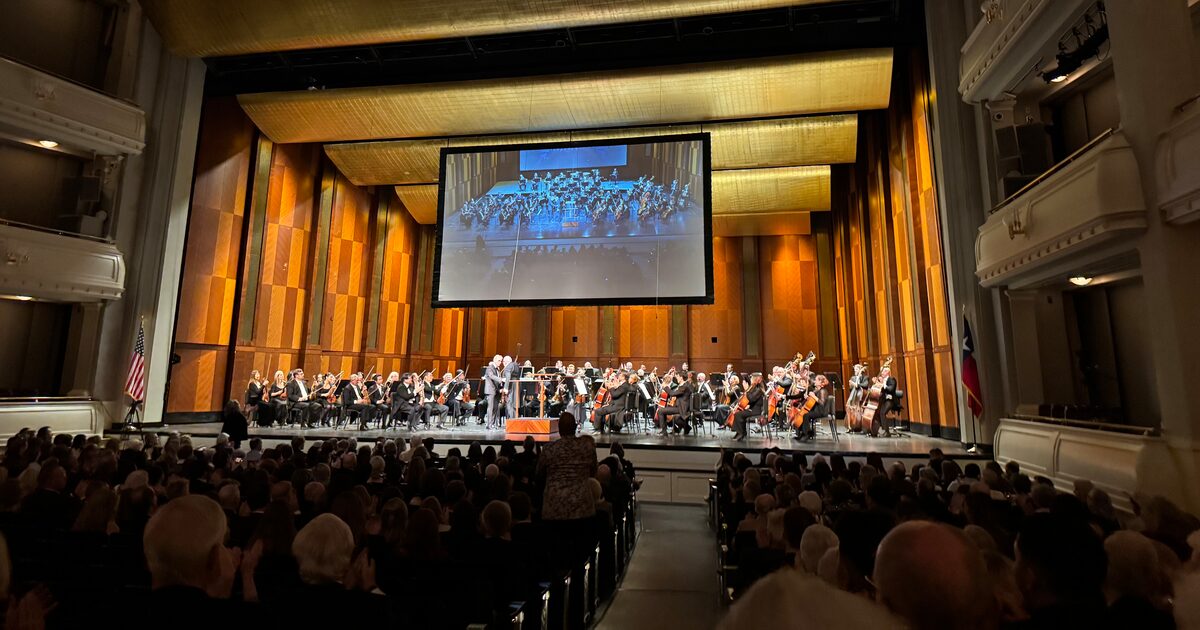
For the Fort Worth Symphony Orchestra’s Saturday night performance of the Brahms Violin Concerto, an enormous screen hung over the stage. Live video projections supplied shifting, zooming, super-size views of soloist Gil Shaham, music director Robert Spano and random sections of the orchestra.
This was the orchestra’s gala concert and Bass Performance Hall was well filled with a mostly black-tied audience. A gala dinner was to follow.
As nearly as I could tell, trying to sift out the oversize video distractions, the Brahms got a splendid performance. The video might even have been less distracting if the shifting views and sometime dizzying zooms in and out had anything to do with the music.
News Roundups
We saw the back of Shaham’s head as often as a frontal view. Violins’ soaring melodies were sometimes illustrated with random pans of other sections of the orchestra.
The middle movement has one of the most beautiful oboe solos in the orchestral repertory, and FWSO principal Jennifer Corning Lucio played it eloquently. But what did we see at that point on that enormous screen but other players in the wind section, only toward the end of the solo showing Lucio.
At least Shaham, smiling much of the time, was obviously enjoying himself, and he played with fastidious technique and unforced elegance. His was also a commendably interactive performance. When the violin is mainly spinning decorative curlicues around more important orchestral parts he didn’t hesitate to pull back — physically as well as sonically — to give the music proper balance.
When I managed to block out the video distractions, it was clear that Spano had a solid and sympathetic feeling for the music, and the orchestra played on its accustomed high level. But the musical experience would have been far better without competition from a gigantic amateur TV show.
For an encore, Shaham dispatched a tidy, graceful Bourrée and Double from Bach’s B minor Partita (BWV 1002). Unlike too many violinists who treat these unaccompanied movements as rhythmic playgrounds, he mostly played it as a stylized dance, in a definite meter.
Minus screen and projections, the compact program opened with Ralph Vaughan Williams’ lush Fantasia on a Theme by Thomas Tallis. Scored for strings only, it divides them into three: a main body, a smaller secondary group and a string quartet.
Spano had the secondary group at the back left of the main strings, lending an aptly distanced effect. The orchestra’s principals supplied the quartet: violinists Michael Shih and Adriana Voirin DeCosta, violist DJ Cheek and cellist Allan Steele.
Again, Spano timed and shaped the music with organic understanding. Individually — Cheek with an especially gorgeous tone — and in the score’s varied combinations, the strings played with delicacy where called for, lustrous surges and sweeps elsewhere.