
By David Wilfong
NDG Contributing Writer
In one of the most unusual congressional primaries in Texas, former U.S. Rep. Colin Allred and incumbent District 32 Rep. Julie Johnson are locked in a high-stakes Democratic contest for the newly redrawn 33rd Congressional District.
This seat in Dallas County, seen by poll watchers as solid blue, is one of the more interesting that emerged from Republican-led redistricting in the North Texas area..Early voting began last week for the March 3 primary, where Allred and Johnson headline a four-candidate Democratic field.
The winner is highly expected to prevail in November against a Republican nominee from a crowded but low-profile GOP primary.
Republicans, who control the Legislature, eliminated one of three Democratic-held seats in the Dallas-Fort Worth metro area. The old 32nd District, which Johnson won in 2024 after Allred ran for Senate, was stretched eastward into heavy Republican territory. The old 33rd, long represented by Rep. Marc Veasey, lost its Fort Worth anchor and was redrawn entirely within Dallas County.
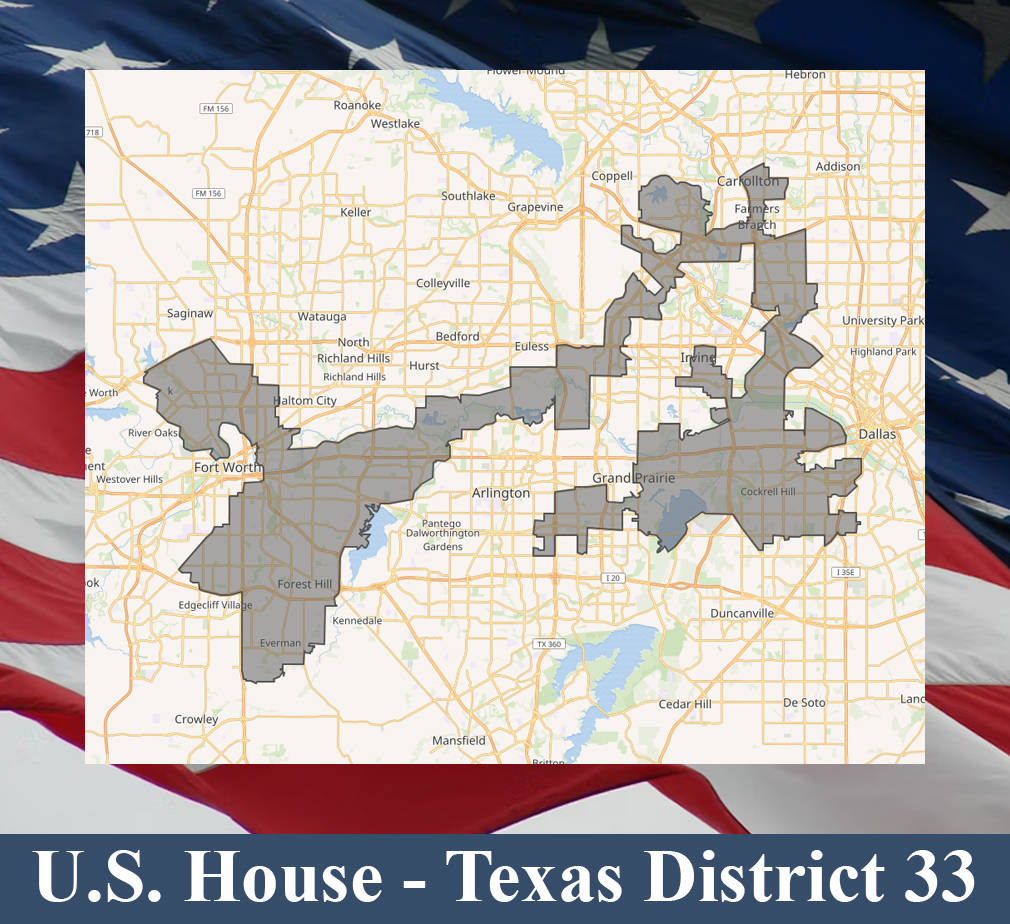 District 33 is a highly-gerrymandered result of redrawing congressional lines to try to boost GOP seats in congress. (Map via Wikimedia)
Veasey, first elected in 2012, announced in December 2025 he would not seek re-election to Congress after the new lines left him with only about one-third of his former constituents. The new 33rd is rated D+18 by the Cook Partisan Voting Index, which gives an advantage to former House Representative Allred in the current contest. It has a majority-Latino eligible voter population and stretches from Grand Prairie through downtown Dallas to parts of Oak Cliff and the Reinhardt neighborhood.
Johnson, the first openly LGBTQ member of Congress from Texas, filed for the seat on the Friday before the Dec. 8, 2025, deadline.
Allred, who represented an earlier version of the 32nd from 2019 to 2025, dropped out of the Senate race that same Monday and filed for the 33rd hours later. The overlap, representing roughly one-third of the new district’s residents coming from the old 32nd, has turned the contest into a rare predecessor-versus-successor matchup.
Allred is a former NFL linebacker, civil rights attorney and Obama-era Housing and Urban Development official. He has emphasized his record of delivering $135 million in federal funding for transportation, health care, housing and law enforcement while in Congress. He touts a bipartisan reputation and says he never accepted corporate PAC money or traded stocks.
“I felt a responsibility to those folks to try and make sure that we have a unified party going into November, and that I could best serve by looking at serving my hometown,” he told reporters after switching races.
Johnson counters that she has been the consistent voice on the ground.
“This new district deserves representation that has been present in the tough moments, including throughout the redistricting fight, instead of parachuting back when another campaign doesn’t work out,” she said.
She has highlighted her work in the Texas House from 2019 to 2025, where she authored legislation to expand Medicaid, and her congressional focus on abortion rights, gun safety and lowering prescription drug prices.
The campaign has grown testy. Johnson has accused Allred of taking “a Republican turn” during his Senate run, citing his vote for the Laken Riley Act, which she says allows mass deportations without due process.
Allred has criticized Johnson over stock trades, adding that she held shares in Palantir Technologies (a contractor involved in immigration enforcement) and was among the most active traders in Congress. Johnson defends the trades, saying they were managed by independent advisers, that she has divested all actively traded stocks, and would support a congressional stock-trading ban.
The race has exposed tensions within North Texas Democrats after redistricting forced a game of politically-musical chairs while voters in the district grapple with issues familiar to urban Texas: rising housing costs, public school funding, access to health care and the effects of federal immigration enforcement under a second Trump administration.
Both leading Democrats have promised to protect reproductive rights, expand health coverage and invest in infrastructure, but they differ in tone on confronting the administration. Allred stresses his willingness to “stand up” even in a tough district; Johnson points to her votes against Republican-led measures on immigration and nonprofit investigations.
Two lesser-known Democrats round out the field. Zeeshan Hafeez, an attorney and tech executive and son of immigrants, is running a progressive campaign calling to abolish ICE, label the situation in Gaza a genocide and reject corporate PAC money.
“A lot of Democratic primary voters that we’re talking to are frustrated with the status quo,” he said in a recent interview. “I think they’ve seen that the establishment Democrats have let us down. The country is going and creeping towards an authoritarian takeover by Donald Trump. We see ICE, and there are gross injustices that are happening where they’re literally murdering people on the streets.”
Carlos Quintanilla is a community activist who has run for the seat before He criticizes both front-runners on immigration and stock issues and says he takes no PAC money.
Hafeez and Quintanilla, both polling in single digits, hope to capitalize on dissatisfaction with the establishment. Hafeez has positioned himself as the only candidate willing to call for abolishing ICE and addressing Palestine directly. Quintanilla leans on decades of local activism on issues from heroin addiction to education.
On the Republican side, four candidates are competing for a nomination that some say offers little realistic path to victory. Patrick Gillespie, Monte Mitchell, Kurt L Schwab and John Sims are on the ballot.
Republicans acknowledge the district’s leanings, with the general election rated “Solid Democratic” by most political watchers. The Democratic nominee will enter November as a heavy favorite in a district where Democrats have won by double digits for years.
With primary day approaching fast, the contest has drawn national attention as a test of Democratic unity in a state where the party lost ground in 2024. Turnout is expected to be modest, typical for a non-presidential primary, but the winner will carry the burden of uniting the party quickly for November.