
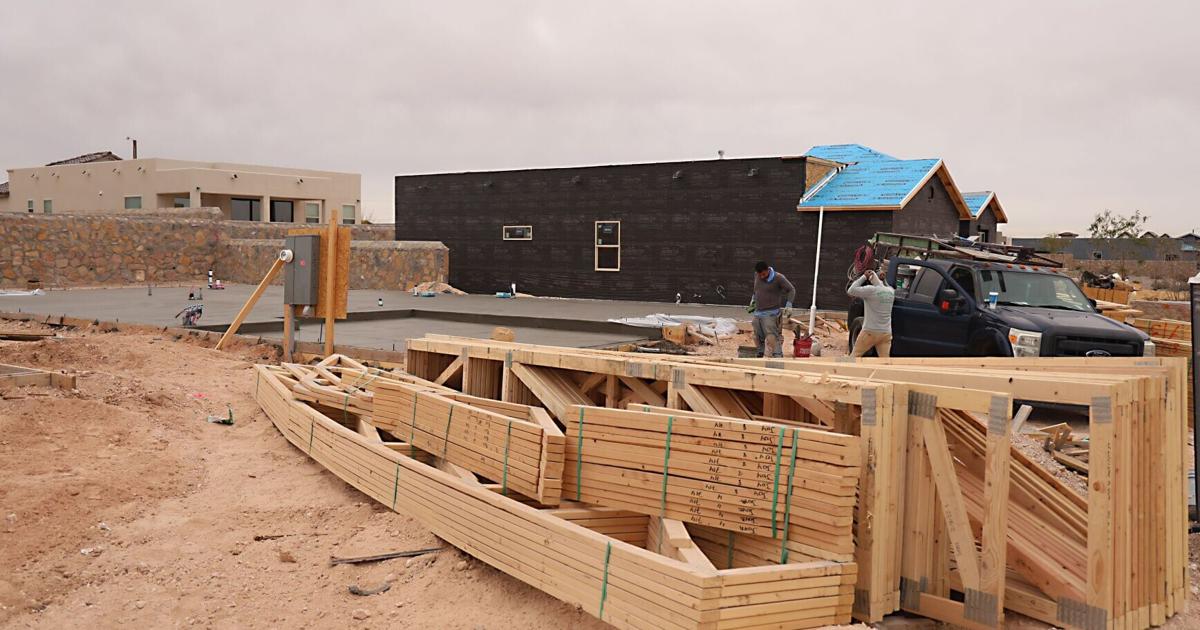
Recent immigration raids at El Paso construction sites have caught the attention of local homebuilders, but industry leaders say the impact on the local workforce has been minimal and projects are moving forward.
“I haven’t seen any effects as of yet to our company, and we haven’t really had workers not showing up,” said Randy Bowling, president of Tropicana Homes, an El Paso-based homebuilder.
Tony Rodriguez, owner of TR Corp. Roofing and Construction Services, a family-owned business started by his father, echoed that assessment.
“We haven’t experienced any of the stuff that’s been out there. Nothing’s been experienced yet. And I say ‘yet’ because you never know,” Rodriguez said.
Social media posts around the country have shown immigration officials – including agents from U.S. Immigration and Customs Enforcement, U.S. Citizenship and Immigration Services and the U.S. Border Patrol – swarming construction sites as part of President Donald Trump’s mass deportation effort.
Footage recently circulated on El Paso social media pages shows workers fleeing residential construction sites as immigration agents arrived in convoys, aided by helicopters, to question workers about their immigration status.
Several homebuilders told El Paso Inc. they have heard about the raids and seen the videos but said the scale appears too limited to significantly impact the local homebuilding economy.
In addition, there has yet to be any significant information gathered locally to measure the impact of raids on the El Paso economy, said Tom Fullerton, an economist and professor at the University of Texas at El Paso.
“It is a concern, but not enough data have been published yet to be able to quantify or otherwise assess the extent, or non-extent, of those impacts,” he said.
Homebuilders and trade groups in the Rio Grande Valley have signaled a workforce emergency, alleging that immigration raids are keeping employees and subcontractors away from job sites.
With fewer workers available, projects are being delayed, they said, driving up home prices and cutting into profit margins for builders and material suppliers.
“They are basically taking everyone in there working, whether they have proper documentation or not,” said Mario Guerrero, chief executive of the South Texas Builders Association, in recent statements to the national media.
A January trade poll by the Associated General Contractors of America indicated that immigration raids are affecting many of the nation’s contracting firms.
“One-third of firms (33 percent) report having been affected by immigration enforcement actions in the past six months,” the report states. “Six percent report a jobsite or offsite was visited by immigration agents. Eleven percent report workers left or failed to appear because of actual or rumored immigration actions, and 24 percent report subcontractors lost workers.”
As a border community, El Paso has historically relied on a Mexican immigrant workforce for home and commercial construction.
“They are vital. They have always been a big part of our industry,” Bowling said, adding, “It’s been extremely frustrating” not having access to a capable immigrant workforce that is blocked from legally joining the El Paso building industry.
“We’ve been fighting for a reasonable path for people that want to come to the United States to work, to be able to work. For whatever reason, the federal government has not been able to create a reasonable path, unfortunately, due to politics.”
Ray Adauto, executive vice president of the El Paso Association of Builders, said he was aware of the raids but declined to comment on their broader implications. He emphasized the importance of compliance with the law.
“We don’t have any personal thoughts on it other than to tell you that the association tries to follow the laws as written,” he said. “We suggest to all business members that they do the same. That pretty much tells you where we’re at. If it’s legal, it’s legal. And if it’s not legal, it’s not legal. We don’t interpret the law. We try to follow it.”
Riordan Frost, a research analyst for the Harvard University Joint Center for Housing Studies, published a study in January highlighting the significant role immigrants have in the nation’s building industry.
“Three-fifths of plasterers and drywall installers were foreign-born in 2024, as were half of all roofers, painters, and carpet, tile, and floor installers,” Frost stated in the article.
The nation’s top homebuilding metro region is the Dallas-Fort Worth-Arlington area, which had 61% of its construction workforce composed of immigrants between 2019 and 2023. During that period, nearly 350,000 residential permits were issued there.
During the same period, El Paso had more than 13,300 residential building permits issued, with nearly half of its construction workforce employed with immigrant labor, according to the Harvard data.
The number of single-unit private residential home permits has dropped across the state, according to data from the Paso del Norte Economic Indicator Review, which tracked numbers from January 2024 through February 2025.
Austin had the steepest drop at 16%, and El Paso had the smallest decrease at 4.4%. Nearby Las Cruces had a dramatic 26% drop.
But these drops “may be due to housing demand, market preferences and rising construction costs or interest rates,” stated the report, which did not identify federal immigration raids as a likely contributing cause.
While local homebuilders say it’s too early to determine whether immigration raids have affected construction, some acknowledge the raids could impact the economy in another way.
“The economic impact of the uncertainty of everything going on, that has impacted us,” said Delton Deal, a managing partner of Deal-2-Deal Custom Homes in El Paso. “But whether that’s indicative of just the raids themselves, well, I can’t speak to that.”
The number of new private housing permits in El Paso has gone through dramatic changes since 1990, according to data from the Federal Reserve Bank. That year, there were 2,111 permits issued in El Paso County. The numbers trended upwards in the following years, reaching a high of more than 5,000 permits in 2005.
The number fell to about 3,000 permits in 2009, and dropped to 2,562 in 2020 during the height of the COVID-19 pandemic. There was a rebound to nearly 3,000 permits in 2021, but permits have steadily dropped again to 2,247 in 2023.
The latest numbers available show 2,320 permits in 2024.
Some builders report signs that home sales may be improving.
“Well, 2025 was down from 2024,” Bowling said. “But in the fourth quarter of ’25, sales picked up again, and they’ve been good so far at the beginning of 2026. I think overall, I would say the market is good.”
Fullerton also expressed cautious optimism.
“Although median prices for new and existing single-family units are still increasing, affordability is improving due to income gains and small declines in mortgage rates,” he said.
While insurance and property taxes may rise this year, mortgage principal and interest payments “are projected to decline this year in El Paso,” Fullerton said, adding that the forecast for El Paso housing “is fairly positive.”
Whether jobsite raids will expand and bog down the homebuilding economy remains an open question. Until that is answered, El Paso will continue to navigate the broader immigration climate, Adauto said.
“Is it something that has gone on before? Yeah, absolutely, it has,” he said. “Will it continue to go on? Probably, until immigration reform happens.”