
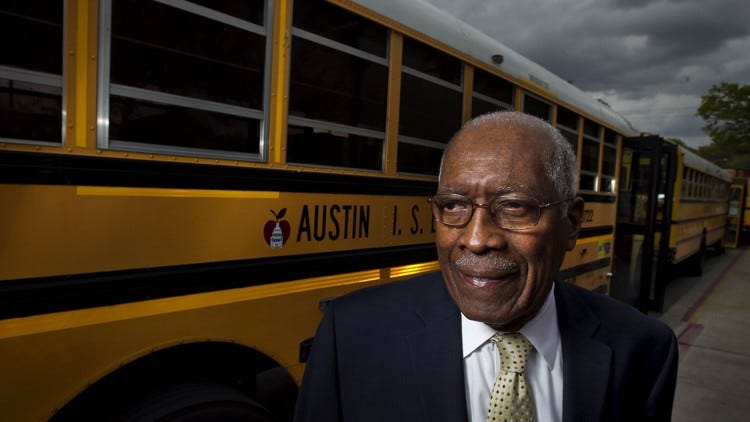
Charles Akins in 2013. Akins received an honorary doctorate from Huston-Tillotson University in 1982. In honor of his commitment to the Austin school district, in 1998 the school board voted to name its new high school after him.
Austin American-Statesman
From the outset, “Edward L. Blackshear at Prairie View,” a new book by John A. Adams Jr. (Texas A&M University Press), answers a question that had lodged in the back of my mind for decades: Who was the namesake of the historically African American Blackshear Elementary School in East Austin?

Born into slavery in Alabama in 1862, the educator, strategist, poet, essayist, agriculturalist and community advocate Edward Blackshear studied at progressive Tabor College in Iowa. During the late 19th century, Blackshear helped lead a widespread campaign to educate emancipated African Americans, 80 percent of whom had been kept in illiteracy by their enslavers.
Article continues below this ad
The American Missionary Association, a Congregationalist group, populated many of those first teaching efforts — Blackshear attended one of their schools in Montgomery, Alabama, before college. Their initiatives were followed in the 20th century by the Rosenwald Schools, a partnership between Jewish businessman and philanthropist Julius Rosenwald and self-sufficiency advocate Booker T. Washington.
Adams offers much more background on Blackshear, who in Austin served as principal at the Eighth Ward School and the Wheatville School before he was named superintendent of all local Black schools. He was appointed the third educator to lead Prairie View A&M University. His years at that leading historically Black institution of higher education in the state are the primary focus of Adams’ straightforward biography.
Early in the book, author Adams shares this particular local-history gem: One of Blackshear’s Tabor College classmates was Hightower Theodore Kealing, namesake of Kealing Middle School in Austin. A native Austinite, Kealing might be the prime reason Blackshear landed in Texas. He also preceded Blackshear as principal of Austin’s segregated African American high school.
Why did I not know more about this pair of classmates and trailblazing educational leaders? Since childhood, I had been curious about the frequency of names such as Dunbar, Wheatley and Bethune for historically Black schools, before and after segregation.
Article continues below this ad
Time to disambiguate some of the namesakes for historically Black elementary and high schools in Texas. Please send further suggestions to mbarnes@statesman.com. Expect a follow-up column with more histories.
Black leaders who became Texas school namesakes
Blackshear Fine Arts Academy in Austin Tuesday, Feb. 10, 2026.
Mikala Compton/Austin American-Statesman
W. Charles Akins (1932-2017) — At Old L.C. Anderson High School in East Austin, Akins served as teacher and assistant principal during the height of the post-World War II phase of the civil rights movement. Following the traumatic closing of segregated Old Anderson in 1971, Akins became the principal of a newly named Anderson High School in Northwest Austin. In 1998, the longtime educational leader, sportscaster, community advocate and active member of Wesley United Methodist Church lent his name to Akins Early College High School in far South Austin, where he continued to encourage student success even after his retirement.
Article continues below this ad
L.C. Anderson (1853-1938) — A contemporary of Blackshear and Kealing, Tennessee-born L.C. Anderson earned his B.A. at Fisk University and then taught at the Tuskegee Institute with Booker T. Washington. The first Black high school in East Austin, originally called Robertson Hill, was renamed for educator E.H. Anderson, L.C.’s brother. (Both taught at Prairie View and, like Blackshear, served as principal there.) After 17 years as a university president, he returned to Austin to run what became L.C. Anderson High School for 32 years.
Edward L. Blackshear (1862–1919) — An Alabama native, Blackshear moved to Texas after college because of his friendship with Kealing. (See biographical notes above.)
Mary McLeod Bethune (1875-1955) — A leader in the women’s movement who campaigned for — and advised — President Franklin Roosevelt, this educator was a prominent philanthropist and activist. Her private school for African American students evolved into Bethune-Cookman University in Daytona Beach, Florida. Although she is the namesake of countless American schools, the only ones that I could find in Texas are in Dallas and Houston.
George Washington Carver (1864-1943) — The agricultural scientist, inventor and educator has inspired many American cultural institutions. In Austin, he is the namesake for a library, museum and cultural center located on an East Austin hill above Kealing Middle School. Texas schools named after Carver can be found in Georgetown, Lockhart, Houston, Greenville, Waco and elsewhere.
Article continues below this ad
Frederick Douglass (1818-1895) — During the 19th century, Douglass was America’s most gifted and prominent civil rights speaker, writer and statesman. He escaped from slavery in 1838 to become one of the world’s most effective abolitionists. His books are required historical reading. Schools in El Paso, San Antonio, Jacksonville, Denton and Tyler were named after him. (Some were renamed after mergers or closures.)
Paul Laurence Dunbar (1872-1906) — A poet, novelist and short-story writer whose work deserves more attention these days, Dunbar was born in Dayton, Ohio, to formerly enslaved parents. He wrote the lyrics for the first all-African American musical produced on Broadway. Schools and libraries across the country have borne Dunbar’s name, including examples in Fort Worth, Dallas, Lubbock, Lufkin, Temple and San Marcos.
W.E.B. Du Bois (1868-1963) — During the early to mid-20th century, Du Bois, based at what is now Clark Atlanta University, was among the most respected intellectuals in America. A sociologist, educator, historian and author, he grew up in an integrated Massachusetts community and was the first African American to graduate from Harvard University. He opposed Booker T. Washington’s Atlanta Compromise, which traded away social equality for basic education and justice within the legal system. Du Bois rivaled Washington’s role as spokesman for his race. The honors program at Huston-Tillotson University is named for Du Bois.
Teacher Mary McClellan, left, huddles with her seventh-grade magnet science class students at the beginning of a group project at Kealing Middle School.
Austin American-Statesman
Hightower Theodore Kealing (1858-1918) — Born in Austin to former slaves, Kealing graduated from Tabor College and taught briefly at Paul Quinn College in Waco before it moved to Dallas. (Some of the buildings still stand in Waco.) He headed the Robertson Hill School before focusing on advocacy for freedmen and working for the A.M.E. Church. He spent the last eight years of his life as president of Western University in Quindaro, Kansas.
Article continues below this ad
Barbara Jordan (1936-1996) — Not often does one get to meet one’s personal heroes, but I met Jordan in Houston when she was my U.S. congresswoman, and in Austin, where she taught at the LBJ School of Public Affairs and regularly attended UT women’s basketball games (our season tickets were for seats a few rows back over her right shoulder). An extraordinary orator, she is best remembered as a staunch defender of the U.S. Constitution during the Watergate Crisis. Her name adorns schools in Austin, Houston, Dallas, Odessa, Richmond and elsewhere. There are two prominent statues in Austin, one at UT, the other at the Barbara Jordan Terminal at Austin-Bergstrom International Airport.
Martin Luther King Jr. (1929-1968) —The most celebrated civil rights leader of the 20th century, the Rev. King, pastor of Ebenezer Baptist Church in Atlanta, had few equals among American orators before his assassination in 1968. King firmly pushed President Lyndon Johnson to ensure that the Civil Rights Act of 1964 and Voting Rights Act of 1965 were passed and enforced. In Austin, King’s name was given, after a long dispute, to the entirety of 19th Street, among other honors. Schools named in his honor can be found in Houston, Dallas, San Antonio, Beaumont.
Abraham Lincoln (1805-1865) — One of only two white figures on this preliminary list — although we should add LBJ to these ranks, long based in Austin and namesake for an East Austin high school — the name of the Civil War president can often be found adorning streets, schools and other public buildings in Texas, often in historically Black neighborhoods. Schools named for the 16th president can be found in Dallas, Houston, Montgomery, Edinberg, Palestine and Abilene.
Bertha Sadler Means (1920-2021) — Reared in the Waco area, this educator and community advocate married a Huston-Tillotson professor and then helped found a business and one of the first integrated churches in Austin. She is remembered for helping lead civil rights protests that inspired her daughter, Joan Means Khabele, and grandson, Khotso Khabele. An academy for young women leaders located in Northeast Austin bears her name.
Article continues below this ad
Julius Rosenwald (1862-1932) — This Chicago businessman rose to lead Sears, Roebuck and Co., the world’s largest retailer at the time. Among his philanthropic efforts were hundreds of rural schools championed by Booker T. Washington. The Bullock Texas State History Museum recently devoted a compelling exhibition to the Rosenwald Schools, including those in former Central Texas freedom colonies.
Booker T. Washington (1856-1915) — While some post-emancipation Black leaders backed social integration, author, orator and educator Washington, the first leader of the Tuskegee Institute, urged self-reliance. He once spoke on the subject to a large crowd in Austin’s Wooldridge Square Park. Schools all over Texas are named for him. Some trivia: Charles Akins’ first teaching job was at Booker T. Washington High School in Marlin.
Phillis Wheatley (c. 1753-1784) — Like Dunbar, Wheatley was a poet, considered the first African American author of a published book of poetry. A landmark high school in Houston, one of the largest for Black students in the country during the 1920s, was named for her. Wheatley schools, libraries and other institutions can be found in Temple, Washington D.C., New Orleans, Columbia, S.C., and elsewhere around the country. (Her first and last names are sometimes spelled alternately.)
Article continues below this ad
John Henry “Jack” Yates (1828-1897) — The Rev. Yates was taught to read by his enslaver’s offspring. When his wife was moved to Texas, the free Yates volunteered to become re-enslaved in order to join his family. They relocated from Matagorda County to Houston after 1864. He preached at Antioch Missionary Baptist Church and helped found Freedman’s Town, a large freedom colony. Yates organized Houston Academy, which became Booker T. Washington High School. Houston’s Yates High School was named after him.