
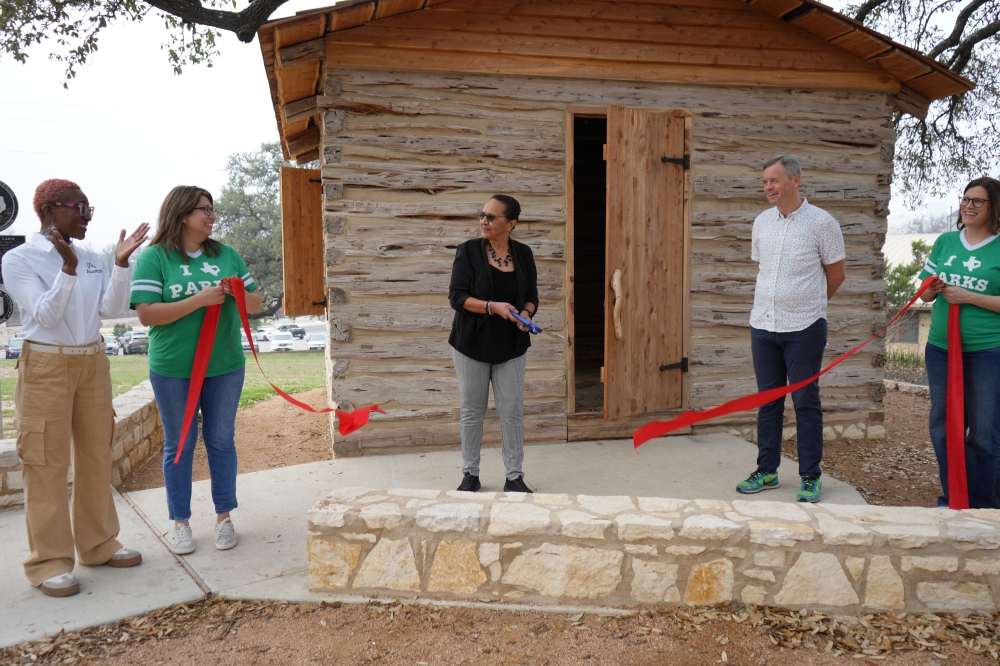
Community members marked the completion of recent preservation efforts for an historic cabin built by Henry Green Madison, Austin’s first African American council member, during a February ribbon-cutting at Rosewood Park.
The big picture
Madison was born into enslavement in Tennessee in the 1840s and moved to Austin in the 1860. Soon after, he built the cedar log cabin at 807 E. 11th St. where he lived with his wife, Louise, and eight children, according to state history records.
After serving in the 1868-69 Texas Constitutional Convention and as a Texas State Guard captain, Madison was appointed to Austin City Council by former Gov. Edmund Davis in February 1871 and held the position through November 1872. He later worked in several roles, including policeman and farmer, according to the city. He died in May 1912 and is buried at Oakwood Cemetery.
The original cabin was enclosed in a larger house structure by Madison in the 1880s and hidden for decades; it was only rediscovered by a demolition crew in the 1960s and then given to the city by its property owner. A few years later in 1973, the cabin was relocated, reassembled and rededicated in its current home at Rosewood Park in East Austin.![First side of: [Henry G. Madison Cabin Photograph #1], a photograph available in the The Portal to Texas History](https://www.newsbeep.com/us-tx/wp-content/uploads/2026/02/med_res.jpeg) [Henry G. Madison Cabin Photograph #1] hosted by The Portal to Texas History
[Henry G. Madison Cabin Photograph #1] hosted by The Portal to Texas History
After its move, the cabin was designated as a Recorded Texas History Landmark in 1974 and a city landmark in 1976.
The project
Recent restoration efforts, led by the city and Austin Parks Foundation, came together after a 2021 site assessment found the Madison cabin’s wood was deteriorating. The project kicked off in late 2024, and construction was completed last summer.
The project included architectural and structural improvements like log repairs, window and door restoration, roof replacement, and work on the surrounding site and landscaping including lighting and sidewalk upgrades. The restoration was led by architect Donna Carter of Carter Design Associates and contractor Phoenix One.
 The Henry Green Madison cabin restoration at Rosewood Park was completed in 2025. (Ben Thompson/Community Impact)APF contributed $55,000 for initial design work and helped secure hundreds of thousands more, including a majority—nearly $270,000—from two city heritage preservation grants. Other funding included $80,000 from the Texas Historical Commission, $15,000 from the Alice Kleberg Reynolds Foundation, $5,000 each from the Summerlee Foundation and Six Square, and $4,500 from Preservation Austin.
“This cabin behind us was a real labor of love for us. We don’t get to be a part of projects like this all that often, but when we do we jump at the opportunity,” APF CEO Colin Wallis said at the Feb. 19 ribbon-cutting.
The cabin project was also recognized with awards by both Preservation Austin and Preservation Texas last year.