
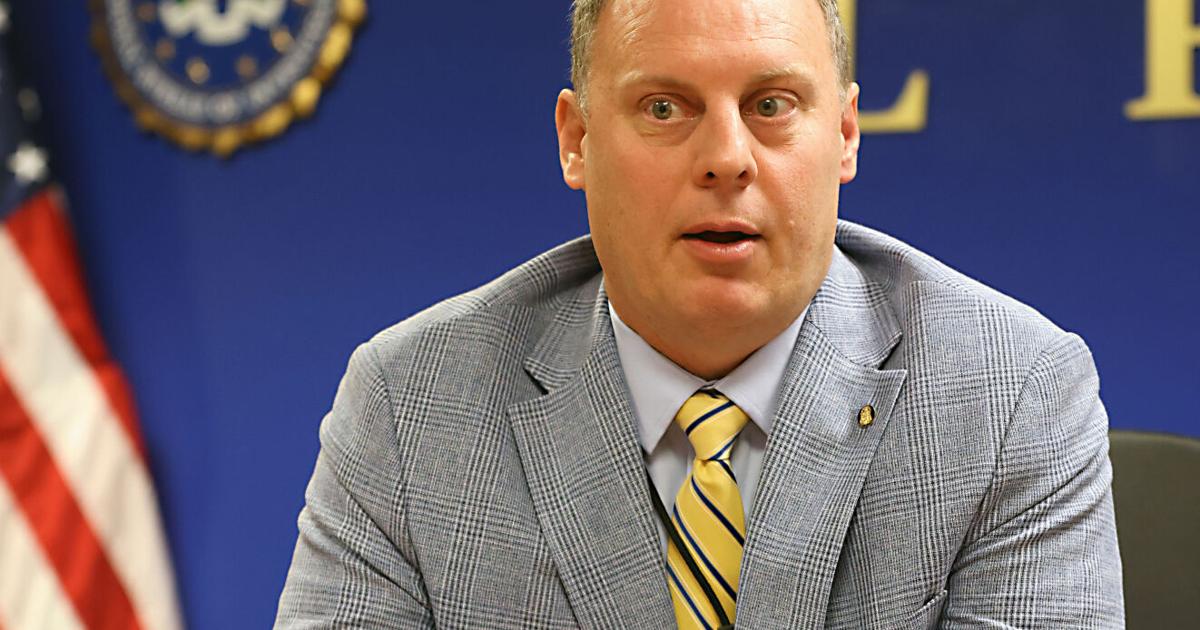
Some of the FBI’s toughest work happens before anyone is arrested.
Jarod Brown, the special agent in charge of the FBI El Paso Field Office, says building cases against cartel figures and violent offenders sometimes means monitoring threats for months to stop attacks.
For Brown, that challenge became real a few years ago while he was assigned to Los Angeles. He and other agents had to stop a man from carrying out a plan for an act of violence that could have killed multiple people.
“He had not committed a crime yet to where it would be sufficient to put him in handcuffs,” said Brown, who has worked for the FBI for 18 years. “We were monitoring him for a couple of months to ensure he didn’t hurt anybody, but to also build the evidence to safely arrest this man before he could harm anyone.”
Stopping violent crime is one of the FBI’s primary missions and one that Brown has led locally since assuming his role in late September 2025. That goal is tied to law enforcement’s ongoing struggle against cartels to halt the flow of illicit drugs across the U.S.-Mexico border and through the region.
More than 256,000 pounds of drugs were seized on the southern border in fiscal year 2025, from October 2024 to September 2025, according to the latest U.S. Customs and Border Protection data.
That figure marks a decrease from the more than 275,000 pounds of drugs seized in fiscal year 2024.
More than 100 special agents are assigned to the El Paso field office, which has an area of responsibility that spans West Texas. The office works with and provides intelligence to state, local and other federal law enforcement departments. It also partners with Mexican authorities in ongoing operations targeting the drug trade.
Brown has more than 25 years of experience in law enforcement, including more than seven years as a police officer in Utah. He succeeds John Morales, who Brown said has retired from the FBI.
El Paso Inc. sat down with Brown on Wednesday at the field office. He spoke about his goals, the presence of cartels in the region and the office’s involvement in immigration enforcement operations.
Q: What are your short-term and long-term goals?
Our short-term goals are making sure the FBI is in a place where we can be a force multiplier for all of our law enforcement partners in the area.
I’m new to the region, and we’ve had a lot of leadership changes in federal law enforcement agencies in the area, but our state and local partners have been stalwarts. Making sure that we’re integrated extremely well with them, and they know what we can bring to the table, is important.
A short-term and long-term goal for us this year is recruitment. The bureau is looking for highly motivated men and women who want to be a part of something amazing.
A big part of our focus is encouraging folks to look at it if they didn’t before.
Back in my days in the academy, I had school teachers, engineers, doctors, lawyers, police officers, folks from the military and everything else in my class. It wasn’t just folks who have been in law enforcement.
It’s not. Our applications are actually up. What we’re finding, though, is we want to make sure that we’re getting the very best. It’s based on the fact that you have to have a security clearance.
It’s not one of those things where you can just sign up and then start tomorrow. There’s a process where we want to make sure that we’re finding those individuals who have the desire to be part of the FBI.
You want them to understand what they’re signing up for and then make sure that they’re compatible with us as much as we are with them.
Q: What are the El Paso office’s other goals?
One of our major goals is crushing and diminishing violent crime. Having been a police officer and now an FBI agent, the reality is that violent acts in our community are detrimental to everything we do. Anything we can do to limit that in coordination with our state, local and federal partners, that’s what our goals are.
There are other criminal acts that are part of that. Crimes against children is a priority for me, as well as for the bureau.
The threats to national security have not diminished. We look back on 9/11, almost 25 years ago, that changed the landscape of our perspective on counterterrorism.
We have states that have adversarial goals against the U.S., and that doesn’t just take place in Washington, D.C., or New York or Los Angeles. We see a significant amount of those threats here in the Southwest.
Adversaries who may think that this is a soft target or that we are not paying attention are wrong.
Q: On violent crime, what examples or data does the office have on El Paso? I thought it was commonly known that El Paso is a safe city.
Statistically, El Paso has been in the top five safest cities in the nation for years. It will continue to be. It is a safe place to live.
It doesn’t diminish the fact that we have local street gangs that cause problems. We have individuals here who are associated with Mexican drug cartels, which are now foreign terrorist organizations by designation.
Those are a plague on our community here in El Paso. They’re a plague on every community in the United States. If we can look at addressing those criminal elements, the trickle-down effect on a larger scale makes for a better community.
It’d be hard to say that we can eliminate every piece of violent crime. We can’t predict the future. We can hold people accountable for acts that they’re involved in or attempting to be involved in.
Q: Any examples of investigations and arrests in El Paso?
We’ve arrested some very prominent individuals from the cartels recently, some Plaza (territory) bosses from down south.
I’m hesitant to go into too much detail though because some of those investigations, even where we have made arrests, there are associated investigations with their conspirators that we’re still looking at.
We have been very successful. We will continue to be very successful.
A lot of that is recognizing that it’s not, for the most part, single individuals. These are criminal organizations that are well-organized.
Q: How strong is the presence of cartels and gangs in El Paso?
It’s strong across the U.S., but based geographically on our proximity to Mexico, it’s a little stronger here.
We’re paying more attention to it. Our CBP partners at the border are phenomenal at understanding the intelligence coming across the border.
If the El Paso office can take out or take down members of the cartel or drug traffickers here, those are drugs not going to Denver, Chicago or Memphis.
Q: Is the term “war on drugs” correctly used when talking about these operations against cartels and drug trafficking?
We use the term “war on drugs,” and I don’t know if that’s necessarily accurate.
What I do know is the number of deaths from fentanyl, you look at the number of deaths from methamphetamine and other narcotics that come into the country and destroy families and young kids. The reality is that we have an obligation to make sure that our citizens are safe.
Q: How much is the FBI cooperating with other agencies like U.S. Immigration and Customs Enforcement in immigration enforcement in El Paso?
They’re our federal partners. It’s a federal violation to enter the country illegally, so we have Title 8 authority, but that’s not our only authority. We have Title 21, Title 18 authorities to focus on other federal violations.
While we’re supportive of our ICE partners, and the component that is their sole job, like that’s what they’re best at, that’s not our sole job.
We’re obviously a component of that. We will support them any way we can with immigration enforcement, but our focus is broader than that.
Q: With supporting them, what exactly does that mean?
They’ll request assistance with something.
Based on the nature of our investigative procedures, the way we set up, we want to look at people who are the most violent. Those targets that are maybe associated with one of our current investigations, so we can talk to those individuals and learn more about current investigations we have up and running.
I would say that here in El Paso, we haven’t received a ton of requests. We work with them in sharing intelligence on a daily, if not hourly, basis.
Between Border Patrol, ICE and CBP and all of the components of the Department of Homeland Security that those guys fall under, they’ve done a really good job.
Q: What was your reaction to the ICE operations in Minnesota? What are your thoughts on how the people reacted to these operations?
It’s a difficult situation. If you look at the goals and objectives of holding those people who are illegal here in the U.S. and committing crimes, how do we handle that situation appropriately?
I’m not putting the blame on anybody. I think those agents were put in a very difficult situation.
But people have their First Amendment right to freedom of speech, freedom of assembly. We want to make sure we’re adhering to those first and foremost on everything. That’s why all of us swore an oath to the Constitution to protect that.
I think things got out of control a little bit. They’ve made some good choices and kind of ratcheted some things back down, working more closely with our state and local partners up there to make sure that we’re being much more strategic in our enforcement, versus kind of a sweeping motion.
It’s heartbreaking that people got hurt. It’s heartbreaking that the agents were hurt, that civilians and citizens were hurt. That’s never how things are supposed to work. That means something went wrong.
Q: Is there any concern that negative perceptions of immigration enforcement agents could spread to other law enforcement?
Of course. Folks see law enforcement as law enforcement. Some don’t care what the badge is.
When I was a police officer, that was the same thing. We’re concerned about that, but you only control what you can control.
Recognizing that we need to put the narrative out there that this is who we are, and kind of diminish a lot of the noise that’s in social media that’s just false and get the true message out of what the goals and objectives are in the FBI.
We don’t want to damage investigations or compromise classified information, but you should feel comfortable asking what’s going on in your community.
Q: What was your reaction to the FAA’s abrupt shutdown of El Paso airspace last week? Did you know what was going on?
I had a lot of questions about that. It highlighted how well our departments in El Paso communicate with each other.
I started getting questions around 10:30 p.m. at night, 11, and then I was on the phone with headquarters and our Strategic Command Center back in Washington, D.C.
I was not previously notified of that at all. I don’t think any of our federal partners here were either. When I talked to the chief of police and with the sheriff’s department and with DPS, there was a lot of concern.
I still don’t know all the answers to be totally transparent.
I don’t know why that was done and who authorized that. That’s something we’re going to look into to ensure that doesn’t happen again.
Obviously, it created a lot of panic. The chief of police over at the University of Texas at El Paso called me in the middle of the night asking, “Hey, what in the world is going on?”
He had calls from all over the country, all over the world. Parents were calling if there was a problem.