
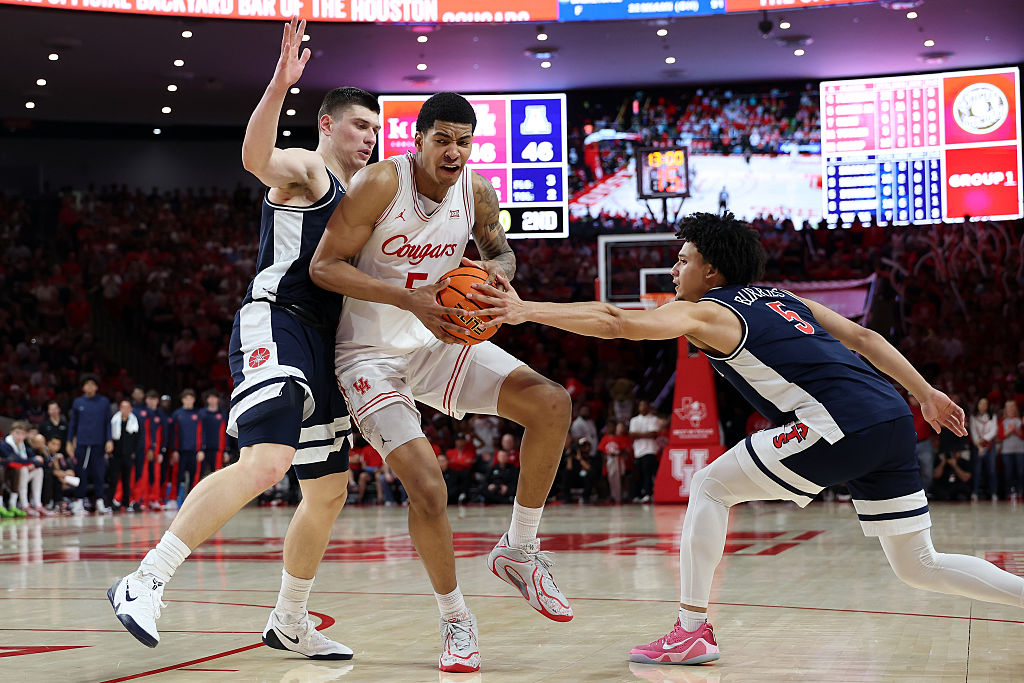
Dan Johnson takes you through his preview, prediction, and pick for tonight’s college basketball game between the Kansas Jayhawks and the Houston Cougars.
Houston walks into Allen Fieldhouse with the Big 12 title math sitting right on the table. The Cougars are 23-4 (11-3) and a game behind Arizona, but they arrive off back-to-back one-possession losses: 70-67 at Iowa State and 73-66 vs Arizona. Kansas is 20-7 (10-4) and still owns the building, but the recent shape is jagged, and the Peterson storyline has turned every late-game sequence into a question of who is actually closing. The urgency is real on both sides, but Houston’s identity is steadier because it does not need one player’s availability to keep the offense organized. Below is my preview, prediction, and pick for tonight’s college basketball game between the Kansas Jayhawks and the Houston Cougars.
Here’s how I’ll play it. I’ll be pumping out these predictions for individual games all season, with plenty of coverage here on DraftKings Network. Follow my handle @dansby_edits for more betting plays.
The matchup is a possession knife fight, and game’s a true coin flip. Houston’s profile is ruthless on the margins: 127.5 AdjOE, 93.4 AdjDE, a clean 12.8 turnover rate, and a real theft engine with a 21.4 forced-turnover rate. Kansas is still elite, but looser where Houston bites: 121.5 AdjOE, 95.6 AdjDE, and a 15.3 turnover rate with a much softer 13.7 forced-turnover rate. The shot-quality advantage is tight, but the shot-count layer is not—Houston is a 36.7% offensive-rebound team, and Kansas’s defensive shape invites threes by volume (opponents’ 3-point attempt share shows up at 43.3%), which is exactly how road variance gets loud in a hurry. The tempo band also matters: Houston lives slower (62.9 AdjT) while Kansas is closer to 67.0, so any live-ball slop becomes a storyline in the box score.
Kansas’s side is still a star show with real teeth—sometimes, and that’s the whole story this week. Darryn Peterson (G) is a true closer when he is actually on the floor: 19.8 points per game on 48.0% shooting, 41.3% from three (45/109), and 78.9% at the line (60/76). Tre White (W) gives them a second clean scoring wing at 13.7 points per game, 40.4% from three (40/99), and 86.1% at the line (105/122), plus 6.7 rebounds per game. Melvin Council Jr. (G) is the connector Kansas can’t lose—13.6 points and 5.1 assists per game, with only 1.7 turnovers, which is the one Kansas piece that can keep the offense breathing when Houston starts turning catches into panic. Flory Bidunga (C) is the rim and glass engine: 14.6 points, 9.3 rebounds, 2.7 blocks per game, and 65.8% from the field, and his offensive-rebound presence is the cleanest Kansas way to steal extra shots without needing hot shooting. If Kansas wins, it is usually because the Peterson-White shotmaking plus Bidunga’s second-chance lane keeps the shot volume even, then the free throws land late.
Houston’s difference is that it does not need one hero to play a perfect game to stay organized. An NBA-bound Kingston Flemings (G) is 16.6 points per game with 141 assists on the season, and he is the tone-setter for how composed Houston looks when the crowd starts hunting mistakes. Emanuel Sharp (G) matches him at 16.4 points per game, and the three-point volume is real—74 made threes on 195 attempts—while still shooting 87.6% at the line (92/105), which is a big deal in a 1-point spread game. Milos Uzan (G) is another steady ball-handler at 11.1 points per game and 110 assists, and the frontcourt keeps manufacturing possessions: international phenom Chris Cenac Jr. (F) is 9.6 points with 7.8 rebounds per game, and Joseph Tugler (F/C) adds 5.3 boards per game with 39 blocks—rim protection that travels. That is the whole Houston identity: multiple handlers, multiple rebounders, and defense that turns one bad decision into two empty trips.
Houston vs. Kansas pick, best bet
Kansas at home is a different animal, and the cleanest way for Kansas to flip this is a whistle script plus a full-minute Peterson game: Kansas’s free-throw rate is high (32.9), and Houston’s defensive free-throw rate allowed is the one red alarm in the matchup data (40.0). Kansas also plays faster (67.0 AdjT) than Houston (62.9 AdjT), so any early-bonus stretch can balloon the scoring without a pace war. If Kansas gets into the bonus early, Peterson and White can turn a tight game into a parade. That is also the exact way Kansas has survived weird nights in big spots: it erased a 16-point deficit vs TCU and finished overtime at the line, with Council doing the late-game organizing, and it just won at Texas Tech because Peterson hit two late threes in the final 1:20 when the half-court got tight.
Even without Peterson, Kansas beat Arizona by leaning into second-half composure and a steadier, more physical scoring mix, with Council and Bidunga carrying the closing stretch. The other way Kansas can bend the script is by simply shooting over the top, because Kansas owns a cleaner raw shot profile with a 53.3 eFG% and 35.4% from three, which is enough to survive even if Houston makes them work. And if Peterson is available for his highest diet of minutes, Kansas’s half-court ceiling jumps, because he can create clean looks without needing Council to win every decision. The question is whether Kansas can keep that same composed identity for forty minutes here, because Houston’s pressure is built to force one rushed stretch, and one 6-0 burst in Allen Fieldhouse is always enough to turn the whole game into a different sport.
Still. The reporting around Peterson is not just fans being weird—it has been a recurring on-court pattern, and Bill Self has publicly described the cramping issue as concerning after another midgame exit. Speculate all you want on the player’s motives, but Peterson’s whole situation matters because it is not only about points; it is about composure. A team plays more composed when roles do not change at random in the middle of the second half. Houston’s rotation is built to look the same possession-to-possession, even coming off losses, and that steadiness is why its defense keeps scoring cheap. The underlying reason the Houston side travels is that the Cougars create extra chances: their profile pairs 36.7 ORB with a 21.4 TORD, while Kansas sits at 28.7 ORB and 13.7 TORD, which is a real gap in how each team manufactures shots.
Kansas can absolutely match Houston’s quality, but it is carrying a live variable in the one player who most determines its late-game shot hierarchy. Bill Self is indeed a championship-caliber coach—his track record is as decorated as anyone active, so he’s made for this spot—but Kelvin Sampson’s current Houston group is an institutional habits team, and that shows up routinely in the turnover and rebound ferocity.
And so the board is asking for Houston by a bucket (-1.5) with a short Houston moneyline around -130 and a 136.5 total. Best bet: Houston moneyline (-130). Playable-to: -150. The ticket ages well because the most repeatable road survival traits are on Houston’s side—turnover pressure, offensive rebounding, and multiple free-throw-capable guards—while Kansas’s most dangerous edge depends on two things that can be volatile on a given night: whistle shape and Peterson’s minute load(?).
Projected score: Houston 68, Kansas 64.
Best bet: Houston (-130) at Kansas
Tail it with me in the DKN Betting Group here!