
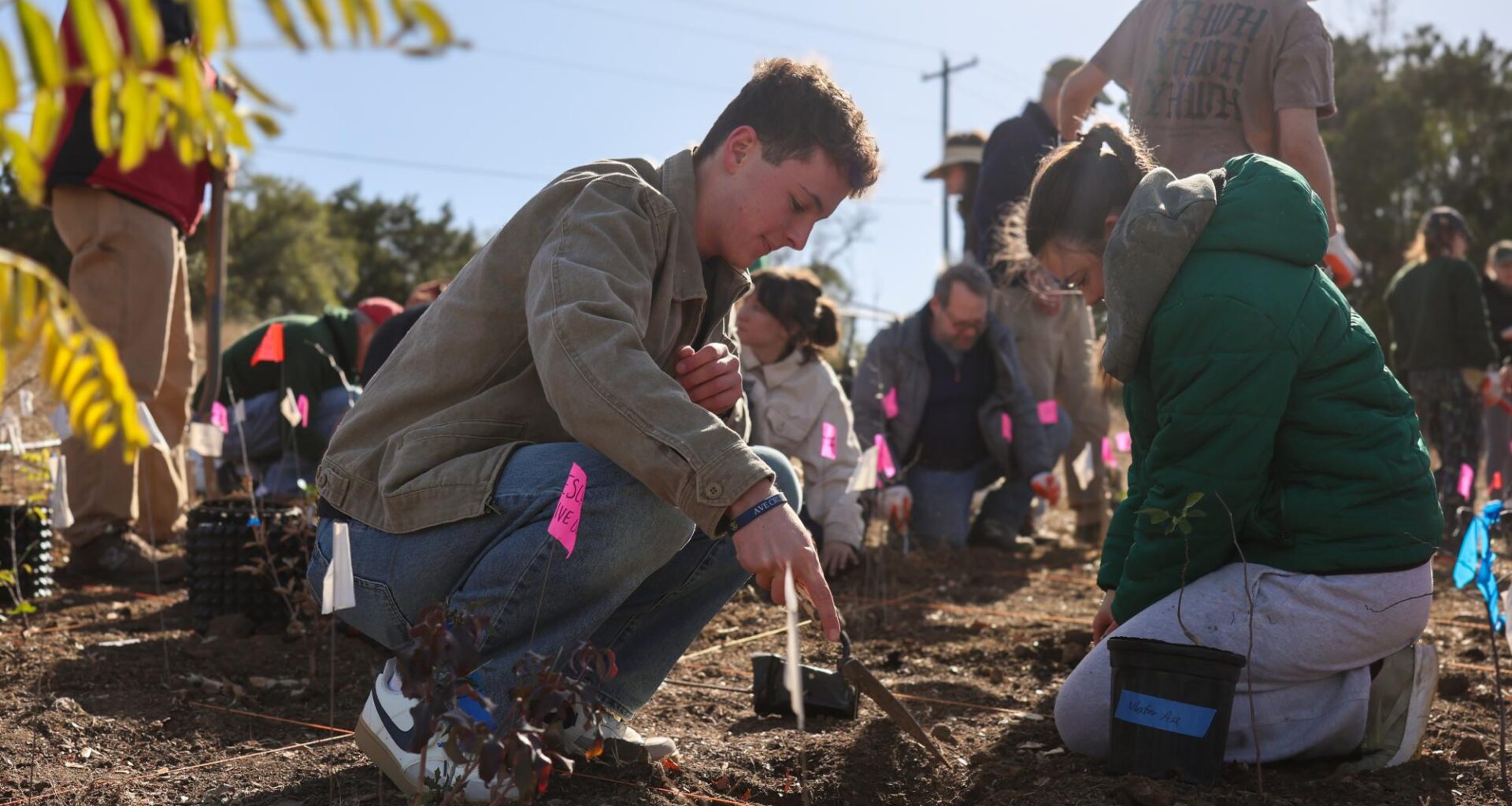
St. Edward’s University planted the first tiny forest in Central Texas, becoming a pioneer for the use of the technique in the region. Led by Roy Johnson, university arborist and sustainability coordinator, community members came together on Jan. 17 to bring the proof-of-concept model to life by planting over 150 native trees and shrubs across 35 different species in a 54 square meter area.
The tiny forest is one of five projects under the Climate Resilience Living Laboratory on campus, a project started by Johnson, associate professor of environmental science and policy Amy Concilio and former former associate vice president of university operations Jim Morris. The process of collecting the plants that were used started in the summer, when Johnson received around 15 saplings from friends and neighbors. Johnson explained that “since I was unable to source some species that were representative of what would be found in our local forests, I found some seedlings that I dug up in the early fall. Everything else was sourced and assembled throughout the fall semester of 2025.”
 Anna Pratts / Hilltop Views
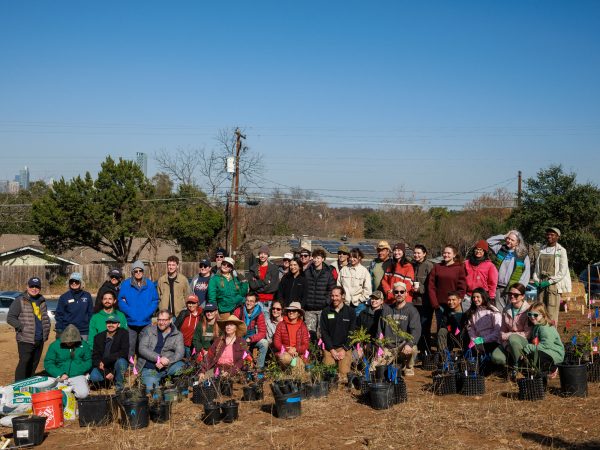
The group of approximately 50 people — composed of students, university faculty and staff, alumni and community members — gathered around the designated lot by the baseball field on the cold Saturday afternoon. Johnson kickstarted the event explaining the “Miyawaki method” while attendees sipped hot coffee and looked at the several plant species placed around them.
The method was created by Akira Miyawaki in the 1970s, prompted by the destruction he witnessed during World War II. Miyawaki originally called it “protection forests,” aiming to create forests that we would be able to see in our own lifetime instead of planting trees that would only be seen by the next generation.
“It is not an answer for everything, but it is a great tool for climate change mitigation as well as environmental justice,” Johnson said. “You can make this as small or big as you want to. You could take this into the Eastern Crescent of Austin, where they have poor tree equity, and you can take a small space and give them all the benefits of trees.”
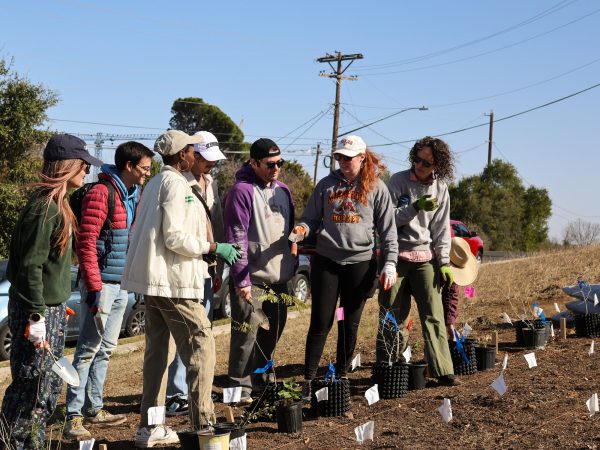
The attendees split into three groups – one led by Agatha Ais, pictured above, and two others, each led by fellow interns Veronica Chavez and Javier Zavala. The lot had been pre-prepared and divided in subsections, where volunteers could match the potted saplings to their designated spot, both marked by a flag.
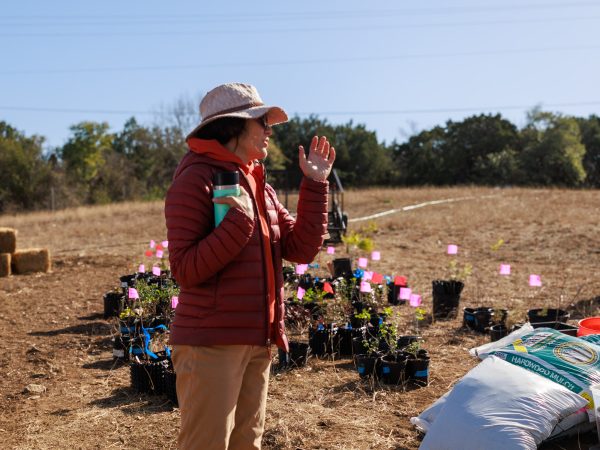
“Saplings are just a stage of their growth, a very, very young stage,” Johnson said. “It can be a little seedling, but you’re trying to go just beyond that. They’re a little bit older than just sprouting out of a seed. Smaller trees actually grow faster than large trees, bringing in the climate resilience portion of this concept.”
The plants that were used were climax species, the last in the natural succession of a forest and that they are the biggest trees and plants in that environment. In order for the tiny forest to be successful, the plants that were used were also all native species that thrive the best in the Central Texas region.
“(Ecological succession) can take 150 to 200 years,” Johnson said. “We don’t have that much time, so we are jumping straight to a climax species, all long lasting and shade tolerant plants.”
 Anna Pratts / Hilltop Views
Although the lot is small and all the plants are very close together, it is all part of the method. Concilio explained that its environmental impact is largely attached to the competition for resources that these plants experience in such a small space.
“Because the trees are planted so densely, they’ll grow more quickly because they’re competing for nutrients,” Concilio said. “The idea is that they’re growing faster for those reasons and we also put a lot of amendments in the soil, which are nutrient rich and will help the plants grow faster.”
Although all of the plants are climax species, they each represent different types of function in the forest ecosystem, so shrubs, medium canopy height plants and taller trees were all planted in the lot. Concilio explains that what the tiny forest does is mimic an actual native forest, but way into the future.
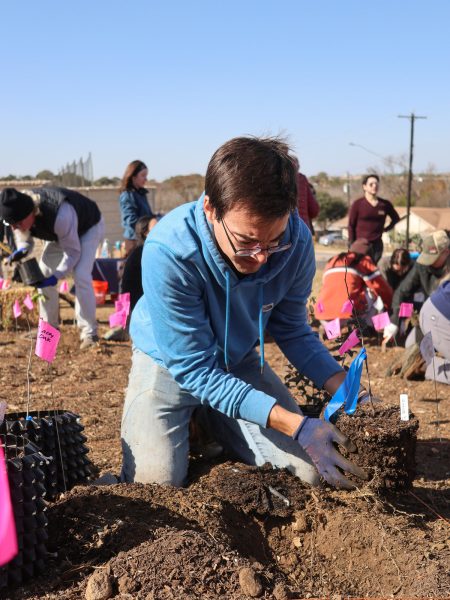
“The animals that are living in these ecosystems are going to use different parts of the forest for their habitat,” Concilio said. “By having this diversity of structure you’re creating lots of different habitats and different resources to use for different purposes. They create a lot of diversity for the underground community too with the root systems, which helps with infiltration and pulling water into the aquifer.”
 Anna Pratts / Hilltop Views
Although several volunteers are still students or have previous ties to the university, many are community members who are interested in conservation and are excited about the prospect of the use of the Miyawaki method. Austin Thielmann came to the event through a personal invitation from Johnson. The two met through Festival Beach Food Forest and Johnson’s project at St. Edward’s sparked Thielmann’s interest, prompting him to volunteer and help the community.
“I feel like it’s really special to get people involved that otherwise wouldn’t know anything about this,” Chavez said. “It just feels really nice to see everyone helping out and getting together, getting more interested. You never know, maybe later they’ll find the passion to do something else like this.”
Johnson himself didn’t expect a group as big to show up, but the success of the event left him “flabbergasted.” This has been a passion project of his, so being able to bring the community together to work towards climate change mitigation has been “an honor.”
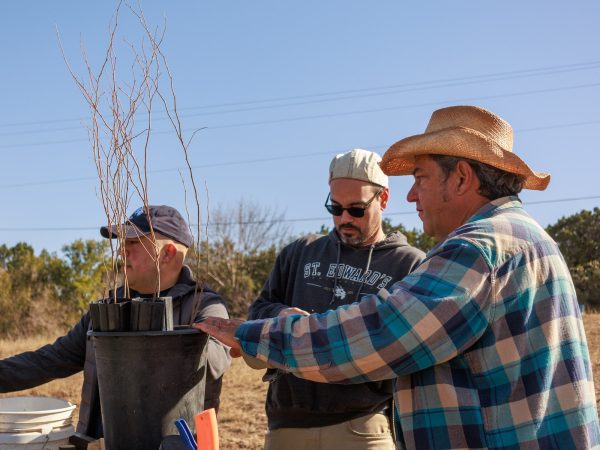
Planting the tiny forest on campus was made possible through a grant from the Trees For Texans program, a partnership between H-E-B and the nonprofit Texan By Nature. This is the second time that Weston Sythoff (middle), assistant director of corporate relations, worked with Johnson and former associate vice president of university operations, Jim Morris, to find ways to fund tree planting on campus. In 2024, the university received the grant for the first time with the goal to use it to plant trees around the bus stop on South Congress.
“Our urban forest on campus is one of my favorite things in terms of supporting different initiatives,” Sythoff said. “We’re making sure that we’re taking care of our urban forest and that we’re trying different methods that can provide data and feedback to the community.”
Along with the sustainability initiatives that the tiny forest promotes, the project is also part of the campus vibrancy portion of the Strategic Plan 2027. Sythoff sees St. Edward’s campus as “the best kept secret of South Austin,” due to its investment in environmental protection and the large tree canopy coverage in an urban environment.
 Anna Pratts / Hilltop Views
“We’ve been here for 140 years and we want to always make sure whatever we do is going to provide some benefit to the community,” Sythoff said. “This provides data to show what trees are doing well in the current climate, what trees maybe aren’t, and how we can help mitigate the rapid development in Austin with urban forests. This is really important not just for climate, but also broadly in terms of quality of life, shade, pollinators and biodiversity. This is a way that we can hopefully make a difference.”
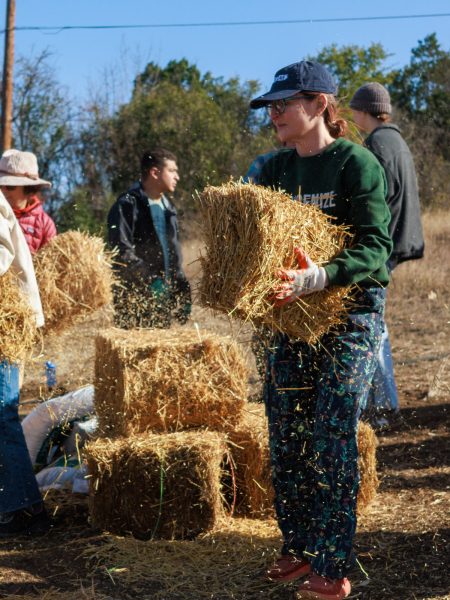
After all the saplings were planted, the volunteers broke down the piles of hay that had been waiting on the sides of the lot. Since the tiny forest was planted ahead of the arctic cold front that hit the Central Texas area in late January, straw was used to protect the plants from the low temperatures and ensure that the newly planted lot didn’t suffer major losses.
The process for a full forest to grow can take up to 200 years, but the method used in the tiny forest allows the community to see the results – and enjoy the benefits – much faster. Now that the tiny forest has been properly planted, results can be seen as early as two to three years, with plants up to 8-feet tall. In 10 years, the St. Edward’s and broader South Austin community will be able to visit the lot near the baseball field and see a fully maturated urban forest.