
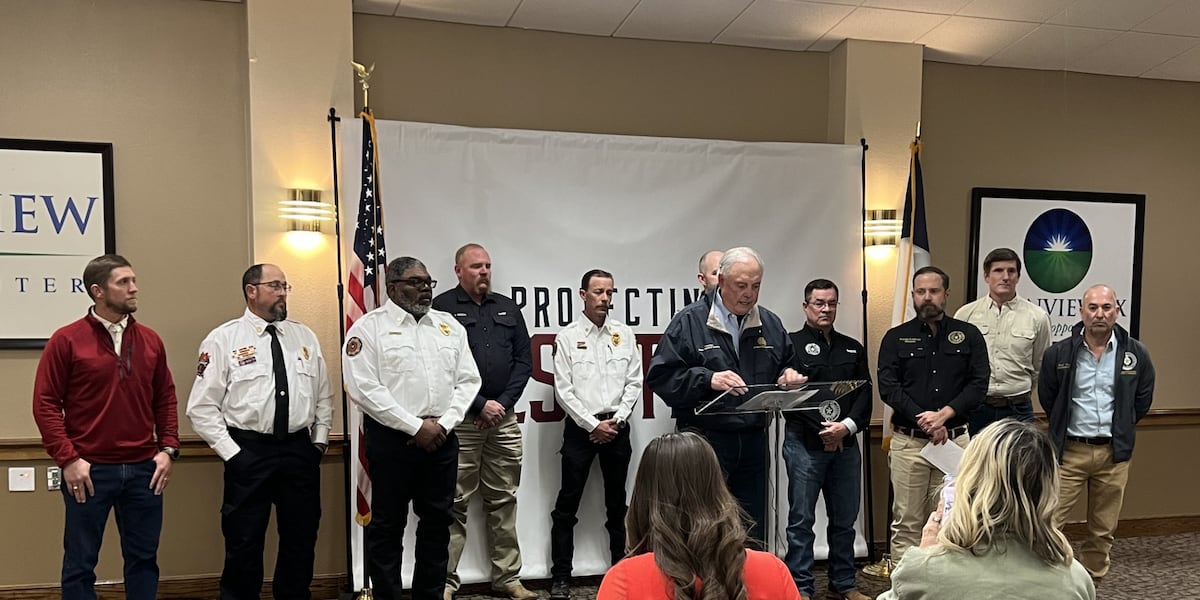
LUBBOCK, Texas (KCBD) – State lawmakers say because of legislative reforms passed last session, firefighters are better prepared to respond to wildfires, and the response to a few in the Panhandle last week prove it.
This week marks the two-year anniversary of the Smokehouse Creek Fire, the largest wildfire in state history. Representative Ken King chaired the committee that investigated the 2024 wildfires in the Panhandle.
King says because of lawmakers’ actions last session, the Lavender Fire in Oldham County and 8 Ball Fire in Armstrong County last week only burned fewer than 20,000 acres.
“The response of our first responders, both local and state, and their coordinated effort, having assets in place, where they needed to be when it started was a game changer,” King said.
Legislators got to work after the Smokehouse Creek fire killed two people, more than 15,000 cattle, destroyed more than 100 structures and burned more than a million acres.
King said one of lawmakers’ first actions was addressing the budget, pushing out $197 million in backlogged state grants to volunteer fire departments.
Randall County Fire Chief Joe Koch said neighboring departments received new equipment as a result.
“As a fire chief and an incident commander, it is a huge weight off of my shoulders knowing that these guys have the proper safety equipment out there on the deal and the training,” Koch said.
King said the state also increased annual funding for those grants from $22 million to $50 million to prevent the backlog from recurring. Senate Bill 34 directed the Texas A&M Forest Service to create a statewide database so agencies can see what equipment is available at other departments.
Luke Boedeker, an aerial firefighting contractor from Childress, said every aerial resource in the state was deployed by day two of last week’s fires.
“The fires last week were significant and they were unfortunate and there was a lot of damage. But from the aerial side, there was a tremendous difference in the response,” Boedeker said.
King said power shutoffs by Xcel Energy also helped contain the fires. Legislation passed last session requires all utilities to have a wildfire mitigation plan and conduct annual pole inspections reported to the Public Utility Commission.
“We went down there with a mission to change the behavior of utility companies. And while I know power outages are inconvenient to a lot of folks, they’re not near as inconvenient as 1,700,000-acre wildfire. So, that is a direct response from what we did in the legislature,” King said.
King said that between the time Xcel Energy testified about the pole that sparked the Smokehouse Creek Fire and when the investigative report was made public, the company had replaced 1,500 poles.
“Well, if 1,500 poles needed replaced in that amount of time. How many across the state are failing? We don’t have a wind problem in the Panhandle or in West Texas, we have an aging infrastructure,” King said.
King said while it’s improved, interoperability between state agencies and local responders remains an unresolved issue. He said the average time before state agencies can effectively communicate with local departments during an emergency is 36 hours.
“Chairman King has led on these efforts, and it did not get across the finish line this last session. And it puts us in a vulnerable condition. Because of the work that the committee did and Chairman King did. I will make this an interim charge and a priority next session to make sure that we are not in this position again,” Speaker Dustin Burrows said.
King said $257 million has been appropriated for firefighting aircraft and the Texas A&M Forest Service is currently deciding how to allocate those funds. King said he hopes the state will lean toward hiring contractors rather than purchasing its own equipment.
Representative Drew Darby credited the West Texas delegation with passing what he called the strongest slate of wildfire and disaster preparedness legislation in state history.
Copyright 2026 KCBD. All rights reserved.