
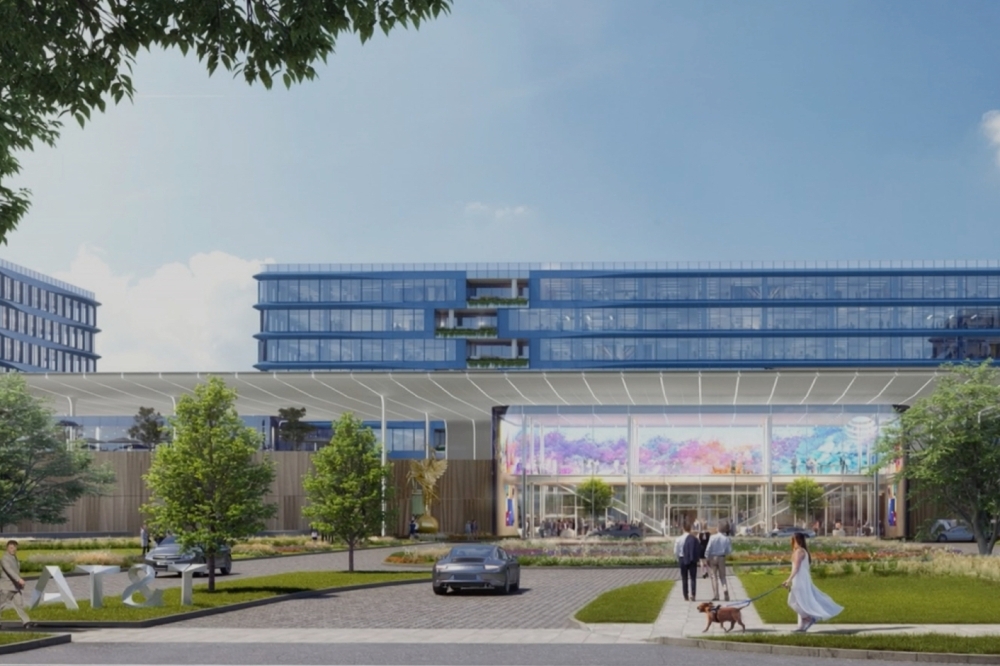
Plans for AT&T’s new $1.35 billion global headquarters in Plano are moving forward.
Plano City Council approved two economic development agreements Feb. 23 that would offer $20 million in financial incentives to AT&T in exchange for establishing the company’s global headquarters in Plano’s Legacy District.
The agreements would support the redevelopment of the former Electronic Data Systems campus, marking Plano’s first major corporate headquarters redevelopment project.
“We are honored to welcome AT&T as the newest member of our Plano business community and deeply grateful for the opportunity to support their global headquarters,” Mayor John Muns said in a statement following the vote.
What’s happening?
AT&T CEO John Stankey announced Jan. 5 the company plans to relocate its global headquarters to a new 54-acre campus at 5400 Legacy Drive.
The site was originally developed in 1985 as the headquarters for Ross Perot’s Electronic Data Systems, a project that city leaders said helped fuel “long-term economic growth” in Plano’s Legacy District, according to city officials.
Michael Ford, head of AT&T’s global real estate and security, said in a statement the company is excited to build its new headquarters in an environment that is dedicated to positive business growth.
“We look forward to continuing to work closely with Plano city leaders as we execute on our vision for a world-class campus, designed for collaboration, innovation and engagement, that our employees can be proud of for many years to come,” Ford said.
Zooming out
Stankey said in the statement the campus will be built to accommodate evolving workplace needs while maintaining AT&T’s long-term presence in North Texas.
Plano Deputy City Manager Doug McDonald said previously Plano’s corporate influence makes it an attractive location for companies that want access to Dallas but need more space, especially as corporate growth continues moving north.
If AT&T meets the required benchmarks of the economic incentives, the company would become Plano’s second-largest employer, behind JPMorgan Chase.
What it means
Under the proposed agreements, the city would offer up to $20 million across two separate economic development agreements, primarily for tax rebates and job grants.
The first agreement would provide up to $20 million in city-funded grants, including $10 million for the redevelopment and $10 million tied to job creation.
According to city documents, the job creation grant would be awarded in phases as employment benchmarks are met, including:
$4 million for maintaining the first 4,000 jobs$4 million for reaching 8,000 jobs by the end of 2034Up to $2 million for reaching 10,000 jobs by the end of 2039The second agreement details a 65% property tax rebate that would last for 25 years. AT&T could choose to begin the rebate period Jan. 1 of 2029, 2030 or 2031, according to city documents.
“All of our economic development agreements are performance-based, so the company has to meet certain metrics in order to be paid out for those incentives,” McDonald said.
In return, AT&T would be required to build at least 2 million square feet of space and invest a minimum of $1.35 billion in construction costs, according to city documents.
Additionally, AT&T would be required to occupy the new building by Dec. 31, 2029 and create, transfer or retain up to 10,000 full-time equivalent jobs. Stankey said previously AT&T is targeting partial occupancy at the new headquarters by the second half of 2028.
City documents note that if AT&T purchases the property during the 25-year period, the company would qualify for a 10-year extension of the tax rebate, but the rebate rate would drop from 65% to 25% during that period.
One more thing
The site was previously part of the 200-acre Texas Research Quarter, a planned life sciences district. The property is still owned by the group behind the development, according to the Collin County Appraisal District.
Council members also approved a zoning change tied to the new headquarters that would revert the property back to its original zoning, repealing the previous 2023 development plan zoning for the Texas Research Quarter.
The property is now zoned as commercial employment, a designation intended for “corporate headquarters and research facilities arranged in a campus-like setting,” according to city documents.