
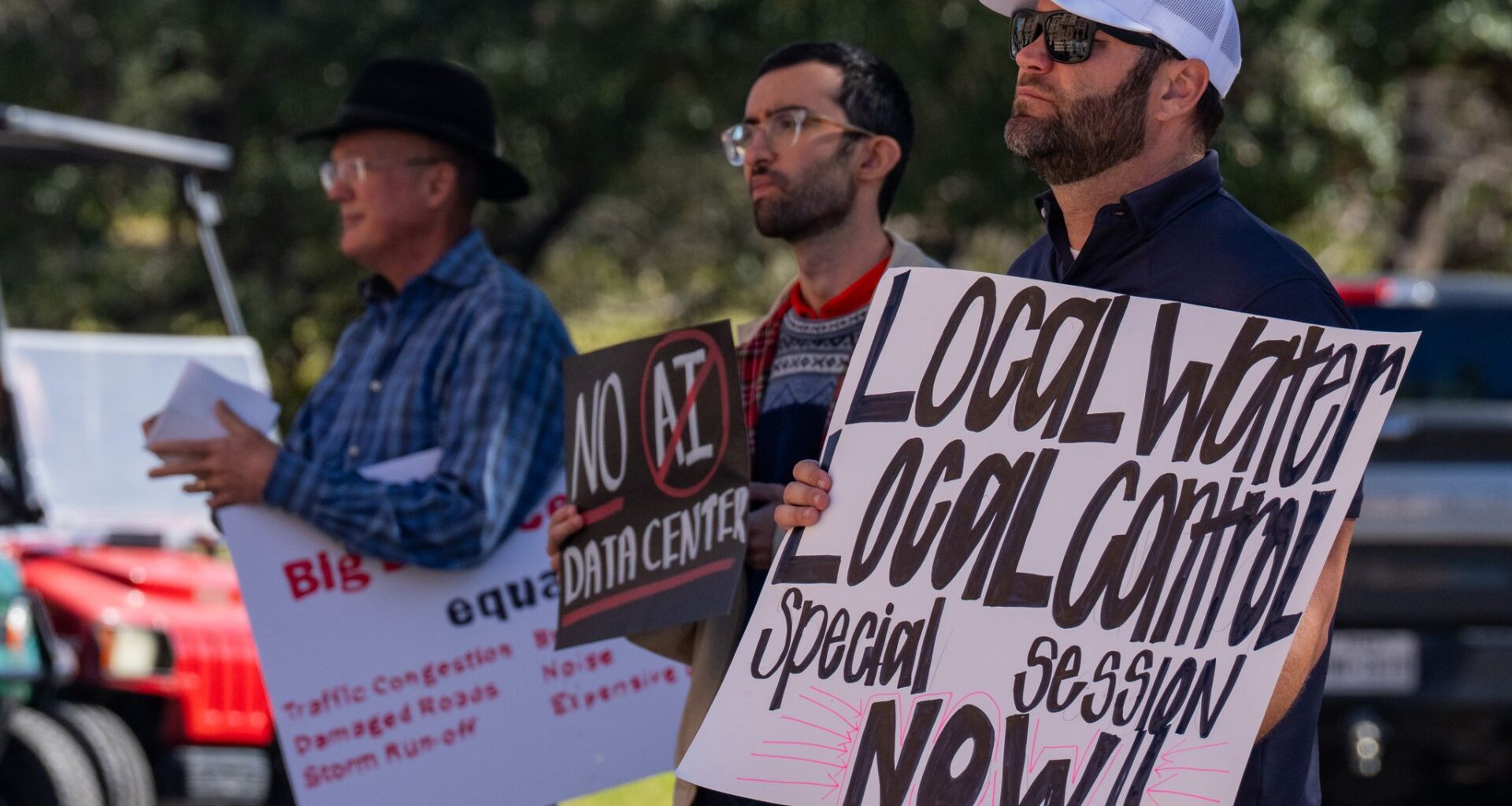
Advocacy groups and community members protest laws surrounding data centers while outside the Texas Capitol in Austin Monday, Feb. 23, 2026. Protestors are advocating for counties to gain legal authority to regulate data center development or enact a statewide pause until protections are in place.
Mikala Compton/Austin American-Statesman
SAN MARCOS — Hays County is joining an increasing push for state lawmakers to give local governments more regulatory authority over industry.

The demand came after county commissioners on Tuesday postponed action on a proposal from County Judge Ruben Becerra for a 30-day moratorium on approvals of water-hungry developments including the data centers rapidly popping up across the state. They called on Gov. Greg Abbott to give them more authority.
Article continues below this ad
“I have always been a pro-business county judge, but this is something that is not necessarily pro business,” Becerra said. “We are in a moment of crisis.”
RELATED: Dozens of rural Texans rally at Capitol against data center development
A moratorium, he said, would give county staff and commissioners time to better understand water scarcity in the area and how large developments affect the supply of both water and power. He had proposed a 30-day moratorium on developments requiring more than 20,000 gallons of water per day.
Commissioners decided to delay his resolution over concerns that such a pause goes beyond the county’s legal purview.
Article continues below this ad
“We want to be able to say no (to data centers). My biggest thing is I hate telling people there is nothing I can do about it,” Precinct 3 Commissioner
Morgan Hammer said. “I want to go to the Legislature … Creating good policy with teeth, that’s exactly what we need. And we need our state Legislature to step up and do that for us.”
Hays joined Hood County and some state lawmakers in calling on the Legislature to give counties authority to regulate zoning, developments and utilities. Under state law, they have limited control over fire code, roadway access, re-platting, groundwater and septic issues. Counties do not have the ability to regulate zoning, development requests or to propose moratoriums.
During several hours of public comment and discussion, commissioners said the lack of legal authority was increasingly frustrating as Texas becomes a beacon for industrial projects requiring massive amounts of water.
Abbott, Legislature
After tabling the proposed moratorium, the commission said Abbott should call a special session on the issue. Commissioners also asked water utilities to enter a stage four drought emergency response, which would pause the issuance of industrial water permits.
Article continues below this ad
“The things that are in the books today are not the way we can act today,” Becerra said. “I am looking for out-front, bold, creative ways to lean forward so that we can make a stance because we don’t have time to wait until 2027 for the Legislature to meet. We don’t have time.”
Earlier this month, Hood County — where a 2,600-acre data center is planned for the Paluxy Valley near Dinosaur Valley State Park — also rejected a proposed moratorium on data center development. It cited a letter Sen. Paul Bettencourt, chair of the Senate’s Local Government Committee, sent to Texas Attorney Gen. Ken Paxton.
Advocacy groups and community members protest laws surrounding data centers while outside the Texas Capitol in Austin Monday, Feb. 23, 2026. Protestors are advocating for counties to gain legal authority to regulate data center development or enact a statewide pause until protections are in place.
Mikala Compton/Austin American-Statesman
Bettencourt warned that counties “cannot claim any powers unless it is expressly conferred by the Constitution or statute.” The Houston Republican asked Paxton to investigate any county efforts to enact moratoriums on data center moratoriums.
Article continues below this ad
That was among the reasons Hays County stood down Tuesday.
“I think we would be exposing ourselves to significant legal liability,” said Chase Young, a Hays County assistant district attorney. “I think if we close at 3 p.m., we’d be sued by 4 p.m.”
The vote came a week after hundreds of protesters swayed the San Marcos City Council to deny a $1.5 billion data center project in the county.
That development would have been located partially within city limits on a rural road marked by several family-owned farms and the Hays Energy Power Plant. The lead developer on the project, John Maberry, initially began the permitting process for a single-family neighborhood before pivoting to a data center development. He now must wait six months before restarting the process for a third time, but could try another avenue.
Article continues below this ad
Maberry could seek disannexation of the portion of the property located in San Marcos, putting the entire property under the purview of the county, which has no zoning authority. Both the city and county would have to approve the disannexation request, though.
Six data centers are already proposed or under construction in Hays County, four of which are along the same road as the one proposed by Maberry.
WHAT ARE DATA CENTERS? : Central Texas emerges as data center hotspot, raising rural concerns
Other counties
Calls for data center moratoriums have cropped up in other county commission meetings across the state, and in state legislative committee hearings.
Article continues below this ad
The Texas House Natural Resources Committee on Groundwater Management and Conservation laid out a plan to address the state’s growing “water crisis” in the 2027 legislative session. After listening to hours of testimony from the state Water Development Board and other water experts, committee members agreed that the state is reaching a critical moment that requires action.
The Electric Reliability Council of Texas, the state’s main grid operator, has said data centers will cause statewide energy demand to surge 71% by 2031.
Torrie Martin, whose family farm is directly next door to the data center’s proposed site, hugs another San Marcos resident after City Council denied measures for a new preferred scenario map. Martin sobbed as the vote was called out early Wednesday morning.
Karoline Leonard/Austin American-Statesman
But water is a leading concern in the state, which is increasingly struggling to supply cities.
An average 100-megawatt data center in the U.S. consumes about 2 million liters of water a day, according to an April report from the International Energy Agency — roughly the same as 6,500 households. The report projects global data center water use could reach 1.2 billion liters a year by 2030. Some facilities use even more. Large data centers can draw up to 5 million gallons a day, according to the Environmental and Energy Study Institute — about as much as a town of 50,000 people.
Article continues below this ad
In Northern Virginia, data centers consumed 1.85 billion gallons of water in 2023 — two-thirds more than in 2019. In Georgia, construction of a Meta data center led to sediment buildup in water infrastructure that affected nearby homes.
Data center developers are increasingly choosing Texas because of the easy and lax regulatory access to water and power as well as Texas counties’ inability to regulate zoning requests.
Central Texas has emerged as the top secondary data center market in the country, with the American-Statesman last year identifying at least 55 completed or planned projects between Temple and San Antonio in 2025.