
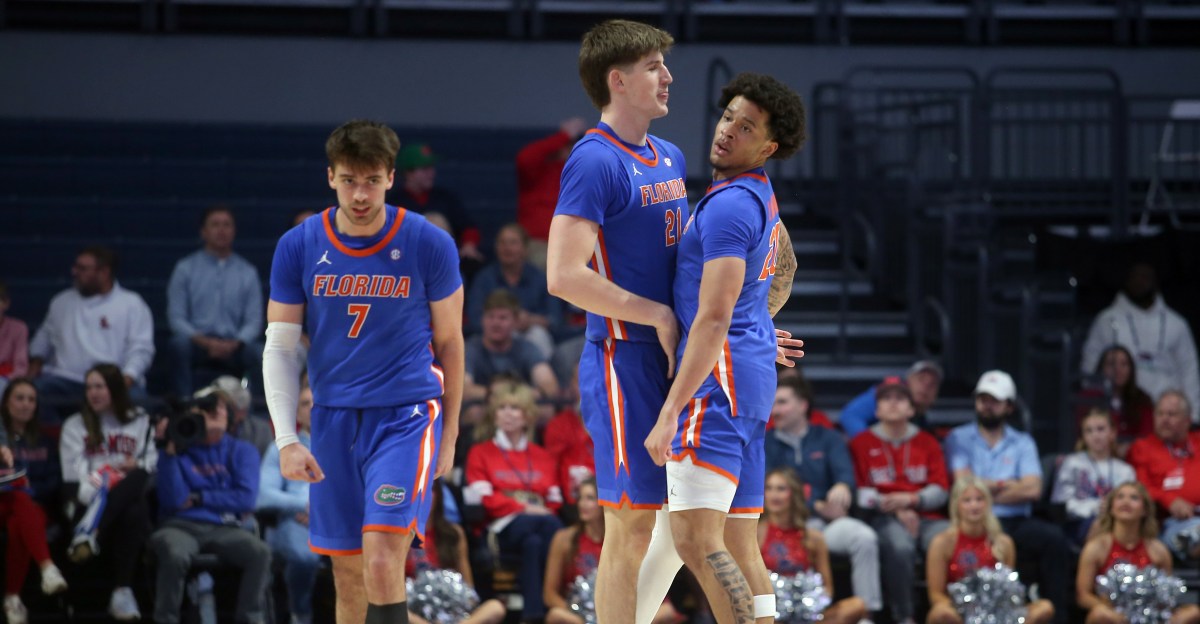
After a five-game winning streak ended with a 91-80 loss to the Georgia Bulldogs in Athens and with three straight wins against ranked opponents, the Texas Longhorns return to the Moody Center on Wednesday for a difficult matchup against the No. 7 Florida Gators, the leader in the SEC standings thanks to a seven-game winning streak.
Since ESPN’s Joe Lunardi has Florida as a No. 3 seed in his latest Bracketology, does that mean that Texas should be a lock for the NCAA Tournament with a win on Wednesday?
“Yes, yes, if we won tomorrow,” Texas head coach Sean Miller said on Tuesday.
Currently listed in 111 of the 112 NCAA Tournament brackets tracked by Bracket Matrix, the Longhorns are a 9.9 seed on average with Lunardi currently slotting Texas solidly in the field because they aren’t among the last eight teams in, but that position could be in jeopardy over the next three games in which Miller’s team will be heavy underdogs before hosting 14th-place Oklahoma to close the regular season.
The pressing challenge is Florida, the defending national champions who have won six straight road games since opening SEC play with a loss at Missouri. Over the last four road games, the Gators have an average margin of victory of 26.3 points per game, including victories over the Aggies in College Station and the Bulldogs in Athens.
“I think they’re playing their very best basketball of this season right now on a win streak in a dominant fashion over the last several road games in our league, not easy to do. They’ve gone on the road, and they’ve won by big, big margins,” Miller said.
Florida’s success start on the defensive end, where the Gators rank third in adjusted defensive efficiency, fueled by the nation’s fourth-best defensive rebounding rate and an emphasis on running opponents off the three-point line and forcing them to play one-on-one basketball inside the arc, where Florida are sixth in opposing two-point field-goal percentage and the No. 53 block rate.
The defense fuels the offense for the Gators, who are tied for 15th nationally with 16.3 fast-break points per game and play at the No. 35 adjusted tempo. As one of the worst three-point shooting teams in the country at 30.1 percent, Florida is able to produce the No. 14 offense in adjusted efficiency because they excel scoring around the basket, taking nearly 80-percent of their two-point shots and more than 45 percent of their overall attempts from the floor on close two-point shots.
The frontcourt of 6’9 Thomas Haugh, 6’11 Alex Condon, and 6’11 Rueben Chinyelu all have 30 or more dunks this season and 94 0r more made baskets on close twos. Haugh and Condon also get to the line regularly, each attempting 151 free throws so far this season.
If the Gators miss, ending defensive possessions with rebounds is extremely difficult — Florida is No. 2 in offensive rebounding rate at 44.2 percent.
“Keeping them off the glass is an immense challenge for every team that plays them, and we will be no different. How many second shots they get against us will be a big determining factor in the final score. We know that, so we have to be able to meet that challenge. I think the team that beats Florida, or the team that’s right there to beat them, they’re going to feel good about their rebounding in that game,” Miller said.
Florida has lost to elite teams like Duke and UConn when rebounding well offensively, and has also won games against good teams without their its typically high-level offensive rebounding, but Texas hardly fits into the former category and struggles to fit into the latter category defensively in too many games.
Miller called Saturday’s loss to the Bulldogs the worst defensive performance this season by the Longhorns and the numbers back it up — it was the worst effort in adjusted defense, worse than the loss to Virginia and the win over Maryland-Eastern Shore.
“When you get this deep into the year, we’ll go only as far as our defense will take us and our guys know that we had a couple guys, quite frankly, not play to the level that we demand. We’ve addressed that,” Miller said.
The Texas head coach also called this group, which currently ranks 141st in adjusted defense, the worst defensive team that he’s had in his head coaching career. That’s disappointing enough on its own, but when combined with an elite offense, it’s all the more frustrating because the offensive success has come without the defense putting the offense in positions to succeed.
“The thing that’s crazy about our offense is all of us benefit offensively from blocked shots, steals, defensive stops — some of our country’s best offensive teams, part of their success story is their defense helps them. Florida is a great example of that. We get very little help on defense. Most of the time our offense is playing against a set defense,” Miller said.
But is it possible for the Texas defense to improve down the stretch?
“I do believe that teams can improve as late as February and March. You see a version of it every year. Sometimes it’s more of a quiet part of their story,” Miller said.
And the Longhorns did have stretches of effective defense during the five-game winning streak, especially in reducing the number of bad fouls they commit.
“If you look at the games leading into Georgia, there are segments in each of those contexts where we defended probably to our best level. When you see that over a two-week stretch, I think you’ve got evidence that you’re able to do it. It’s just a matter of sustaining it,” Miller said.
Regardless of whether the Longhorns are capable of sustaining that level of defensive success, Miller was adamant that he’s looking forward to making changes on the Forty Acres to to be better defensively.
That’s offseason task. For now, Texas will try to hang in with Florida following the tip at 6 p.m. Wednesday on ESPN2 with a particular emphasis on keeping the Gators from getting off to hot starts at the beginning of both halves.