
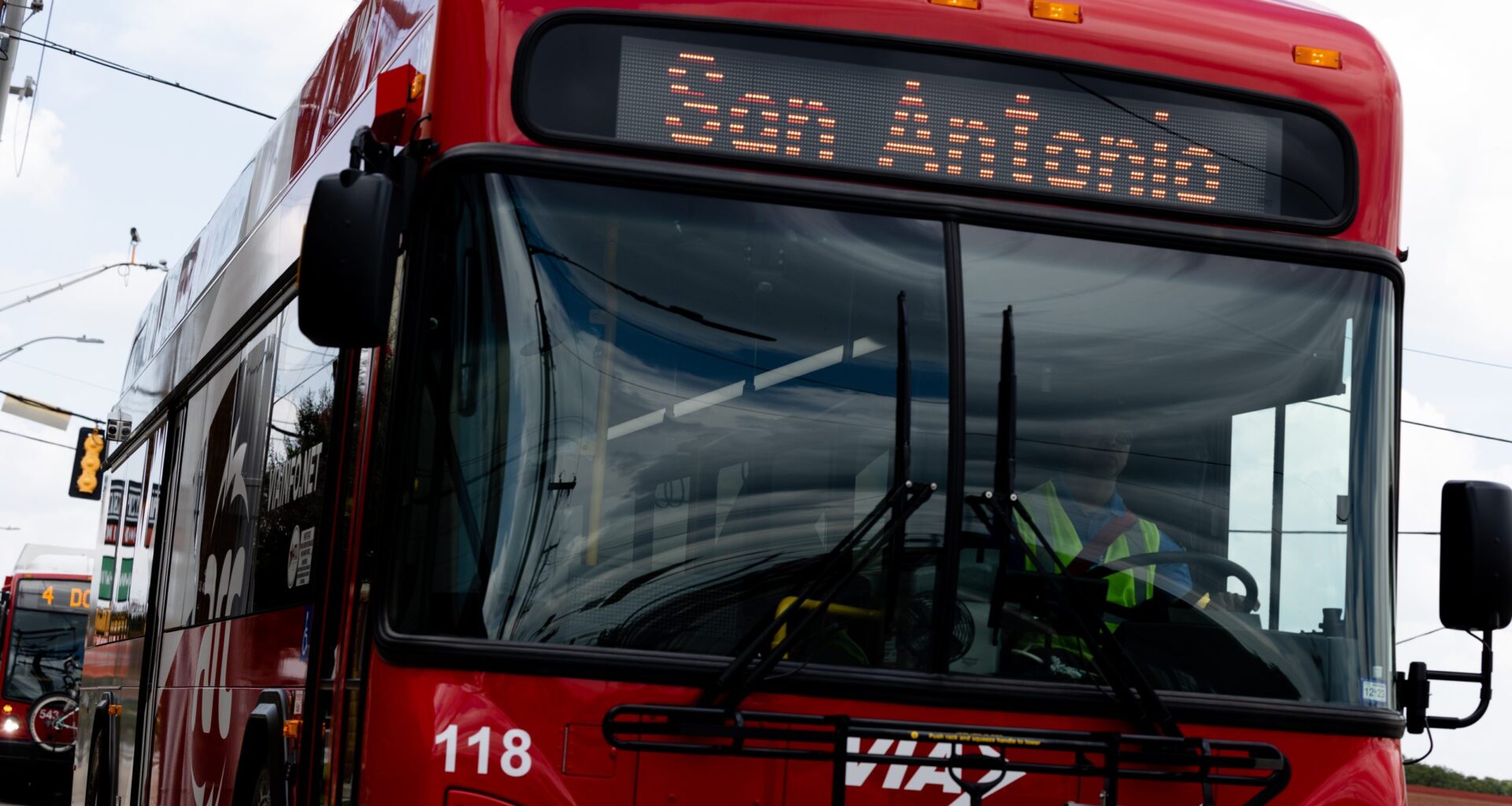
San Antonio residents won’t be getting free bus rides any time soon.
VIA Metropolitan Transit pushed back against a proposal for a fare-free pilot program on Tuesday, when staff argued that cutting fares would make buses less safe and could negatively impact VIA’s finances and expansion plans.
Mayor Gina Ortiz Jones is driving the most recent call for free bus rides. She asked VIA to present a plan for a pilot program that would roll out by July 1 at a San Antonio City Council B Session earlier this month.
Jones’ request was specific — she asked for a six-month pilot program for VIA’s top five routes and got support from three other council members.
VIA’s Board of Trustees rejected the idea unanimously at a Tuesday evening meeting. Trustees ordered staff to stop analyzing, developing or pursuing fare-free programs and focus on its existing plans.
VIA is publicly funded and 75.8% of its budget is funded by sales tax revenue. Jones and several other council members argued that if most residents are supporting VIA through their taxes, they should get free rides.
The agency charges $1.30 for a bus ride and $38 for a 31-day pass. About 5% of its budget, or $18 million, is covered by revenues from fares.
But VIA has said that 5% is essential to its budget and to grant agreements with the federal government for the Green and Silver Lines, planned advanced rapid transit bus routes that are under construction.
On Tuesday, VIA staff took more than an hour to lay out a case against any fare-free program. Staff said when surveying residents about their priorities, San Antonians were primarily concerned about bus reliability and frequency, not cost.
VIA’s Deputy CEO Tremell Brown said a fare-free program would require the agency to use more buses and more drivers.
Those additional costs, along with the loss of fare revenue, would impact VIA’s budget, added Chief Financial Officer J’Maine Chubb.
Chubb estimated that cutting all fares would reduce revenues by $18 million and add $16.3 million in operational costs. There would be $1.3 million in savings if VIA stopped collecting fares. The net impact was $33 million. For a partial fare-free program, that number was $20.6 million, he added.
Chubb said those impacts would hurt VIA’s ability to reliably pay its debts and build large projects. VIA has said it worries federal officials could review grants allocated to the agency if its budget and financial ability are affected.
The Green Line received around $268 million in federal funding while the Silver Line has $134.7 million going through the congressional review processes.
VIA’s bus drivers raised their own concerns with free bus rides on Tuesday at the board meeting.
“When the bus becomes free, the respect for the service and the person providing drops by opening the doors to everyone, without exception. We lose the ability to protect our passengers from those who aren’t there to travel,” said Robert Garza, president of the Amalgamated Transit Union Local 694, which represents VIA bus drivers.
Garza was one of a half dozen bus drivers who spoke at the meeting. They were concerned about their safety and passengers’ safety if fares are cut. It was one of the few issues the union agreed with VIA management on, Garza added.
Brown added that VIA had allowed free bus rides during the pandemic and heard increased concerns from drivers about bus riders who would board and stay on with no particular destination. That impacted cleanliness, safety and other customers’ satisfaction, Brown said.
He said VIA bus operators had experienced increases in verbal abuse and incidents where angry riders had spit at them, leading the agency to add physical barriers to protect drivers on buses.
VIA’s 11-member board voted 10-0 to stop analysis of a fare-free program, with one member absent.
Five VIA board members are appointed by San Antonio City Council, three are appointed by Bexar County Commissioners Court and two are appointed by suburban mayors. The last board member, its chair, is elected by its sitting board members.
VIA’s board members instead tasked staff with moving forward on its Better Bus Plan and infrastructure updates. Senior VP of Customer Care and Support Priscilla Ingle said 40% of VIA riders use its reduced fare programs. Board members urged VIA to expand those reduced fare opportunities to help get more riders, rather than cutting fares entirely.
The issue could become a political tug-of-war with city council members. VIA is eyeing a telecom tax that if added would boost its budget.
On Feb. 11, councilmen Jalen McKee-Rodriguez (D2) and Edward Mungia (D4) said that if VIA wants council members to approve additional tax revenues for the agency, it needs to look into fare free programs.