
Nearly 20 years ago, Texas launched the Moving Image Industry Incentive Program to help our film and TV industry compete globally.
Last year, state lawmakers effectively supercharged that mission when they passed a bill providing $300 million to fund the program every two years for the next decade.
That massive investment is a primary reason why Dallas College is now transforming its curriculum.
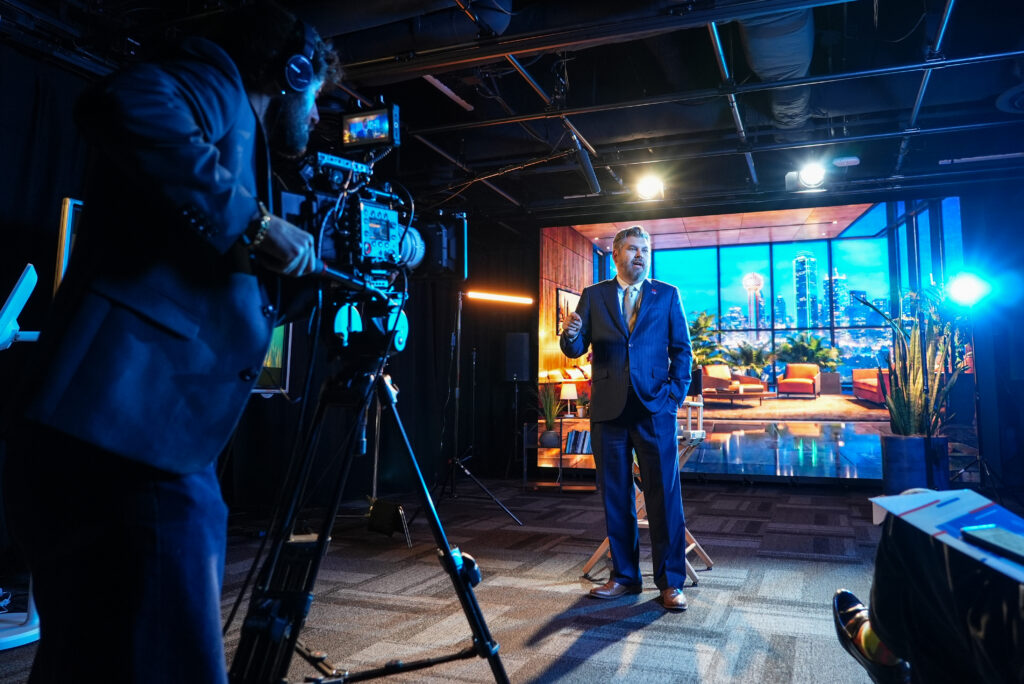
They’ve recently unveiled a new virtual production soundstage at one of their campuses and Director of Gallery & Live Events at Dallas College Brett Dyer joined the Standard to talk about it. Listen to the interview in the player above or read the transcript below.
This transcript has been edited lightly for clarity:
Texas Standard: Tell us more about this new studio. What does it look like? What do you have in there?
Brett Dyer: Oh, it’s pretty amazing. It was a former classroom that we used for a variety of functions. And now, I mean, it is a full-on professional sound stage.
The best way to, I guess, visualize it is instead of having just a green screen behind you, there are all of these LEDs that can really transport you to anywhere and give students those experiences hands-on. You don’t have to worry about the weather or any other outside elements.
We’re finding it already to be just a really positive addition to the college and the programs that we have.
It sounds like it’s far more professional a setup than y’all have ever had before, is that accurate?
We do have a wonderful video tech program that prepares students as best they can and usually plucks them right into the industry.
But this really just helps us level up and be prepared for more of the industry trends that we see coming into Dallas and the film industry.
Let’s talk about that for just a moment, because I’m not sure that I have a good sense of how big the film and TV industry is in the Dallas area. Obviously a major city, but say more about the industry there.
Right now, they estimate that in 2025, the Dallas region welcomed 277 film projects and hired over 3,000 local crew members. So creating quite a demand for graduates that are prepared to really step into those high-skill, high-wage career pathways.
For people who don’t know much about the sorts of jobs, what kind of job specifically would this make you more competitive for? A producer or a camera person or what specifically?
There’s quite a variety of jobs that this helps train students for.
One is just being a virtual production technician, working with some of this new technology, being an LED volume operator, doing motion design, production and coordination, and a variety a virtual productions skills that are in demand for different corporate communications, live events, gaming and all other immersive experiences that we’re seeing grow.
Say more about that LED panel that you were talking about earlier, because it seems like that’s a real focal point here. I’m trying to visualize that.
You sort of say that this takes you way beyond the green screen that most folks are familiar with. How does it work?
You can plug in any images or video into it. So with some of the demos that I’ve seen, it’s been amazing because you can zoom in and zoom out and you can change… Like there’s a panel that basically it’s kind of like a big iPad that you can operate everything on.
There’s a lot of equipment set up in this space, but it all can be operated on just a simple screen. And so they’re able to control all the lights. And then the imagery, and so you could have a big landscape view of some scene, but then also zoom in on parts of it.
So you could create, let’s say, a car driving. You could have a stage set up like a steering wheel, and then you could have that movement on the video behind. So it really looks like they’re driving through a street or a road without actually having to put students in danger.
Now it’s my understanding that Dallas College has set up partnerships with groups like the Dallas Film Commission. What’s the nature of those partnerships and how will that work?
Yeah, we’ve partnered with the Dallas Film Commission, DHC Films, and the Dallas Producers Association. And we feel that those are gonna be really important to building workforce pipelines for our students.
And they’re interested in helping us connect the school to real-time work opportunities, providing access to internships, and sharing the program with industry partners.