
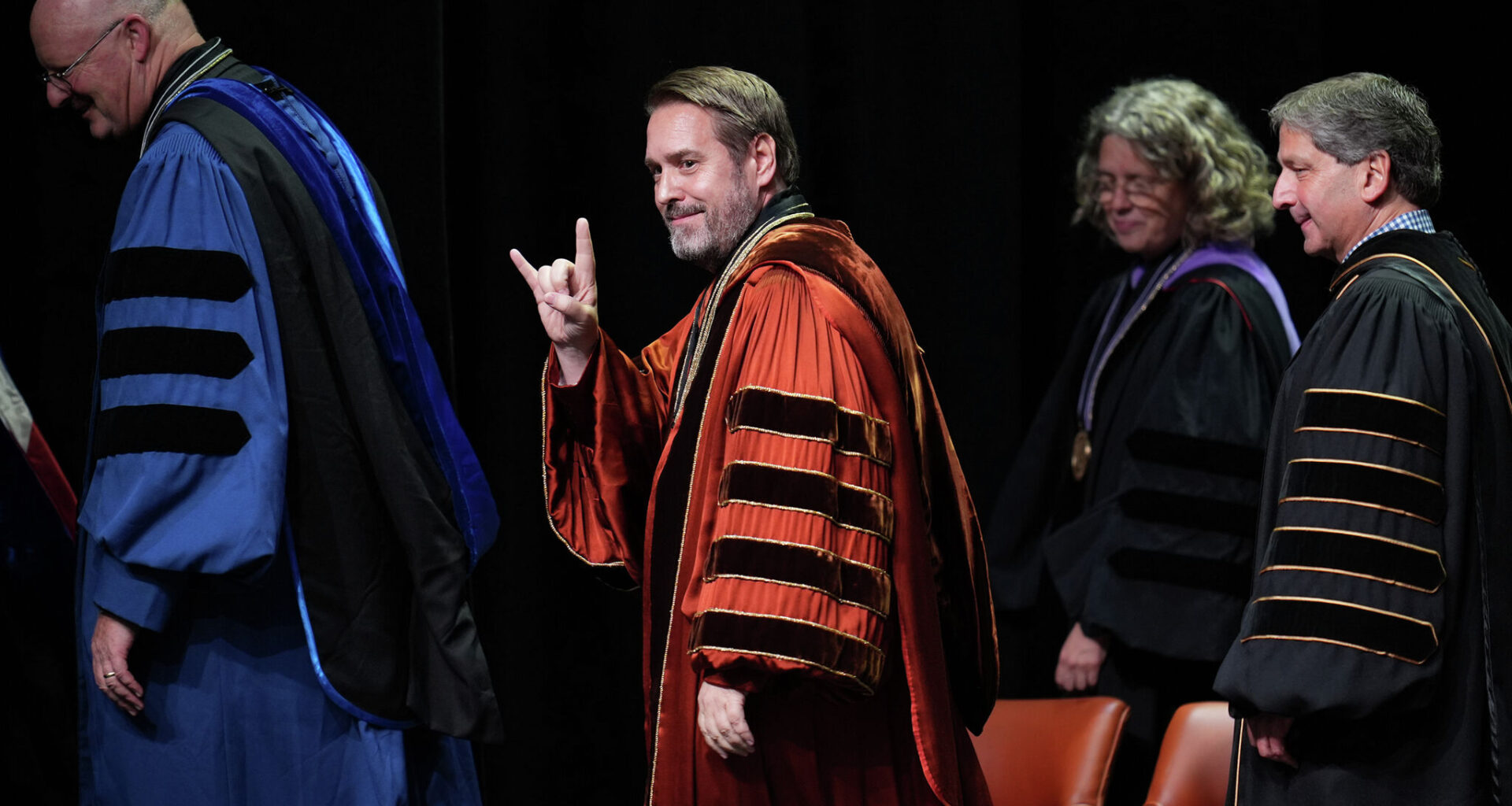
University of Texas President Jim Davis throws the horns while walking off stage at his investiture ceremony at Hogg Memorial Auditorium on Wednesday, Oct. 22, 2025.
Jay Janner/Austin American-Statesman
University of Texas President Jim Davis announces a partnership between the University of Texas Police Department and the Austin Police Department to establish a West Campus patrol district at a news conference at UT in Austin, Tuesday, Aug. 26, 2025.
Jay Janner/Austin American-Statesman
University of Texas President Jim Davis greets Rep. Shelby Slawson, R-Stephenville, before a meeting of the Select Committee on Civil Discourse and Freedom of Speech in Higher Education at the Capitol on Thursday, Nov. 13, 2025.
Jay Janner/Austin American-Statesman
Jim Davis is applauded while being inducted as President of the University of Texas during an investiture ceremony at Hogg Memorial Auditorium on Wednesday, Oct. 22, 2025.
Jay Janner/Austin American-Statesman
Conservative political donor Harlan Crow, left to right, University of Texas Interim President Jim Davis, UT System Chairman Kevin Eltife, Gov. Greg Abbott, Lt. Gov. Dan Patrick, Dean of the School of Civic Leadership Justin Dyer and UT alum Bob Rowling gather for a group photo at the announcement of a $100 million investment in the University of Texas School of Civic Leadership at the UT Main Building Thursday May 8, 2025.
Jay Janner/American-Statesman
One year ago, the University of Texas System Board of Regents unanimously appointed then chief operations officer Jim Davis as UT’s interim president. The former administrator has overseen significant changes to the Forty Acres in his first year on the job.

Davis is the first UT president in more than 100 years not to come from an academic background. His experience includes time as a UT student and graduate, Navy cryptologist, deputy attorney general and senior administrator overseeing legal affairs and operations at UT.
Article continues below this ad
There was no national search or committee involved in his selection last February. UT System Chair Kevin Eltife charged the new president with improving the school’s operational efficiency. Eltife said he had full confidence that Davis’s passion, knowledge of campus and commitment to the role will lead UT to success.
In the last year, Davis has named new leaders, bolstered campus safety and reassured faculty that UT would support them amid federal cuts to research.
Davis has also declined all interview requests with the Austin American-Statesman about decisions made during his tenure thus far, but told The Alcalade, UT’s alumni magazine, in August that “I bring a different set of experiences to questions that many universities haven’t faced in a long time.”
“I have a strong sense of how it operates and where its strengths and weaknesses are,” he said. “This is a place that I truly love, and my commitment to it being special and great is unlimited.”
Article continues below this ad
Here are five major changes he’s overseen at UT since his appointment last February:
“Balance” to the core curriculum
Shortly after becoming interim president, Davis ended the Skills & Experience Flags Program, a series of UT-specific requirements that every Longhorn had to take to graduate. The program required students to take courses in quantitative reasoning, cultural diversity and global cultures. Former President Jay Hartzell charged a committee with reviewing the program after conservative lawmakers targeted core courses focused on race and gender.
Davis’s decision to end the program came after the committee said they supported the program’s value and suggested tweaks to better align it with graduate requirements.
Article continues below this ad
To determine future requirements, Davis launched a core curriculum review committee aimed at ensuring graduates leave UT with a broad and ideologically diverse mix of courses. After Charlie Kirk’s assassination, he suggested to lawmakers that core curriculum can teach students to better disagree and empathize with each other and promised in an October speech to ensure there is “balance” in those classes.
“Has inquiry become indoctrination? Has science surrendered to subjectivity? Have we given in to a culture of asserting my truth, with an intolerance for any other?” he said. “That is not the Texas way.”
In his first State of the University address, he focused heavily on curriculum and his hopes to “broaden” degree programs. In the speech, he said now is the moment for UT to become a “model of public trust.”
Consolidating “fragmented” departments
In an effort to better steward limited university resources and to broaden overly “fragmented” degree programs, Davis announced several reorganizations across multiple schools and colleges.
Article continues below this ad
Last week, UT regents approved a new School of Computing that will open in Fall 2026. The school will be housed in the College of Natural Sciences. The university will consolidate UT’s School of Information into a department under the new computing school, which will also hold the Department of Computer Science and the Department of Statistics and Data Science. UT officials said this is purely an organizational change that will not impact degree programs.
Earlier this month, Davis announced that the university would combine four ethnic and gender studies programs — African and African Diaspora Studies, Mexican American and Latina/o Studies, Women, Gender and Sexuality Studies and American Studies — into a new Department for Social and Cultural Analysis Studies. Departments focused on French, Italian, Germanic Studies and Slavic and Eurasian Studies will become a new European and Eurasian Studies department.
The new European department does not include the Spanish and Portuguese Department. Asian Studies and Middle Eastern Studies departments were also not included in the consolidations.
Critics of the affected programs have argued the consolidated departments should have been folded into larger academic units because of their low enrollment or small faculty size. But similarly sized departments did not face consolidation in the College of Liberal Arts, leading some faculty affected by the move to suggest it was political pressure — not efficiency — that prompted the reorganization.
Article continues below this ad
Davis did not mention politics in his announcement to the UT community — he said the reorganization came after a university review of programs for size, academic mission and breadth. He declined an interview with the Statesman for more information.
Expanding UT’s conservative-championed Civics school
At an announcement Davis hailed as a historic convening of political and university partners, the UT Regents gave $100 million to the School of Civic Leadership last May. Gov. Greg Abbott and Lt. Gov. Dan Patrick praised the university’s newest school, which was created at the Republican Legislature’s urging in 2023 as a way to ideologically balance campus.
With the money, the Civics school is renovating its new home on campus and seeking approval for new degrees in Great Books and Strategy and Statecraft. School officials recently announced a new program in Jewish and Western Civilization with an accompanying scholars program.
Article continues below this ad
The National Endowment for the Humanities also invested $10 million in the school to hire 16 new faculty and launch the new majors, the dean said in a previous interview.
Some faculty have criticized Davis for overseeing the expansion of this school while consolidating overly “fragmented” departments in programs that are politically unpopular among Republicans.
A new way to seek faculty advice
The UT System ended faculty senates to comply with Senate Bill 37, a higher education reform law that handed greater power to governor-appointed regents. The system left it up to institution presidents to determine the best way to engage with faculty.
Article continues below this ad
At the flagship, Davis created a President’s Faculty Advisory Board with 14 members — a body that is significantly smaller than UT’s faculty council, which had more than 70 members. There is no longer a public forum to gather faculty, and Davis did not specify when or how often he will consult his new advisory board.
The 14 faculty serve a two-year term and “regularly” advise on a “broad range” of topics, according to Davis, who sent an email to campus announcing the new board. He also launched faculty committees to advise on core curriculum and academic responsibility.
Scrutiny on gender ideology
UT hasn’t restricted race and gender like the Texas A&M and Texas Tech university systems where courses “advocating” for gender ideology and race ideology can no longer be taught without prior approval. The flagship has also dodged some of the scandals other universities have faced when firing professors because of their liberal speech.
Article continues below this ad
But UT has still seen notable change amid the conservative crusade against “liberal indoctrination.” Under Davis, UT Health Services stopped offering hormone replacement therapy, a common form of gender affirming care for transgender people.
A UT spokesperson told Texas Scorecard it would investigate courses in gender after the conservative publication reported on the school’s LGBTQ course offerings. The UT System regents later announced their own audit into such courses.
Davis promised UT would become a “model of public trust” and honestly investigate questions of indoctrination versus education. As part of the consolidation of gender and ethnic studies departments, he said the university is reviewing degrees in the affected ethnic and gender studies departments. The future of those programs remain unclear.
Article continues below this ad