

Apple recently expanded its Houston operations, committing to produce Mac mini desktops and advanced AI servers in the U.S. for the first time, while opening an Advanced Manufacturing Center to train students, suppliers, and businesses in cutting-edge production techniques.
This shift deepens Apple’s push into on-device AI and localized manufacturing, tightening links between its hardware innovation, U.S. supply chain resilience, and future workforce skills.
We’ll now examine how Apple’s Houston manufacturing expansion, especially its AI server build-out, reshapes the company’s investment narrative and long-term positioning.
Capitalize on the AI infrastructure supercycle with our selection of the 34 best ‘picks and shovels’ of the AI gold rush converting record-breaking demand into massive cash flow.
To own Apple today, you generally need to believe its massive installed base and ecosystem can keep driving iPhone, Mac, and Services revenue while it carefully layers in AI. The Houston expansion strengthens Apple’s on‑device AI and U.S. manufacturing story, but it does not change the near term focus: execution on Apple Intelligence and Siri upgrades as the key catalyst, and regulatory and legal pressure on Services as the biggest risk.
Among recent announcements, Apple’s Q1 FY2026 results stand out: record US$143,756 million revenue, strong iPhone demand, and all‑time highs in Services. That earnings strength gives Apple more room to fund moves like Houston and its broader US$600 billion U.S. investment plan, which could gradually reduce supply chain concentration risk while supporting the AI‑driven upgrade cycle that many investors are watching.
Yet while Houston looks like a positive step, investors should also be aware that…
Read the full narrative on Apple (it’s free!)
Apple’s narrative projects $477.4 billion revenue and $133.6 billion earnings by 2028. This implies 5.3% yearly revenue growth and an earnings increase of about $34.3 billion from $99.3 billion today.
Uncover how Apple’s forecasts yield a $291.65 fair value, a 10% upside to its current price.
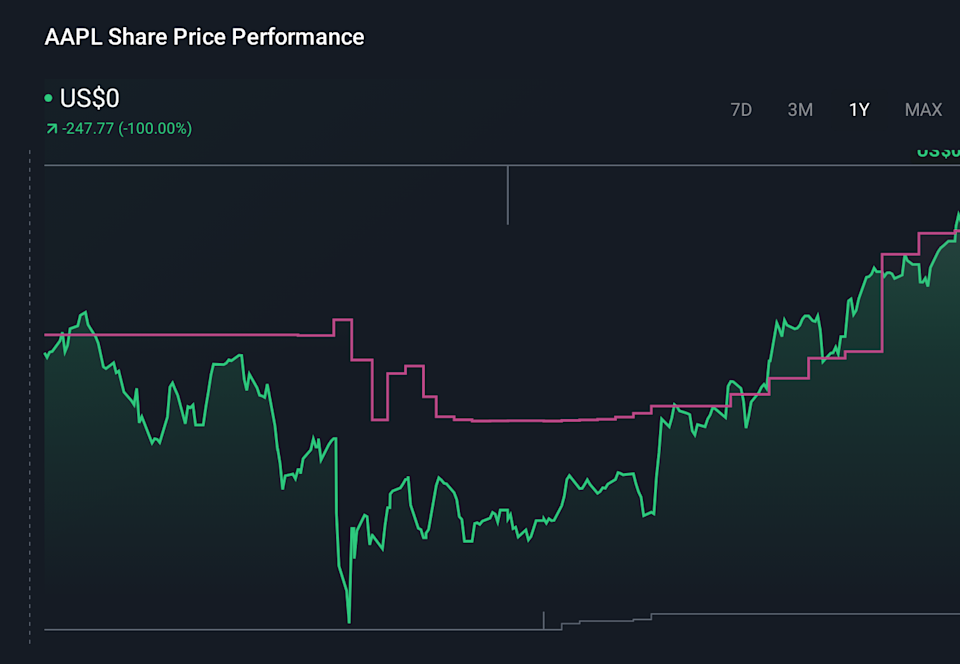 AAPL 1-Year Stock Price Chart
Some analysts are far more optimistic, assuming revenue could reach about US$503 billion by 2028, and see Apple’s massive U.S. manufacturing and AI build out as proof that supply chain resilience itself could be a major long term earnings driver.
Explore 104 other fair value estimates on Apple – why the stock might be worth as much as 31% more than the current price!
Don’t just follow the ticker – dig into the data and build a conviction that’s truly your own.
A great starting point for your Apple research is our analysis highlighting 2 key rewards that could impact your investment decision.
Our free Apple research report provides a comprehensive fundamental analysis summarized in a single visual – the Snowflake – making it easy to evaluate Apple’s overall financial health at a glance.
These stocks are moving-our analysis flagged them today. Act fast before the price catches up:
This article by Simply Wall St is general in nature. We provide commentary based on historical data and analyst forecasts only using an unbiased methodology and our articles are not intended to be financial advice. It does not constitute a recommendation to buy or sell any stock, and does not take account of your objectives, or your financial situation. We aim to bring you long-term focused analysis driven by fundamental data. Note that our analysis may not factor in the latest price-sensitive company announcements or qualitative material. Simply Wall St has no position in any stocks mentioned.
Companies discussed in this article include AAPL.
Have feedback on this article? Concerned about the content? Get in touch with us directly. Alternatively, email editorial-team@simplywallst.com