
Editor’s note: To view this story as it appeared in Community Impact’s Leander, Liberty Hill edition, click here.
In January, Williamson County broke ground on a $132 million road project that is expected to improve west-to-east mobility between Leander and Georgetown.
The project would transform Hero Way and RM 2243, a state road, into a divided, controlled-access highway from 183A Toll to Southwest Bypass. The existing rural two-lane roadway is set to be expanded into two main lanes running in each direction alongside two three-lane frontage roads.
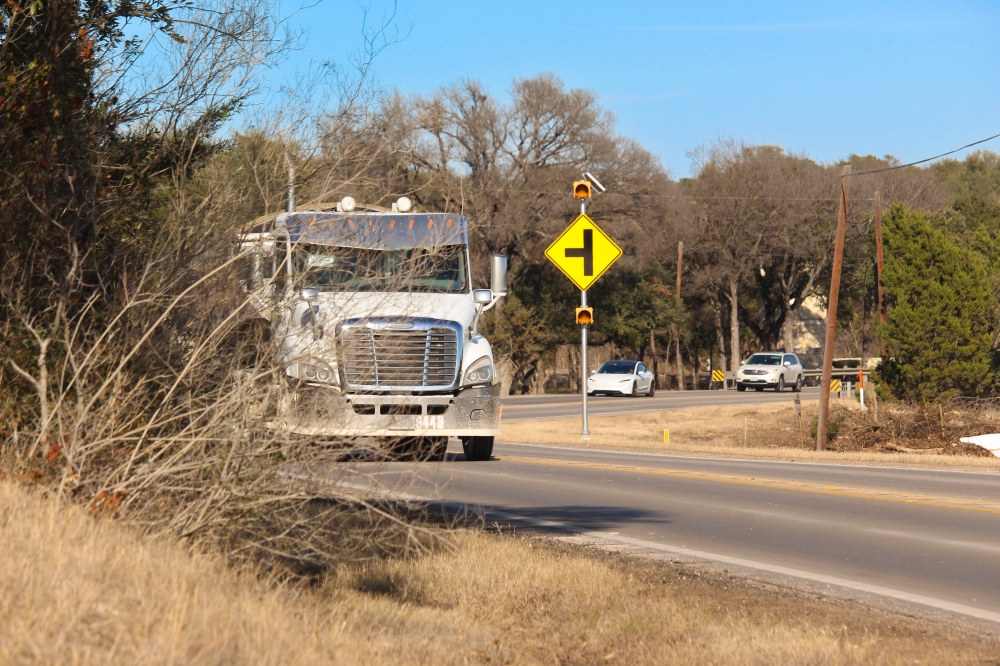
The current situation
For Phase 1A, the county will build the first frontage road from 183A Toll in Leander to Garey Park in Georgetown with one lane in each direction alongside a center turn lane. Phase 1A is scheduled to be completed by early 2028.
The new roadway is anticipated to accommodate increased traffic, address safety concerns and foster economic growth along the corridor, county and city officials said.
“It is going to revolutionize the way traffic moves through Leander, and it’s critical that it starts and opens,” said Bridget Brandt, president of the Leander Chamber of Commerce.
“>
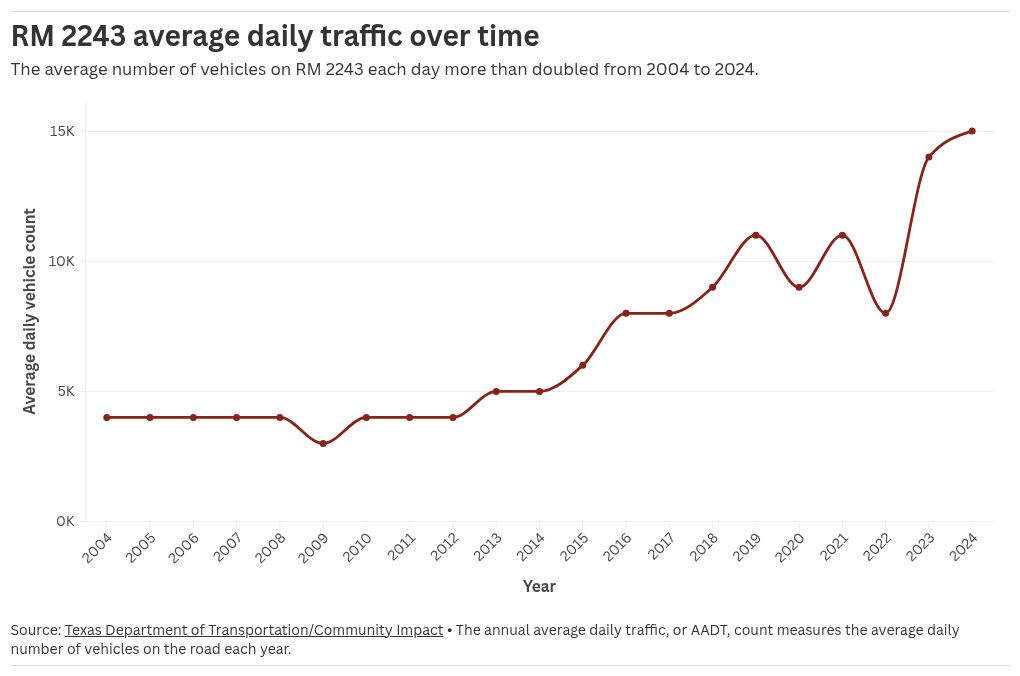
Traffic along RM 2243 has more than doubled over the last 20 years, according to data from the Texas Department of Transportation.
“Anybody that currently drives Leander Road [known as RM 2243] … knows the need for this project,” Williamson County Precinct 2 Commissioner Cynthia Long said. “Both cities have been two of the fastest growing in the county, and it doesn’t show signs of slowing down.”
Leander resident Josh Howard said the road is constantly congested with heavy traffic, resulting in a 30-minute commute from Leander to Georgetown.
Long said she hopes the realignment of RM 2243 with Hero Way helps smooth out dangerous curves along RM 2243 that have resulted in fatalities. From 2016 to 2025, there were nearly 500 crashes along the corridor, according to TxDOT data.
 The cost
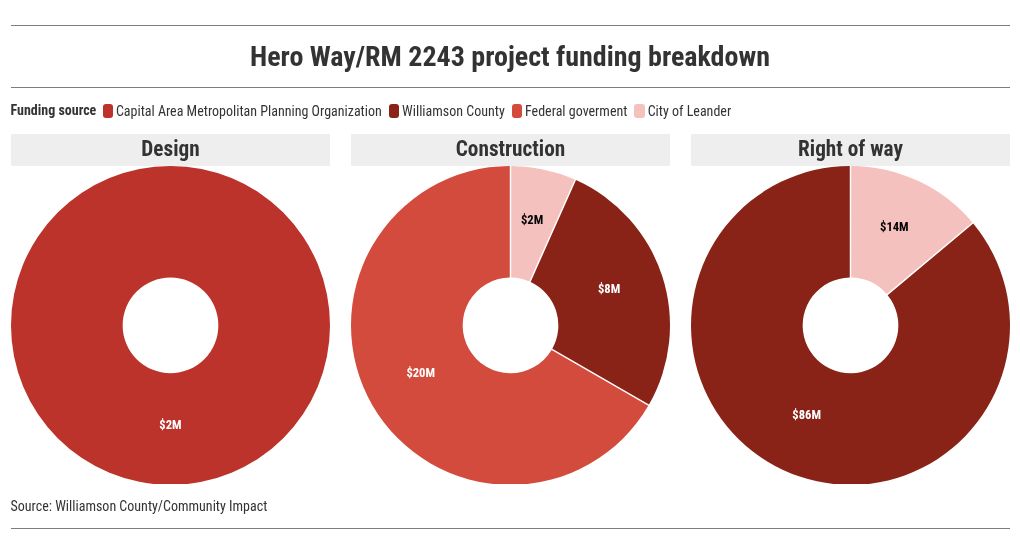
County officials said they spent years acquiring $100 million worth of right of way from about 60 landowners along the corridor. The majority of this funding comes from the county’s $412 million road bond package in 2019.
“There’s not a county that I know of in the country that is as proactive as we are in transportation,” Precinct 3 Commissioner Valerie Covey said at a Jan. 29 groundbreaking ceremony.
U.S. Rep. John Carter of Williamson County helped secure $20 million in federal funding to construct the project, Long said.
 The impact
The city of Leander has seen the Hero Way and RM 2243 corridor explode with economic growth, welcoming new commercial, retail and warehouse developments, said Randall Malik, the city’s director of economic development.
Plans to develop the roadway have already attracted many new developers and employers to the area, Malik said. Future projects coming online include a Home Depot; a 1.3-million-square-foot industrial warehouse space that will house large employers; as well as a new hotel, event center and Big Air trampoline park by ARS Developers.
The availability of undeveloped land and proximity to I-35 have created an unparalleled economic opportunity for the city, Brandt said. Access to major roadways is a main factor many companies consider when deciding where to locate their business, she said.
“It is such a wide-open opportunity that does not exist anywhere else near us,” Brandt said. “I think you have an opportunity to see some really big-scale unique offerings in that vicinity [near Leander].”
Although Georgetown has not seen as much commercial development along the road, the city has issued more than 1,400 permits for new homes in the Parkside on the River subdivision over the last decade, according to city of Georgetown data. This spring, the city is slated to complete its second phase of improvements at Garey Park, including an expanded event center, amphitheater, an 18-hole disc golf course and skate park.
“In five to 10 years, I think we will see enormous potential for commercial growth along that corridor.” Malik said.
Stay tuned
Utility relocations along Hero Way will begin this year, while the majority of roadwork will not occur until next year, according to county information. No lane closures are anticipated, while some traffic may be shifted onto short-term driving surfaces, known as temporary pavement.
Years of ongoing construction could temporarily impede some traffic at existing businesses, Brandt said.
Design work is underway for Phase 2—the construction of a second frontage road from 183A Toll and Ronald Reagan Boulevard. This year, the county will begin designing the continuation of the first frontage road from Garey Park to Southwest Bypass for Phase 1B. Phase 3 will include the construction of the highway’s main lanes.
“We’re going to see real progress very soon,” Long said.