
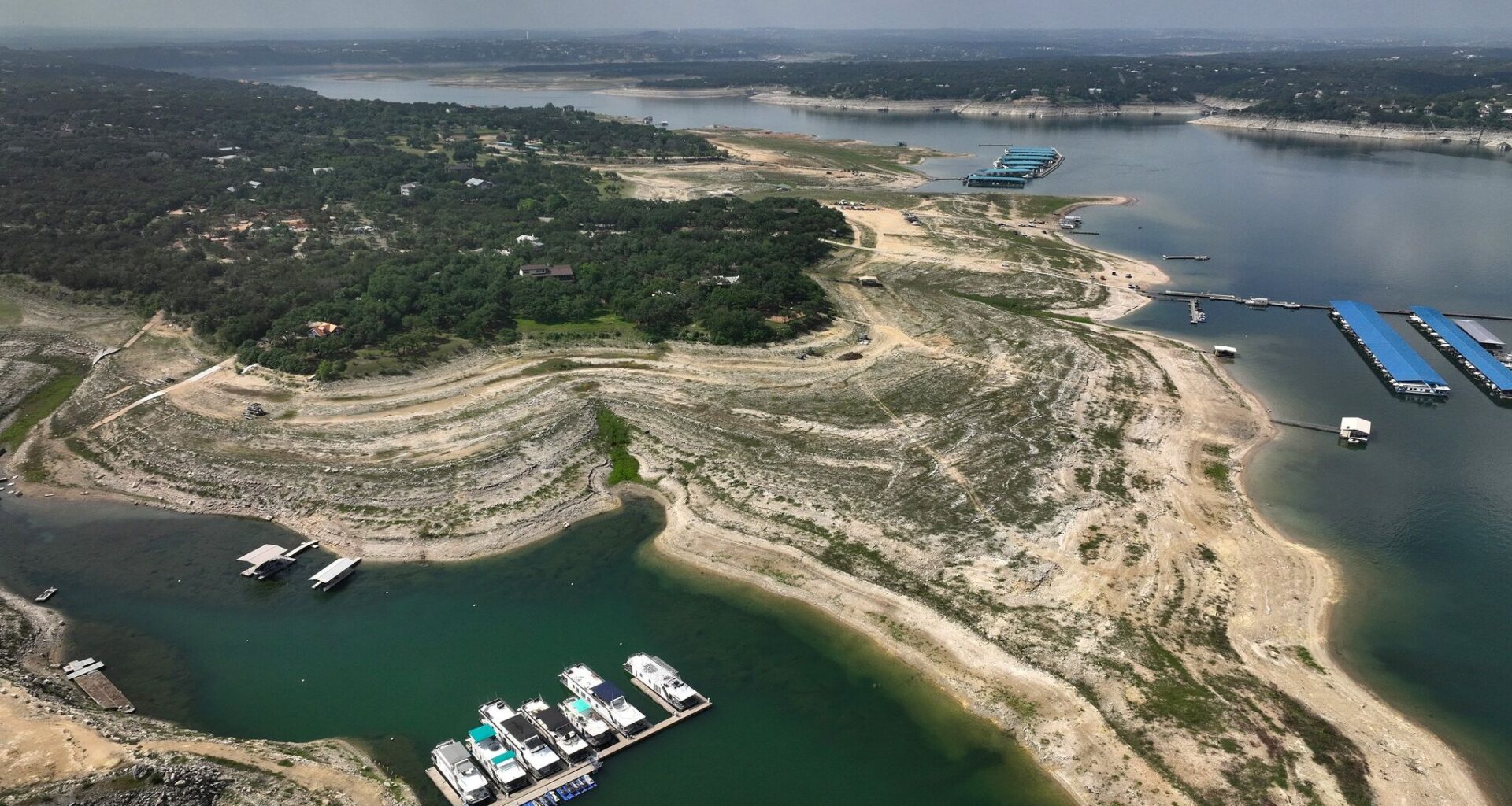
Lake Travis water levels in June 2024, above, were running well below capacity. On Tuesday, the surface elevation at Lake Travis was about 666 feet or about a foot below the historical average for February.
Jay Janner / American-Statesman
February has been a warm one across the Austin metro area. We’ve already logged eight 80-degree days and could log one every day until the month ends Saturday.

We could tie February 2017, when 12 days reached 80 degrees. Austin’s late-February average afternoon high temperature is close to 70 degrees, and temperatures will run about 12 to 15 degrees above normal for the rest of the week, though they should remain below the daily records.
Article continues below this ad
Daily record highs for the week:
Wednesday: 92 degrees (set Feb. 25, 2008)
Thursday: 93 degrees (set Feb. 26, 1954)
Friday: 91 degrees (set Feb. 27, 2009)
Saturday: 89 degrees (set Feb. 28, 1932)
Wednesday in Austin will begin with temperatures in the lower to mid-50s under a partly cloudy sky at sunrise. Breezy south winds of 8 to 15 mph could include gusts topping 25 mph. Those southerly winds will draw atmospheric moisture from the Gulf Coast into Central Texas through the first half of the day.
By the afternoon, a surface system of low atmospheric pressure moving into North Texas will push into Austin a dry-line frontal boundary separating dry and humid air masses. As it arrives, any lingering low clouds will shift east of the city, replaced by a hot, dry west wind flowing in from the Edwards Plateau and Hill Country into the capital. That shift will send temperatures soaring to well above normal.
Article continues below this ad
The afternoon is expected to reach the middle to upper 80s and could feature the warmest temperatures of the month, surpassing the 86-degree readings recorded on Feb. 9 and Feb. 19.
South and Central Texas temperatures will climb into the middle and upper 80s on Wednesday afternoon with breezy west to southwest winds.
Pivotal
The wildfire threat will remain elevated in the moderate to high category across Central Texas, according to the Texas A&M Forest Service.
Thursday will be just as warm, but southerly winds won’t be quite as strong, staying below 20 mph for the most part. A dry cold front is expected to move through during the afternoon, with low relative humidity behind the front creating more wildfire weather concerns across the region.
Article continues below this ad
The air behind the front won’t be particularly cold, as the coldest air remains well to our northeast, but we can expect a modest dip in temperatures through Friday.
Average late-February temperatures are about 48 and 69 degrees, But Austin daily temps will be well above that for the next seven days.
Roberto Villalpando
If you’re hoping for that rare, wet substance we call rain, you’ll need to wait about 10 days for a strong enough front to bring a meaningful chance of showers. In the meantime, southerly winds from Friday onward will continue funneling Gulf Coast atmospheric moisture into Central Texas, which might help ease the wildfire threat through early next week.
Drought update and lake levels
Central Texas continues to face drought conditions, according to data from the U.S. Drought Monitor, especially after several months of below-normal rainfall. While areas like West Texas and the Big Bend region have seen notable improvement over the past year, Central Texas has seen little change. In fact, the region’s severe drought has expanded since this time last year.
Article continues below this ad
Last year, 43% of the state was experiencing drought, with almost 25% classified as severe or worse. This year, drought covers almost 75% of Texas, with about 42% of the state in severe drought or worse.
Drought conditions across Central Texas remain largely unchanged compared to last year, while areas such as West Texas have experienced significant improvement.
U.S.Drought Monitor
Fortunately, the lack of rainfall hasn’t significantly affected the Highland Lakes, including Lake Buchanan and Lake Austin. Over the past 30 days, lake levels have only dropped slightly. The surface elevation of Lake Buchanan is currently 7 feet above its historical February average, sitting at 94% full, while Lake Travis is at 77% capacity.