
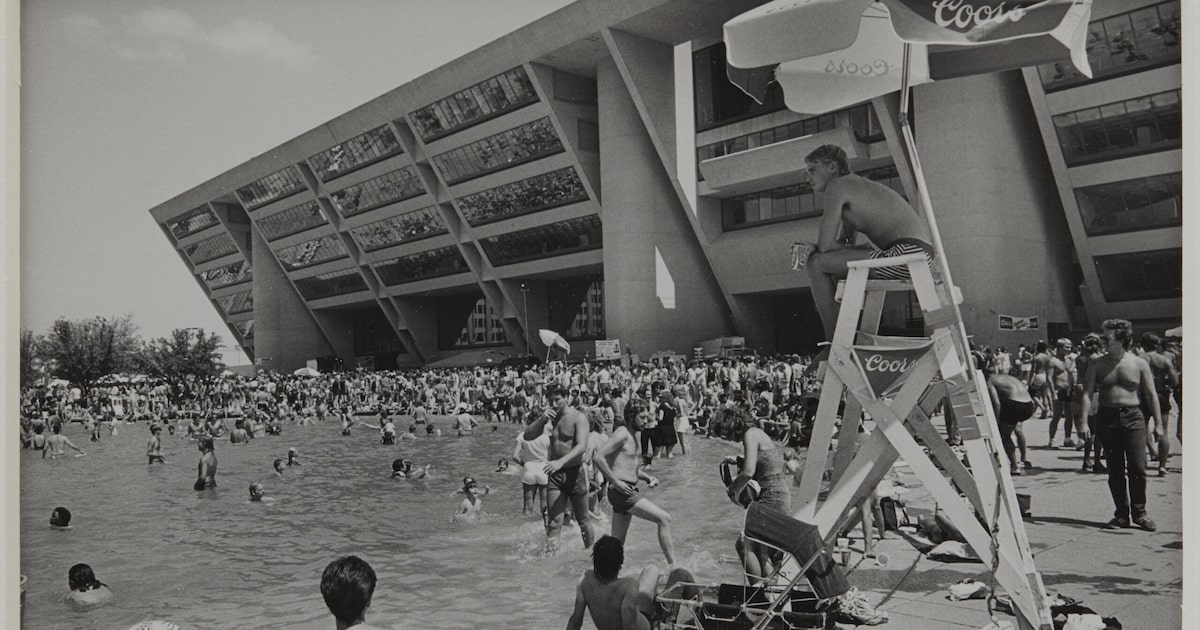

For months, there’s been this idea floating around that if the Dallas City Council tries to offload City Hall rather than repair it, residents would have to approve the sale of the seven-acre plaza in front of the “Brutalist colossus.”
Because that’s just state law, which says that “land owned, held, or claimed as a public square or park may not be sold” unless the voters OK it. And even if the voters said yes, the land would have to be auctioned to the highest bidder. D’s FrontBurner blog reiterated that Monday morning, describing the need for a parkland-sale referendum as a “potential hitch” in the council’s giddyup.
But barring any last-minute revelations, we’re going to have to sideline that argument. It appears after doing some digging that it won’t be a roadblock the keep-it crowd has hoped for.
And, look. I know you’re disappointed. Some of you, anyway. Like, say, those of you who stopped watching Dallas Mavericks games long before Luka was traded.
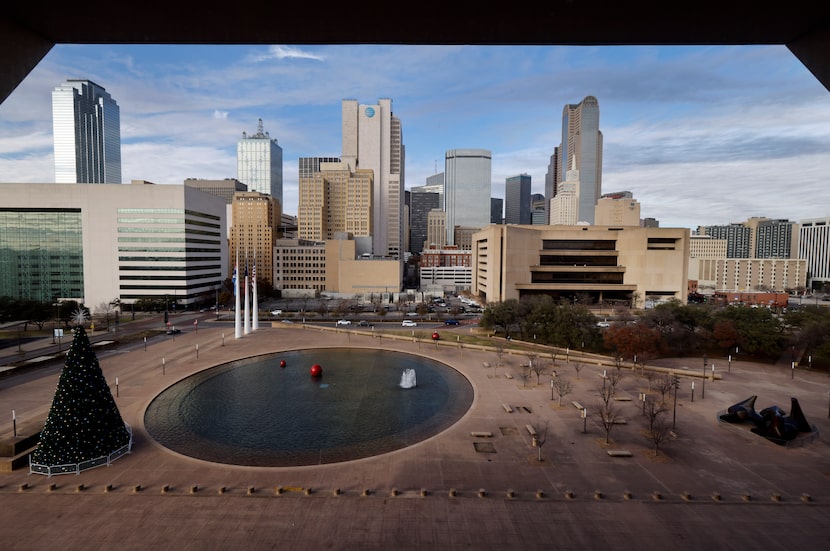
Dallas City Hall plaza as seen (during Christmastime) from City Hall’s Sixth Floor Flag Room, with Henry Moore’s “The Dallas Piece” at far right.
Tom Fox / Staff Photographer
Best I can tell, maybe because I’ve repeated this theory as gospel about 482 times since the fall, the plaza-as-parkland narrative started with a Facebook comment from architect Willis Winters, the longtime director of the Park and Recreation Department who spent decades caretaking the plaza. Winters, who retired in 2019, told me Monday that, yeah, he was probably the first to mention it, because the park department has always been tasked with caretaking the plaza – cleaning the fountain, replacing the dead trees planted in the concrete, programming a handful of events each year.
Opinion
As far as he’s concerned, the 48-year-old combo of concrete and greenery stretching from City Hall’s front doors to Young Street is a park. Which is the same thing Ryan O’Conner, the current Park and Recreation Department deputy director, told me Monday.
“We’ve tended to City Hall Plaza for as long as I can remember, which is 26 years,” he said. “It’s a park, a park plaza, like Pegasus Plaza downtown. Just a different type of park.”
At the very least, O’Connor said, the plaza has served as that public square mentioned in state law, whether for protests, vigils, marathons, parades, Christmas tree lightings, even the one-off beach party in 1984.
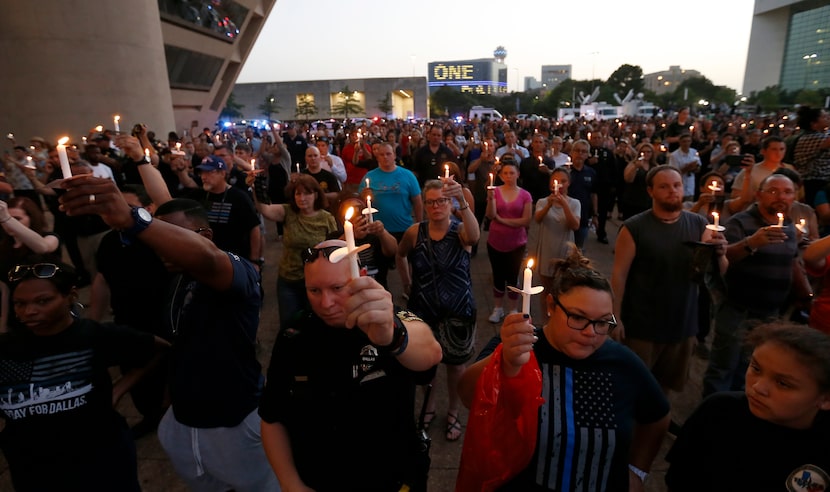
Dallas police officers and other people hold candles during a vigil hosted by the Dallas Police Association at Dallas City Hall in honor of the five police officers killed in an ambush. Photo taken July 11, 2016.
Jae S. Lee / Staff Photographer
Except neither O’Connor nor Winters has ever seen a piece of paper that shows the City Hall Plaza is a park, or that officially puts the park department in charge. And O’Connor has been looking for several months, researching the issue with the city’s archivist John Slate.
“We didn’t find a document,” O’Connor said.
“I don’t believe there’s a document,” Winters said.
Which is the same thing I heard from a former city attorney who swears this issue has been raised before but can’t remember when or why.
The best I could come up with was an excerpt from an undated park department land acquisition master list, emailed to me Monday from a City Hall source. It includes a few pieces of the City Hall Plaza – like the reflecting pool (which takes up about half an acre), the north plaza (about 1.5 acres), the half-acre east plaza and the 2.7-acre south plaza, which amounts to around 5.5 acres.
I was told there’s a hand-written note alongside the inventory: “Municipal Complex not Park Property.” It’s not clear who wrote this. Or when. Or why.
Several people with whom I spoke Monday said City Attorney Tammy Palomino would be able to answer some questions about all of this. I emailed her twice Monday, once while she was behind closed doors for two hours with the City Council discussing the value and potential sale of City Hall out of the public’s earshot.
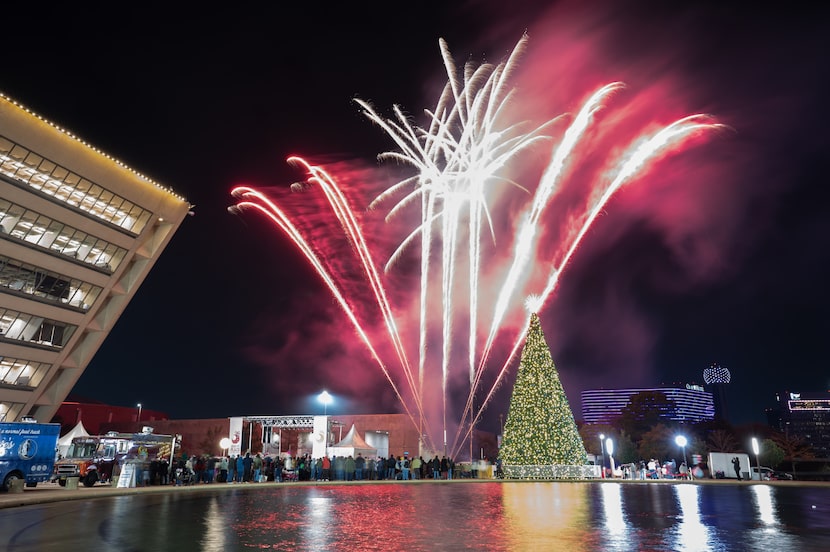
Fireworks at the Deck the Plaza event outside of Dallas City Hall, on Friday, Dec. 05, 2025. The annual holiday event hosted live performances, snow tubing, fireworks and a Christmas tree lighting ceremony.
Ben Torres / Special Contributor
I also asked her to confirm what I was told repeatedly on Monday: Planting an arena on parkland is allowable by state law. Look no further than the $55-million practice facility the Dallas Wings will now have to build themselves on Joey Georgusis Park in west Oak Cliff.
In a brief email sent Tuesday, Palomino said the City Attorney’s Office “does not make determinations, we provide advice. That said, any conversations we may have had with our clients would be an attorney-client privileged communication, so I would not have a comment.”
City Hall’s plaza – unrelentingly punishing during the summer months, barren the rest of the year save for Henry Moore’s depressingly barricaded-off The Dallas Piece – has long been the least popular piece of I.M. Pei’s City Hall, almost from jump. In 1983, just five years after the building opened, D threw a thumbs-up at city officials who gave revered urbanist and public-space specialist William H. Whyte $10,000 to study The People’s Plaza. Wrote the magazine, “It was wise of the City Council to realize that rejuvenating the plaza is not a job for an amateur.”
Whyte’s report could be as brutal as the plaza itself: “It is hot and windy and the trees are stunted.” But he saw great potential and “enormous strengths” in the seldom-used space that sat in the shadow of City Hall, “a great public building, unique in this country, and a sight in its right – especially at dusk, when it is a dramatic view, and so is the view of the city from it.”
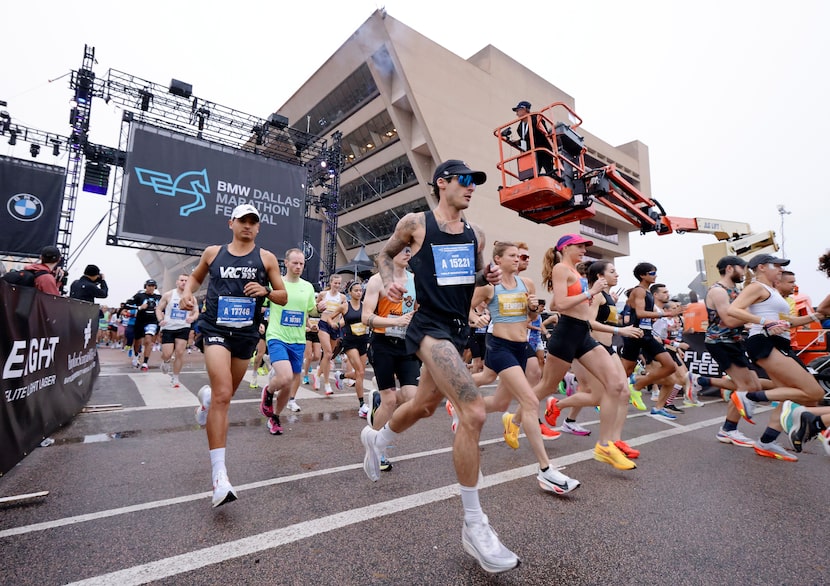
City Hall Plaza serves as the starting line for the BMW Dallas Marathon, seen here on Dec. 15, 2024.
Tom Fox / Staff Photographer
Whyte wrote glowingly of the “generous pool” and the sculpture, and suggested adding amenities – a food kiosk, pavilions, windbreaks – that would turn the plaza into a place where people wanted to spend time together. He also offered numerous suggestions on how better to connect City Hall and its plaza to the downtown from which it felt disconnected, begging city leaders to bring “street life” to an oft-moribund city center bereft of retail storefronts and people walking to them.
His 1983 report is as much a document for tomorrow as yesterday. Absent a clear vision for downtown’s future, save for a wrecking ball and yet another sports arena, city officials would be wise to revisit Whyte’s words.
There were other attempts at salvaging the plaza: In 2015, a developer proposed a public-private partnership that teased a plaza full of retailers and restaurants. Winters also commissioned a redesign by the same team responsible for Harwood Park that would have transformed the plaza into a green space with loop trails around City Hall and adjacent buildings. Winters lamented that the plan is in a drawer somewhere, forgotten and now, likely, unnecessary.
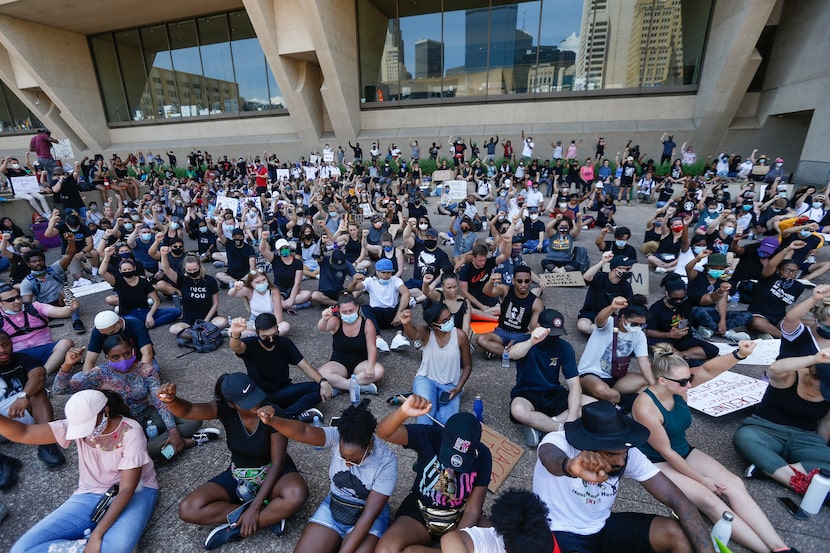
Protesters gathered in front of Dallas City Hall for an eight-minute, 46-second moment of silence after marching from Klyde Warren Park during a demonstration against police brutality on June 6, 2020.
Ryan Michalesko / Staff Photographer
“We are going to lose that plaza, which I took care of for so long,” Winters said. “And I hate it.”
If City Hall is The People’s House, the plaza is The People’s Porch – where we’ve come together countless times to celebrate, mourn, shout, reflect. Which, I think, is why so many folks, like me, so quickly took to this idea that the plaza was sacred parkland untouchable without our approval.
We can certainly improve City Hall’s front porch; should have, long ago, along with the City Hall elected officials allowed to fall into disrepair. Because where will we go now? The sidewalks surrounding a high-rise? A plaza in front of an arena?