
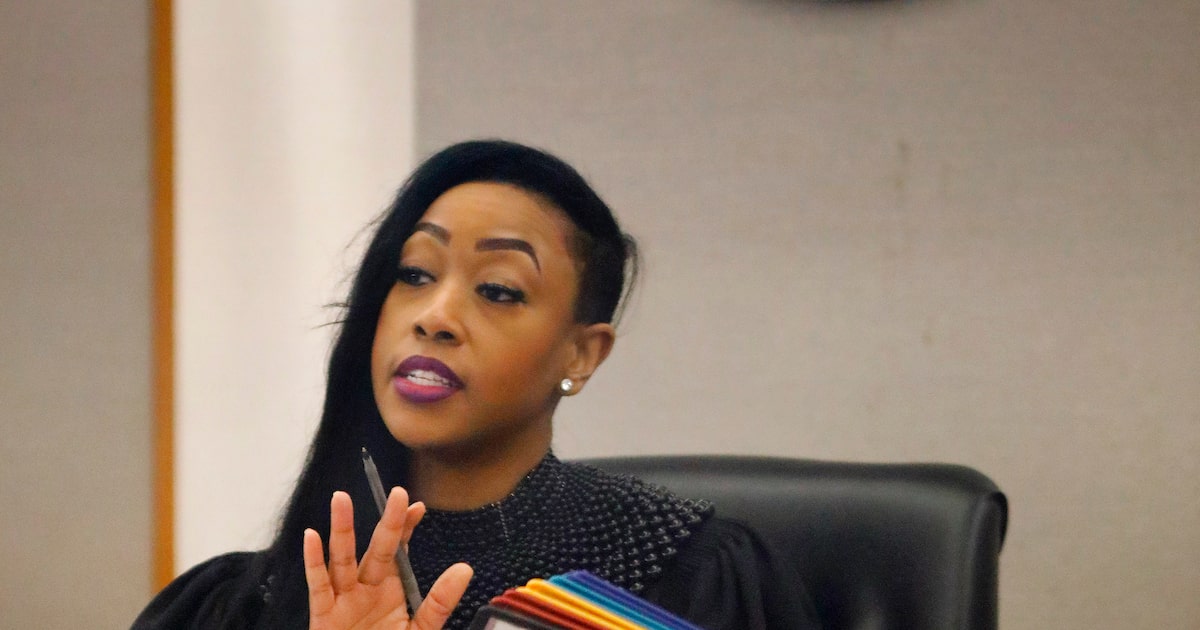
AUSTIN – It was just supposed to be a routine bond hearing.
But since that unusual proceeding in August 2021 in a Dallas County courtroom, the people who witnessed it have been asked to recount it multiple times by various investigating agencies.
On Tuesday, two of them were asked to testify about it again during a judicial misconduct trial being held this week before a three-judge panel at the state Supreme Court in Austin for former District Court Judge Amber Givens.
The State Commission on Judicial Conduct publicly reprimanded Givens last year after determining she had improperly allowed her court coordinator to preside over the bond hearing. The commission also found that she had wrongly revoked bond for one man and sentenced another after she’d been recused from their cases. Givens appealed the sanctions, prompting this week’s trial. It’s scheduled to conclude Wednesday but it could be weeks before the panel issues a decision.
Breaking News
Among Tuesday’s witnesses were Erin Grimes and Amanda Kent, who were both working as probation officers in the 282nd felony district court that Givens presided over at the time. Givens resigned from the bench in December to run for district attorney.
“I was scared about what I had just witnessed,” Grimes said as she told the panel about the bond hearing. “It felt unethical. It felt criminal.”
“In all my years of experience I had never seen anything like it,” Kent said during her testimony. “This was really, really new.”
The Aug. 3, 2021 bond hearing was held virtually, as were most local court hearings during the Covid-19 pandemic. Most of the participants in the hearing – who included the prosecutor, defense attorney, and defendant – appeared live on the screen, the probation officers said. The view of the judge was “blacked out,” they said, yet her name appeared on the screen as a participant.
The “distinct” voice they heard when the judge was supposed to be speaking was not Givens, Grimes and Kent said. It was her coordinator, Arceola Warfield, they said. Both testified that they never heard or saw Givens during the hearing.
After talking to the prosecutor, Grimes and Kent determined they needed to report what they had witnessed and contacted two supervisors. They later would be asked to talk to Texas Rangers, who opened an inquiry into the matter, as well as the judicial conduct commission. No criminal charges were ever filed.
Chip Babcock, Givens’ lead attorney, told the panel in opening statements that Givens participated in the hearing by phone and made all the rulings. The defense lawyer also indicated he had phone records to back up his assertion.
Babcock told the panel all the allegations leveled against Givens were the work of leaders with the Dallas Criminal Defense Lawyers Association who disliked the judge. Babcock pointed to a message he said was written by the organization’s president at the time, Amanda Branan, in which she wrote that “our main goal is to go after Givens and get her off the bench” as proof.
“It was a concerted effort,” Babcock said. “And it was unseemly.”
In other testimony Tuesday, Judge Ray Wheless, the presiding judge for the region that includes Dallas County, told the panel about the approximately 100 recusal motions filed by local attorneys against Givens between 2021 and 2022 in which they sought to have her removed from their clients’ cases. The requests were made after Givens sent the criminal defense lawyers’ group a letter alleging they had defamed her and needed to retract their statements.
When Givens failed to resolve most of the recusals within the required three days, Wheless said he took over and assigned them to another judge.
Also on Tuesday, District Judge Mike Snipes testified that he’s “confident” Givens didn’t know she’d been recused from the two cases the commission determined she wrongly presided over after being removed from them. Snipes said he could tell by the concerned reaction she had when learning she had taken the actions after no longer being on the cases.