
Nueces Groundwater Conservation District representatives urge commissioners to support monitoring, mitigation plans, and local oversight to safeguard rural wells.
CORPUS CHRISTI, Texas — Representatives of the proposed Nueces Groundwater Conservation District (NGCD) presented to the Nueces County Commissioners Court on Thursday, calling for stronger local oversight and protections for rural wells impacted by city groundwater pumping.
Scott Barraza, part of the NGCD organizing committee, told commissioners, “Our main goal was education, to inform what a GCD is, what the issues are, what we’re facing, and what’s going on out there in the county right now.”
Barraza and committee members emphasized that rural residents currently lack a voice in city water management decisions.
Kelly Harlan added, “As rural residents, County commissioners, and the county judge, they are our direct representatives. We don’t have the city council and the city’s not paying attention to the protection of the rural residents and our groundwater, and we’re here to ask for their help.”
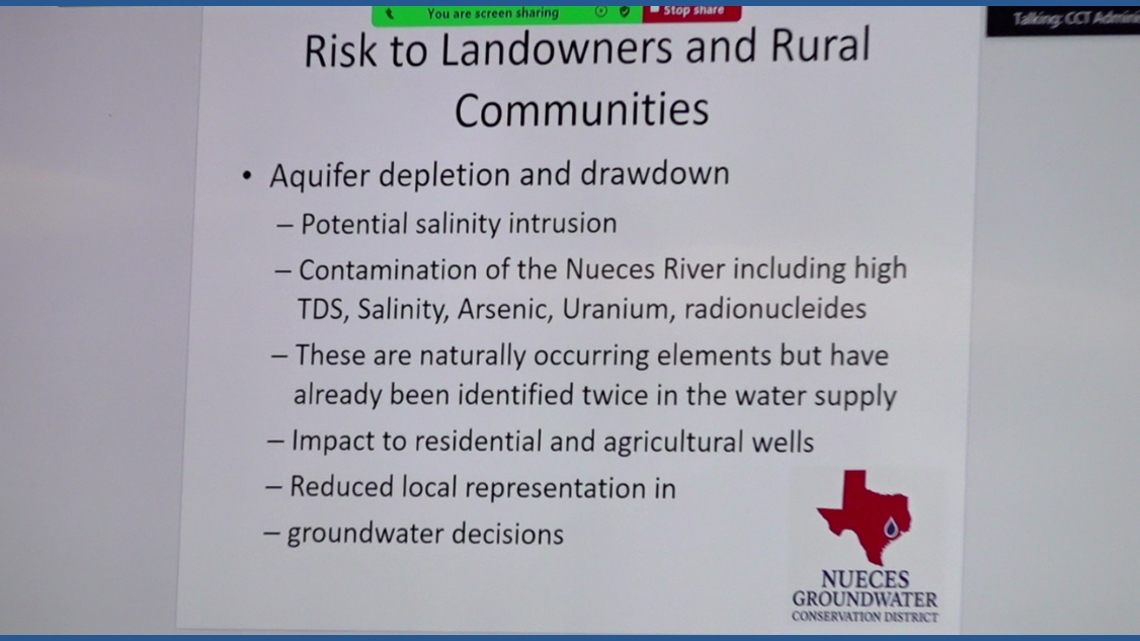
The committee highlighted alarming data, including wells dropping 15 feet in 6 months and potential contamination risks from arsenic, uranium, and salinity.
Trey Cranford, a leading NGCD advocate, said, “From the beginning, we’ve asked for a written mitigation plan because if you harm me, how do you make me whole again?” He stressed the importance of monitoring wells and science-based measurements to ensure sustainable water use.
Nueces County Commissioner Precinct 1 Mike Pulsey challenged claims that city pumping would not impact aquifers. “I spent 40 years in the industry studying reservoirs… I can tell you what they’re saying is absolutely not true,” he said, warning that relying on a single opinion could endanger the region’s water supply.
Residents also shared personal stories. Shannon Scarborough of Bishop, whose family operates cattle directly between proposed well sites, warned, “This will impact the cattle and the water that those cattle drink. It will impact the wells my children need for their property… we hope y’all can support us.”
Another farmer stressed the economic and community impact, saying, “This is not some sideshow gig… it will literally kill my business if our groundwater goes down.”
The NGCD representatives urged the court to support locally governed groundwater management, coordinate with the Texas Commission on Environmental Quality, and ensure rural landowners have a voice in decisions affecting aquifers, rivers, and private wells.
Barraza concluded, “We want to be their voice. We want to help them make sure that their wells will always be productive and have safe water.”