
Ed Roby, former executive director of the PVIL Coaches Association, is pictured Feb. 23, 2026 at UIL headquarters as he looks over a program from one of the group’s Hall of Honor ceremonies. Roby graduated from old Anderson High.
Rick Cantu/Photo by Rick Cantu
Ed Roby had a front-row seat to history as he watched the development of the Prairie View Interscholastic League from his own Austin backyard.

Roby has worn many hats during his 83 years. He was an all-district center for Austin L.C. Anderson High in 1959. He played for Texas Southern before embarking on a long career as a coach and administrator in the Austin area. He was head coach at Reagan (now Northeast) High from 1971-86. An Army vet who served in Vietnam, he’s best known for helping preserve the memories of 20th century Black athletes as the executive director of the PVIL Coaches Association.
Article continues below this ad
Edward Roby 60, Otis McCullough 65 attend Original LC Anderson High School Historical Exhibit Opening at Carver Museum on June 28
Austin 360
Although the PVIL merged with the University Interscholastic League — the state’s governing body for high school athletic, musical and athletic contests since 1910 — in 1967, the history of extracurricular activities for Texas’ African-American high schools stays alive through its association. Specifically, the PVILCA has an awards ceremony every year to induct worthy former athletes and coaches into its Hall of Honor.
“I’m proud of getting these people the recognition they never got,” Roby said in an hourlong interview with American-Statesman during Black History Month.
Austin sports legend and former professional football player John Harvey. Harvey died Thursday, May 30, 2024. He was 74. Harvey was the first Black football player that Texas football coach Darrell Royal signed to a football scholarship, but he did not qualify academically, so he went to Tyler Junior College where he earned All-America status before leaving for UT-Arlington for one season. After his college career ended, Harvey signed with the Canadian Football League’s Montreal Alouettes, coached by future Hall of Famer Marv Levy.
Provided by the Harvey Family
Roby’s eyes have always been focused on his former school. From 1881 to 1971, old Anderson was considered the premier school of Austin’s East Side. But in 1971 the school was ordered closed by a federal judge as part of desegregation and a new, integrated Anderson High was opened at its current site in northwest Austin. He is part of a generation that remembers when Texas athletics were segregated as well.
Article continues below this ad
‘Night Train’ and ‘Hollywood’ started in the PVIL
What a history old Anderson created during that 80-year span until its doors were shut for good.
There were football players such as Hall of Famer Dick “Night Train” Lane and Super Bowl champion Thomas “Hollywood” Henderson of the Dallas Cowboys. But there were also some lesser-known Yellow Jackets such as Julian Spence, Brady Keys, Bobby Micho, LeRoy Bookman, Charles Crenshaw and Charlie Bonner who established themselves in the old PVIL.
Article continues below this ad
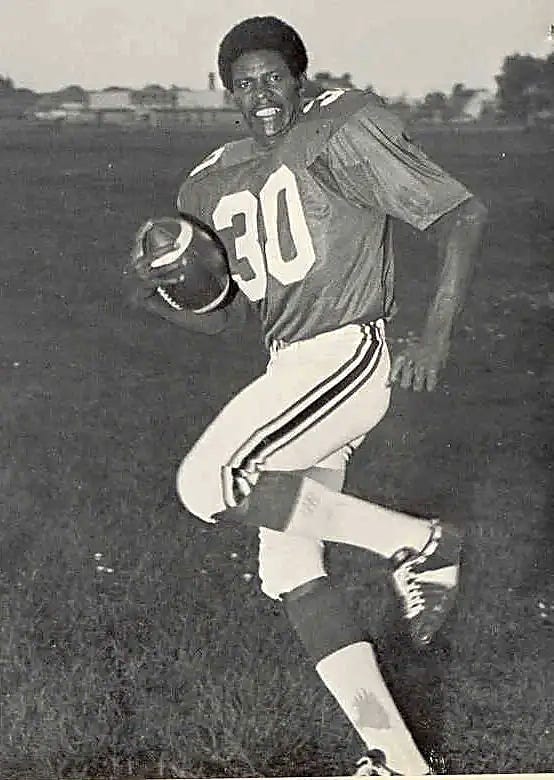
“The best athlete I’ve ever seen was a guy named John Harvey, who played basketball, football and ran track,” Roby said. “Anderson won the mile relay at the state track meet when they got into the UIL and he anchored it. He was a hell of an athlete.”
MORE: Central Texans strike gold at UIL state swimming and diving
MORE: No sibling rival for Ann Richards, LASA swimmers
Henderson echoed Roby’s sentiment about Harvey, who died in 2024 at age 74.
Article continues below this ad
“I want to talk about John Harvey the boy, not the man,” Henderson told the Statesman. “Look, I played with Tony Dorsett. I played against O.J. Simpson and Walter Payton. I had to cover Greg Pruitt, who was a handful, but I did it. John Harvey is the best athlete I’ve ever been around. Those other guys couldn’t touch him.”
LeRoy Bookman, a classmate of Charles Crenshaw’s at L.C. Anderson High, nominated Crenshaw for the Prairie View Interscholastic League Coaches Association’s Hall of Fame. Bookman, a former football standout at Anderson, was inducted into the hall of fame in 2012.
Austin American-Statesman
Harvey earned NJCAA All-America honors at Tyler Junior College in 1970 and spent one season at Texas-Arlington. He went on to play in the Canadian Football League and finished second in league MVP ballotting. He spent three years in the CFL and had brief stints in the World Football League and NFL before hanging up his cleats.
Harvey’s lack of a decorated NFL career does nothing to dampen the fire he lit as a high schooler at old Anderson, Roby said.
Article continues below this ad
“One thing about the Black community is that we messed up by putting people on a pedestal if you played pro football,” Roby said. “If you played pro football, that doesn’t mean you were successful in life. We don’t have that many people outside of Hollywood Henderson and Night Train Lane who made it in the pros. Most guys were successful by not playing in pro football. That’s not a yardstick for being successful around here.”
As for team success, few PVIL programs in Texas could match Anderson’s sustained excellence. The Yellow Jackets won state championships in 1942, 1957, 1957 and 1961. The best Anderson team was arguably the 1957 group that was led by two-way starting lineman Joe Wade, who would become a collegiate All-American at Texas Southern. He helped power Anderson to a 22-14 victory over Dallas’ Booker T. Washington in the PVIL’s Class 3A title game. That victory extended the team’s unbeaten streak to 24 games.
“During those early days, there were only two high schools,” Charles Akins, a 1950 Anderson graduate who played clarinet in the school’s band and the namesake for Austin’s Akins High School, told the Statesman in 2012. He was the first Black teacher to work at an AISD high school after desegregation. “We felt that if Austin High was going to be the best, Anderson was going to be the best on the other side of town. That was the quest academically and athletically.”
Dr. Charles Akins, seen here in March at L.C. Anderson High School, has devoted his life to education and understanding in Austin. As principal of the newly-opened Anderson High School 40 years ago, Akins “met the buses” in the morning and promoted a spirit of community in a tense era of mandated busing in the Austin Independent School District.
Austin American-Statesman
Life was different in Austin in the 1950s than it is today. Perhaps surprisingly, Roby said he wasn’t affected by racism during his formative years.
Article continues below this ad
“There weren’t any white people around,” he said. “I lived in East Austin. We had our own world, our own society. We had never heard of the UIL. All we knew was the PVIL.”
MORE: Miles Teodecki follows father’s footsteps to Penn
Great athletes were produced east of the highway
Roby recalls how old Anderson would sometimes play Austin High, the area’s top UIL team at the time, during the 1950s.
Article continues below this ad
“We weren’t allowed to play them in a real game, so we’d played on a field at the power station (now located at 800 W. Chavez) on Sundays,” he said. “We wanted to see who had the toughest kids in town. I didn’t play because I was too young. The biggest difference between now and then is that we had our own community. When I was growing up, Blacks made up 15 or 16% of the population. Today it’s about 5 or 6% (actually 7%). All the minorities lived east of I-35.”
Former Anderson Yellow Jacket running back Charlie Bonner, the father of Eastside Memorial football coach Darrell Crayton, pictured above, will be inducted into the Prairie View Interscholastic League Coaches Association Hall of Fame this weekend. “I think it’s a great honor, considering the great African-American athletes that have gone through Texas,” Crayton says. “I do feel that if he’s supposed to be all what they have said about him, he should have been in there a long time ago.”
Austin American-Statesman
Changes would come about when the PVIL started to merge with the UIL during the 1967-68 academic year. The PVIL disbanded in 1970.
While some might say that was a sign of progress, Roby equates it as to losing a dear friend. His roots were deeply planted in the PVIL and change was hard for him.
Article continues below this ad
“We lost our identity when we went into the UIL,” he said. “It was the UIL, not the PVIL any longer. We used to have our own state championships, our own one-act plays. In fact our old school won more state championships in band than we did in football. It was quite an era.”
Dick “Night Train” Lane, a former Anderson High School football player, shows off a photo in 1997 of his 1945 Yellow Jacket team that fell 12-2 in the PVIL Class 2A title game to Wichita Falls Washington. Lane, a member of the NFL’s Hall of Fame, earned seven first-team All-Pro awards and was selected as the top football player from Austin in the Statesman’s list of the 100 best players published in 2020.
Lynne Dobson for Statesman