
His message to newcomers and longtime residents alike is simple: “Get to know the people. Get to know the places. Get to know the culture.”
AUSTIN, Texas — Harrison Eppright has spent seven decades in Austin, and he wants everyone who calls the city home to understand its past.
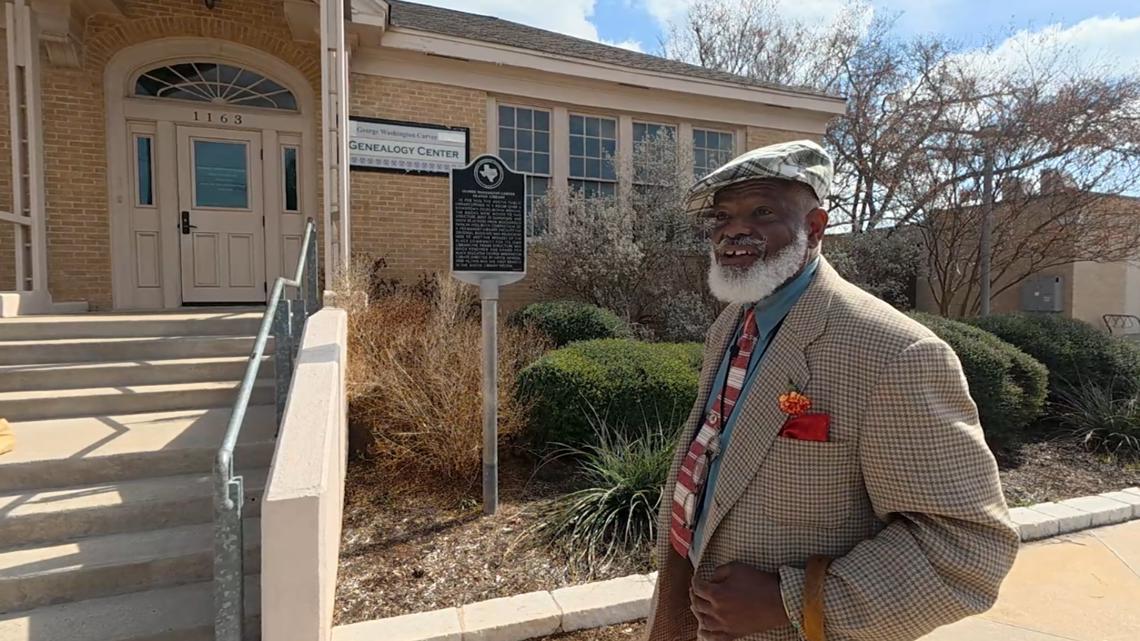
“Born and raised here in Austin, Texas, in East Austin,” said Eppright, 70, who serves as manager of visitor services and tour ambassador for Visit Austin.
His message to newcomers and longtime residents alike is simple: “Get to know the people. Get to know the places. Get to know the culture.”
With 33 years of local tour guiding behind him, Eppright is an authority on East Austin’s Six Square neighborhood – the city’s Black cultural district – and the stories embedded in its streets.
Six Square takes its name from the roughly 6 square miles designated as the “Negro District” in Austin’s 1928 city master plan, a proposal widely seen as an effort to formalize racial segregation. The district is bordered by Manor Road to the north, Airport Boulevard to the east, East Seventh Street to the south and East Avenue, now the Interstate 35 frontage road, to the west.
A library born from exclusion
Among the district’s most significant landmarks is a small building on Angelina Street with a layered history. Originally constructed in 1926 as the Austin Public Library in Downtown Austin, at West Ninth and Guadalupe streets, the building became obsolete when the city built a larger downtown library in 1933.
There was a catch, however. Black Austinites could not check books out of that new library.
Following a coordinated petition effort by Black residents, the city relocated the original building to East Austin, where it reopened in 1933 as the Colored Branch of the Austin Public Library. It would later become the George Washington Carver Branch: Austin’s first branch library serving the city’s Black population.
Emancipation in sculpture
Steps from the Carver Branch, behind the Carver Museum, stands the Emancipation Garden – a collection of statues that were originally proposed for display on the grounds of the Texas State Capitol. The sculptures depict the moment Texas slaves learned they had been freed.
Eppright described the scene the statues portray: an orator holding the Emancipation Proclamation gestures to a minister, who turns to tell a husband and wife, who in turn tells their daughter, arms raised, about freedom.
“Ideally she should turn to us, where we stand on this pedestal, any of us, and we receive the message of freedom,” Eppright said.
A congregation born in 1865
That message of freedom gave rise to Wesley United Methodist Church, Austin’s oldest Black congregation, founded in 1865 by formerly enslaved people following the Emancipation Proclamation.
Though the congregation formed that year, the church building now standing on San Bernard Street, which is listed on the National Register of Historic Places, was constructed in 1929 – one year after Austin’s master plan was approved by the city council. The Gothic-style building became a hub for prominent Black families in the community.
Education against the odds
Many of those families had ties to Samuel Huston College and Tillotson College – two historically Black institutions that had been operating since roughly 1880, predating the founding of the University of Texas. During slavery, teaching Black people to read or write was illegal, making the role of these schools especially significant after the Civil War.
“After the war, when these schools were established, they greatly played a major part in educating Blacks on how to read and write,” Eppright said.
The two colleges merged in 1952 to form Huston-Tillotson College, now a university whose entire campus is listed on the National Register of Historic Districts.
For Eppright, himself a living piece of Austin history, the lesson of Six Square extends beyond the past. Learning where Austin has been, he said, is the only way to truly appreciate where it is going.