
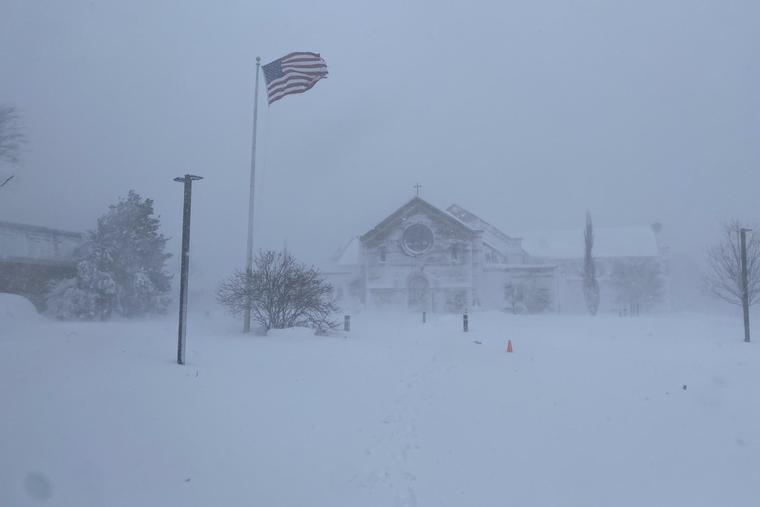
Whatever the weather or the circumstances, the understanding at Corpus Christi Parish in Sandwich, Massachusetts, is that if the priest can make the walk from the rectory to the church, Mass goes on, even in blizzard conditions.
The second thing I thought of when I saw the fallen pine tree covering both lanes of my usual escape route early Monday morning was: “That gap on the left looks wide enough.”
Sure, there was a snowbank there, maybe three feet high, between the (former) top of the tree and the woods to the side. But only 11 hours into the storm, it was probably all snow, and little or no ice. If I got a running go, my Jeep might be able to blast through it.
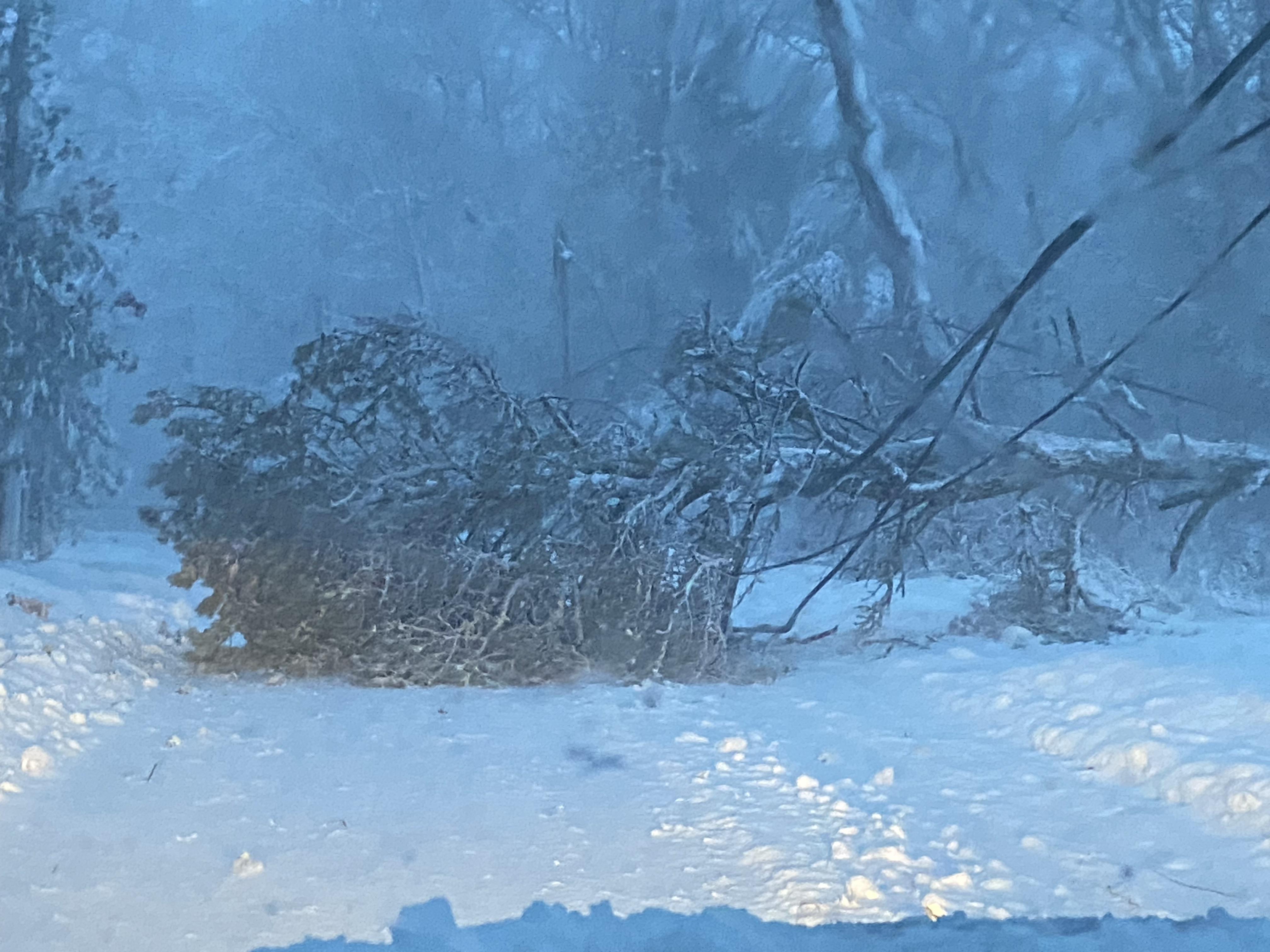 Downed pine tree en route to daily Mass(Photo: M.J. McDonald)
I gunned the motor and hit the snowbank hard. But I got hung up on the top of it, about halfway through. I thought I was stuck. With some forwards and backwards, though, I was eventually able to reverse violently back onto the road.
Then I thought: “Well, half the snowbank is gone. Maybe if I tried again …”
The storm — the big one that hit the Northeast this past weekend — brought about 20 inches of wet, heavy snow and wind gusts of 40 to 50 miles per hour to Cape Cod, where I live. We’re used to snow in this part of the country, but the intensity (four inches an hour in some places) and length of the storm were unusual. The wind and wet snow knocked down trees and power lines in many places. As of midday Wednesday, much of the Cape has no electricity (and thus, for many, no heat). Utility company says it may be days. (As I typed most of this while under blankets, the hum from the generator outside my neighbor’s unoccupied house across the street mocked me.)
Whatever the weather or the circumstances, though, the understanding at Corpus Christi Parish in Sandwich is that if the priest can make the walk from the rectory to the church, Mass goes on, including the 7 a.m. Mass on weekdays.
I gunned the motor again, hit the snowbank hard, and this time got through to the other side.
My elation deflated, though, when I saw that, on the other side of the tree, a telephone pole had snapped about 20 feet up, leaving power lines hanging low across the road.
I turned around and blasted through the snowbank again, this time from the other direction.
There are four possible routes out of the neighborhood I live in. My second option sent me through a lightly plowed winding, elevated and canopied roadway, with trees bent over with snow forming a sort of igloo ceiling over the road, with debris strewing the sides and the roadway.
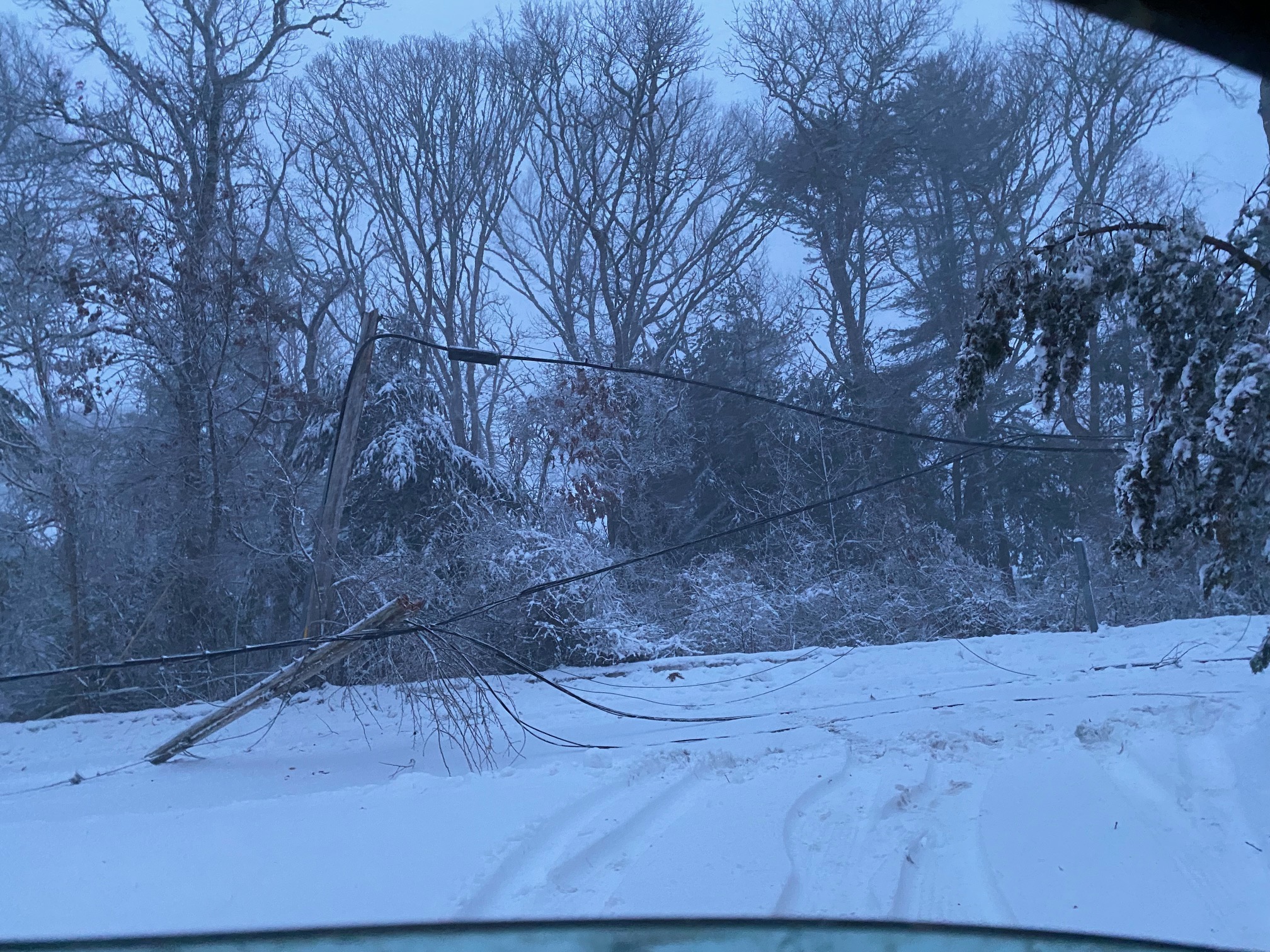 Downed power line, post-Northeast blizzard(Photo: M.J. McDonald)
One trick when driving in snow is to never stop unless necessary, to always keep momentum going forward. With that in mind, the rest of the 13-mile route was passable, though downed trees blocked half the road in two places. The snow made for slow progress, and in East Sandwich occasional crosswinds caused whiteout up the gradual ascent of what I affectionately call “Mount Corpus Christi.”
At the church parking lot, two guys were plowing. But no one had gotten to the walkway. So I slow-sprinted through snow up to my knees to the door, which a man in his 20s held for me. Rounding out the congregation of three was a middle-aged man.
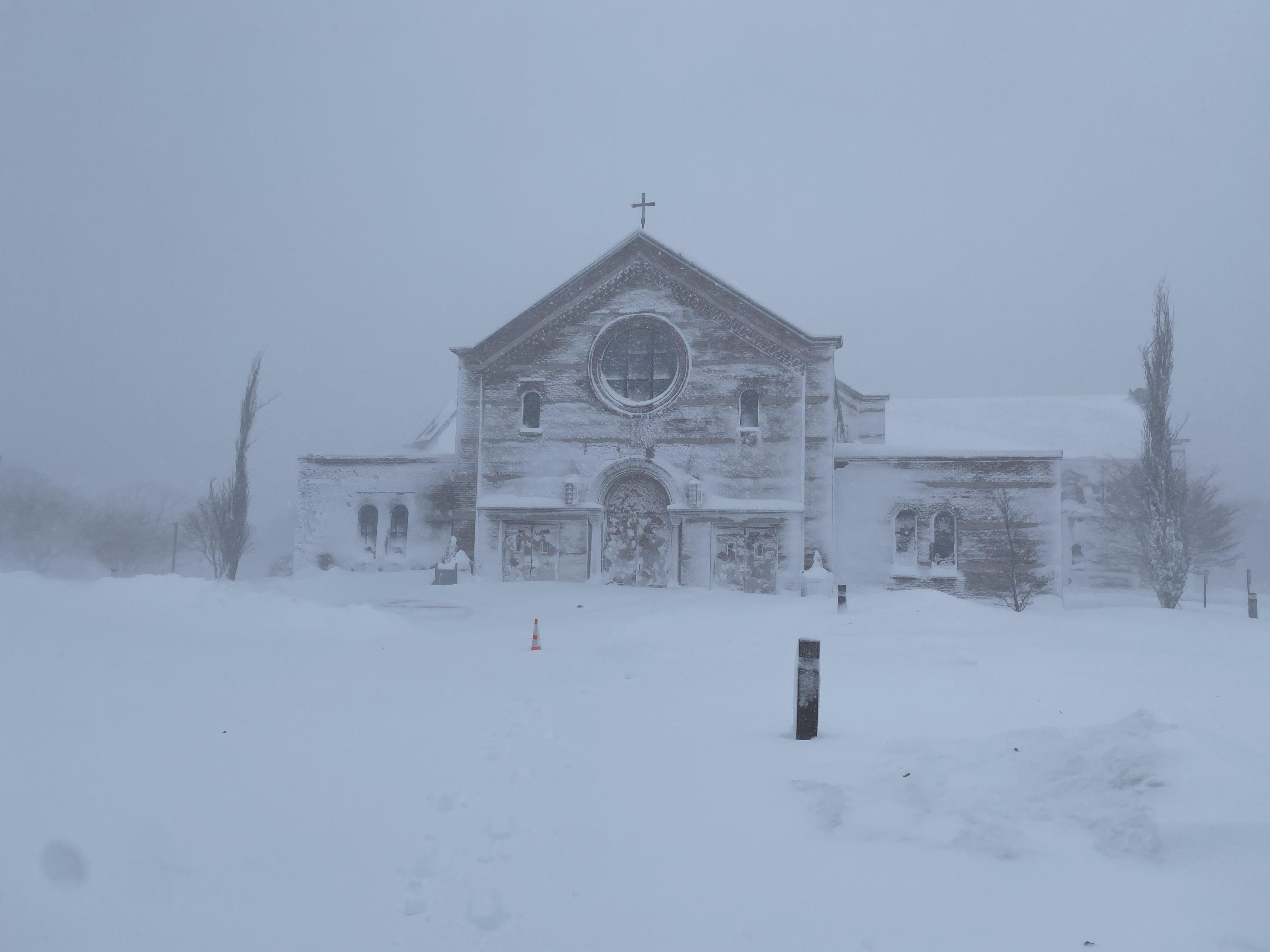 Snow-covered Corpus Christi Church in Sandwich, Feb. 23, 2026(Photo: M.J. McDonald)
‘We Are a Small Number Today’
About an hour away, Our Lady’s Chapel in downtown New Bedford, run by the friars of Our Lady, Queen of the Seraphic Order, is known for never closing. The friars live in the two-story former commercial building that houses the chapel, where they host round-the-clock adoration of the Eucharist.
On Tuesday, the regular 12:10 p.m. daily Mass went on as usual, despite there being no businesses or government buildings open and no cars parked on any of the ordinarily busy streets.
Metered spots were verboten because of the snow. So what to do?
A city employee driving by casually noted to me that a certain well-plowed, nearly empty and ordinarily off-limits parking lot was only a couple of blocks away, while emphasizing that he was not saying I could park there.
Gotcha. Thank you.
The plowed snow at the end of the road outside the entrance to the street-level chapel ranged from six feet to 10 feet high. But the sidewalk was clear, and a blue flag with white letters announced that the chapel was open.
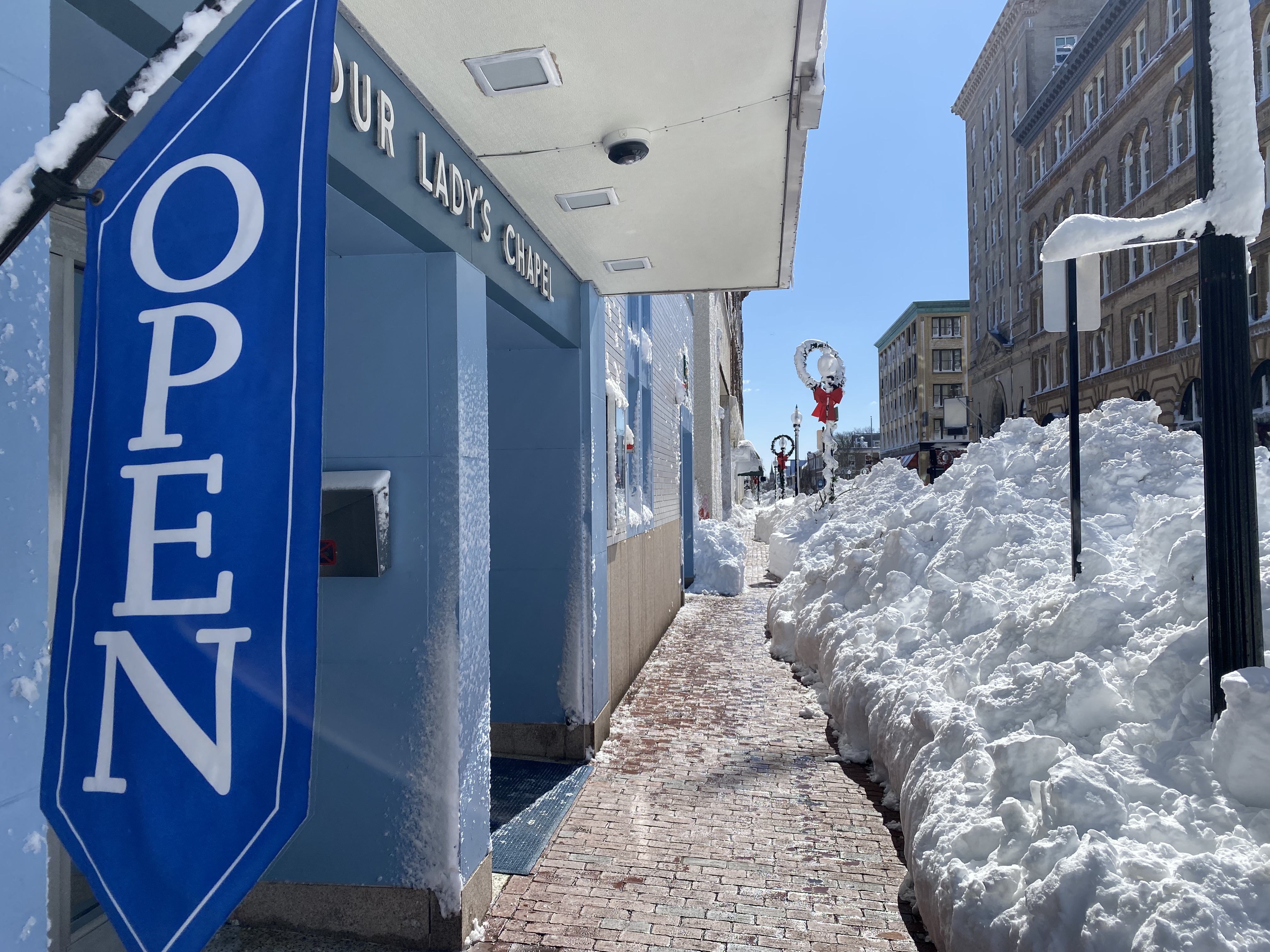 ‘Open’ sign hangs outside of Our Lady’s Chapel in New Bedford, Massachusetts, at midday on Feb. 24, 2026.(Photo: M.J. McDonald)
Mass began with an a cappella opening hymn — Jesus, Remember Me — with a congregation of three (an older man, an older woman and me). Two other people, a younger woman and a middle-aged man, came in about halfway through.
“We are a small number today. But it means that God has chosen us,” the priest said at the beginning of his sermon.
He also pointed out the appropriateness of the first reading from Isaiah, which includes: “Thus says the Lord, just as from the heavens the rain and snow come down, and they do not return until they have watered the earth, making them fertile and fruitful, so shall my word that comes forth from my mouth.”
Things I’m Grateful For
We got power and heat back early Wednesday morning, after less than 48 hours without. This temporary situation of living without things I am used to having reminds me of several other things I’m grateful for. They include:
the guys who plow the roads, who make it possible to get from Point A to Point B even during and after giant snowstorms; the linemen and tree trimmers who restore utilities after bad weather; four-wheel drive, which is one of the wonders of the age; natural gas stoves, which allow simple cooking and provide some warmth even when power lines are down; the priests who keep church open in bad weather; the kindness of strangers, including a half-dozen guys who stopped to help shovel out and push a car that had gotten stuck in the snow on Coggeshall Street in New Bedford late Tuesday morning; the sun, which came out Tuesday, and which, even though it is still below freezing, kept us much warmer than we otherwise would have been; and the end of the ordeal — unlike so many people who survive natural disasters in other parts of the world, I was confident that help was coming.