



Photo illustration by Haley Walton
Wendy recently dreamed that her work visa renewal had been denied.
As she recalled it, Wendy — who requested a pseudonym for fear of retaliation — laughed, joking at first, until the emotion caught up and her voice broke.
“It actually affects my mentality a lot,” she said. “Without getting a legal immigration status in the U.S., the only thing you can do is go back.”
Wendy, an assistant professor who has taught at UTA for three years, said she felt neither excitement nor surprise when she first received H-1B sponsorship. To her, employer sponsorship is expected for qualified workers and is not a competition with U.S. domestic employees.
But federal and state lawmakers don’t see it that way as they increasingly scrutinize the program. As a result, faculty like Wendy on work visas now live with constant anxiety that their renewal process could become more complicated.
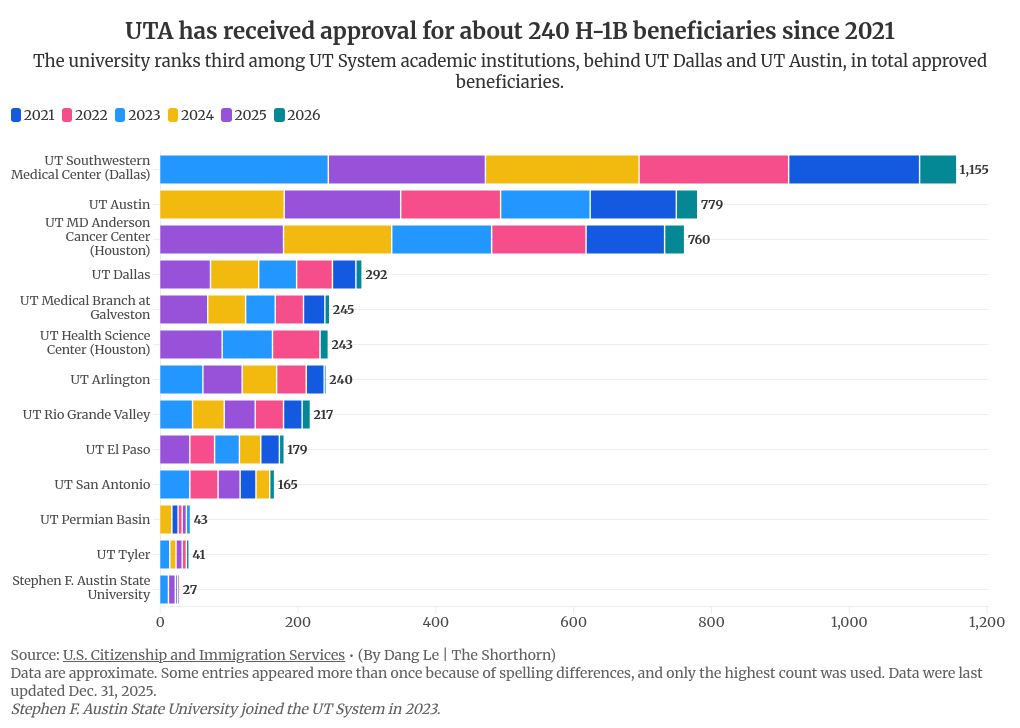
Since 2021, UTA has received approval for 240 H-1B beneficiaries, ranking third among UT System academic institutions behind UT Dallas and UT Austin, according to federal data.
In January, Texas Gov. Greg Abbott issued a letter blocking public universities and state agencies from processing new H-1B work visa petitions through May 31, 2027. He wrote that the program is “used to fill jobs that otherwise could — and should — have been filled by Texans” and employers have “fired American workers and replaced them with H-1B employees, often at lower wages.”
The letter did not specify what would happen to current H-1B workers seeking renewal, leaving universities and faculty uncertain. Once approved, an H-1B visa is valid for up to three years and can be extended once, for a total of six.
“This kind of issue has impacted my research, my teaching a lot because I kept thinking about this matter during work, research and all that,” Wendy said.
What Americans think about legal immigration
About 6 in 10 of U.S. adults say legal immigrants contribute to economic growth, and half of the public believe American companies benefit from the expertise of skilled workers in fields like science and technology, according to a September 2025 AP-NORC survey.
Additionally, about 42% of people taking the survey say that it’s a major benefit that legal immigrants fill jobs that U.S. citizens don’t want.
Wendy said her opportunity at UTA came after she had proven herself. An international student from China, she completed her bachelor’s through doctoral degrees at three American universities within 10 years. Her work focusing on human behavior and how it plays out online sets her apart in her field, she said.
Since joining UTA, she has published about four to six academic papers annually and secured federal funding for her department while teaching two to three classes each semester.
Beyond her credentials, Wendy is confident in what she brings to her work.
“I’m fluent in English, so nothing has stopped me except my status,” she said. “I have no issue communicating with my students. Why bother firing me to get local people but do not have my perspective and my skill set?”
The role of H-1B
The H-1B visa program allows U.S. employers to temporarily hire foreign workers in specialized occupations.
As part of the application, employers must submit a certified application attesting that sponsored employees are paid at least as much as U.S. workers with similar experience in the same area.
“
I’m fluent in English, so nothing has stopped me except my status. I have no issue communicating with my students. Why bother firing me to get local people but do not have my perspective and my skill set?
Wendy, an assistant professor who has taught at UTA for three years
”
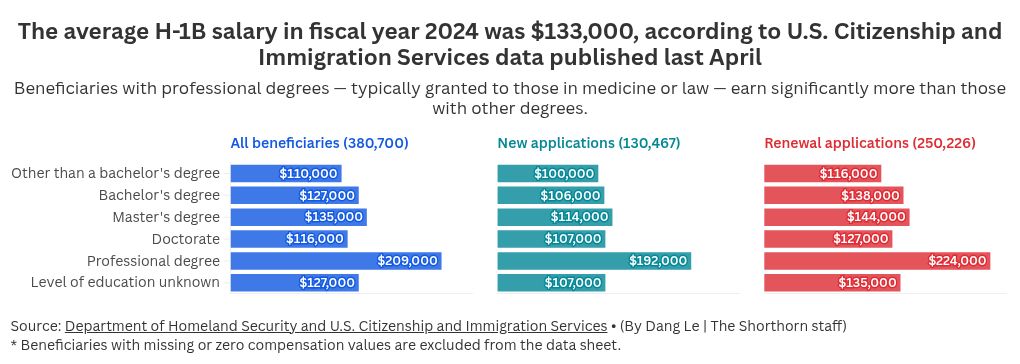
The average H-1B salary in fiscal year 2024 was $133,000, according to U.S. Citizenship and Immigration Services data published last April.
“When we are hired, employers already consider very rigorously about if the international people is better than the local U.S. candidates,” said Roy, an assistant professor whose research focuses on health research. “The standard is already higher for the international candidate.”
Roy, who requested a pseudonym for fear of retaliation, said they chose to study in the U.S. for its research resources and global reputation. Since joining UTA, they have received millions of dollars in federal research funding and have peer-reviewed work for dozens of international journals.
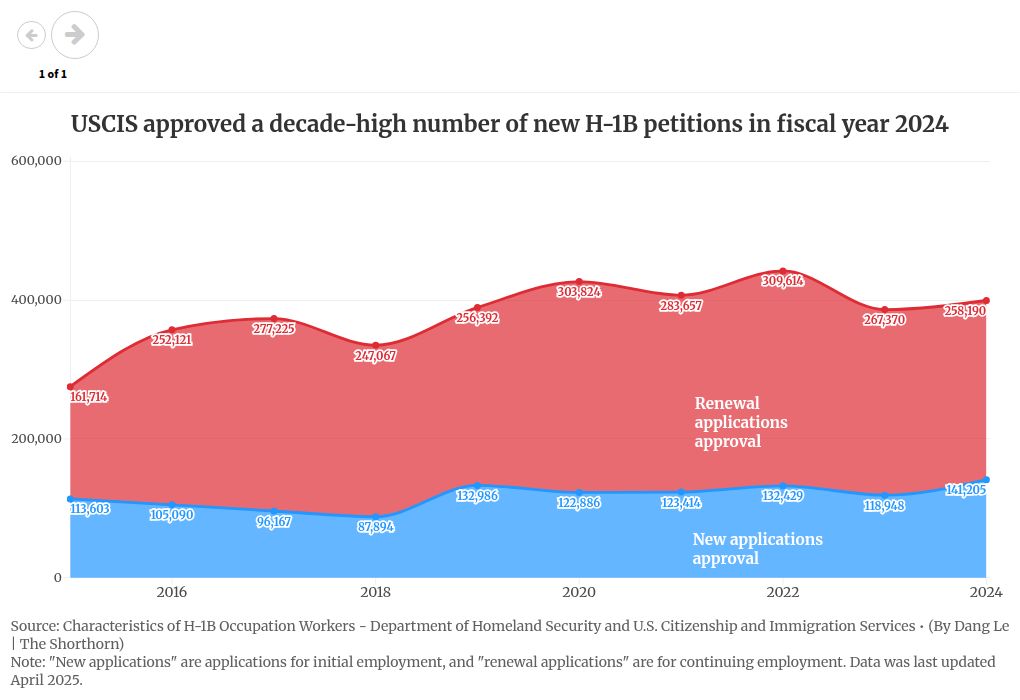
About 40,600 faculty members nationwide hold H-1B visas, according to estimates from the College and University Professional Association for Human Resources.
“The reason that we have relied so heavily on researchers, faculty, students with H-1B visas is because we haven’t produced the talent in the United States,” said Lynn Pasquerella, president of the American Association of Colleges and Universities. “There are not qualified Ph.D.s in the U.S. to do much of this work.”
Pasquerella said H-1B faculty are considered stronger in developing research, securing grants and training students who stay in local communities — efforts that help universities generate revenue and rely less on state funding.
“The policy that Gov. Abbott is putting in place actually ends up shrinking the economy and raising long-term costs,” Pasquerella said. “It also weakens global competitiveness.”
Gov. Greg Abbott addresses the media during a press conference at city hall June 2, 2020, in Dallas. In January 2026, Texas Gov. Greg Abbott issued a letter blocking public universities and state agencies from processing new H-1B visa petitions through May 31, 2027.
File photo / Elias Valverde II
University immigration lawyers told Wendy her renewal should not be affected, she said. Still, she filed paperwork early and spent hours coordinating documents with the lawyer.
“It’s just taking so much of my time,” she said. “Like 70% of my time recently.”
The UTA executive orders task force wrote in a Feb. 16 email to faculty and staff that the university is reviewing Abbott’s directive while seeking clarification. Officials remain hopeful it won’t affect current H-1B employees.
“We anticipate being able to provide a more comprehensive update in March,” the email reads.
The national scene
Last year, Florida Gov. Ron DeSantis called for limits on work visas at the state’s public universities. The Florida Board of Governors — whose members were mostly appointed by DeSantis — took public comments on a proposal that would block new H-1B hires through Jan. 5, 2027.
In September, the Trump administration imposed a $100,000 fee on new H-1B petitions to bring foreign workers to the U.S., arguing that the program suppresses wages and disadvantages American workers.
Rep. Brian Harrison, R-Waxahachie, said Texas state institutions combined are a “potentially top 10 abuser” of the H-1B program. Following Abbott’s directive, he said the order does not affect current visa holders.
“Given that it’s just a freeze and there’s no revocations, nobody’s being terminated, nobody’s being laid off. It’s not a hiring freeze. This won’t change anything,” Harrison said in an interview with NewsNation posted on his X account.
Change, however, is necessary, he said.
While the Texas Legislature is not scheduled to return until 2027, Harrison said he wants lawmakers to conduct “immediate, emergency, interim oversight hearings” on the H-1B program this year.
“If the universities need this, the job of the university is to train the workforce of tomorrow,” he said. “There should be no entity more capable of training the future employees that they themselves need than our great public universities.”
The answer is more complicated for Pasquerella, as she pointed to long-standing challenges in the K-12 system and a lack of interest in pursuing fields like engineering and medicine.
Pasquerella, a former college president who held multiple leadership positions at universities, said she understands why some supporters of Abbott and Trump feel shut out by higher education, but restricting the H-1B program does not solve those problems.
“We can no longer claim that we are at the top of the world in terms of test performance, and so we have to reckon with that and tell the truth,” she said.
Roy said they initially weren’t worried about a second Trump administration. Senior family members, some of whom support the president, reassured them that they wouldn’t be targeted because they’re a “legal immigrant.”
That confidence has faded. Between last year’s student visa revocation, heightened rhetoric around H-1B and proposals to limit the Optional Practical Training program, which allows international students to work after graduation, their concern has grown.
“I felt it’s targeted at those who are going through the legal process of immigration and did not do anything wrong,” they said.
The worries
In his letter, Abbott also ordered state agencies and public universities to submit detailed H-1B visa reports to the Texas Workforce Commission by March 27.
“
We can no longer claim that we are at the top of the world in terms of test performance, and so we have to reckon with that and tell the truth.
Lynn Pasquerella, president of the American Association of Colleges and Universities
”
The reports must include the number of new and renewed H-1B petitions filed in 2025, the number of H-1B visa holders currently sponsored, their job titles, countries of origin and visa expiration dates, along with evidence that institutions attempted to recruit Texans for those roles.
“State government must lead by example and ensure that employment opportunities — particularly those funded with taxpayer dollars — are filled by Texans first,” Abbott wrote in his letter.
The UT System and its 13 institutions have submitted visa information to the governor’s office, according to a statement to The Shorthorn.
Pasquerella said policies in Florida and Texas may create long-term problems for Republican-leaning states trying to recruit international scholars and researchers.
The policies reinforce a false narrative that diversity undermines academic excellence, she said, when it actually strengthens research and scholarship. A message emerges: International researchers aren’t welcome.
“You contribute to the society and now you are being suspected, and that you’re not welcome, and your work is not appreciated,” Roy said.
The H-1B scrutiny adds to the hurdles international students and faculty are facing. Already, universities nationwide are experiencing international enrollment decline, shrinking tuition revenue that helps fund research and instruction.
UTA’s international student enrollment dropped 20% in fall 2025, causing a 26% decrease in net tuition tied to that group.
Experts say English-speaking countries such as the United Kingdom and Canada, along with emerging destinations like China and other European nations, are becoming more viable destinations for international students.
“
You contribute to the society and now you are being suspected, and that you’re not welcome, and your work is not appreciated.
Roy, an assistant professor whose research focuses on health research
”
Roy said the rhetoric around H-1B visas has left them and other international faculty members feeling unwelcome in the U.S. despite supplying its research power.
They likened it to the Trump administration canceling or suspending major sources of research funding in higher education. In 2025, the Trump administration disrupted nearly $30 billion in grants.
“Federal research funding cuts just limit our ability to do research, but the H-1B restrictions affect our sense of security, belonging and motivation to sustain long-term research efforts,” Roy said.
The scene back home
These days, Wendy’s calls with her parents often lead to arguments.
Her mother has been calling after seeing reports about increased scrutiny of the H-1B program and wanting her to return home if her visa renewal fails. Wendy said she tried explaining that nothing is final and the university hasn’t told faculty to leave.
“I just feel bad because, of course, they are thinking on behalf of me,” she said. “They don’t want me to feel abandoned by her country or abandoned by their families.”
She didn’t come to the U.S. to pursue the American dream, Wendy said, but for better academic opportunities — and stronger scholarships than Canada, her other option.
But the dream came to her. She is married. Her husband is in the middle of his green card process. The couple recently bought a house. Wendy is working toward tenure.
“I don’t want to start from beginning again,” she said.
@DangHLe