
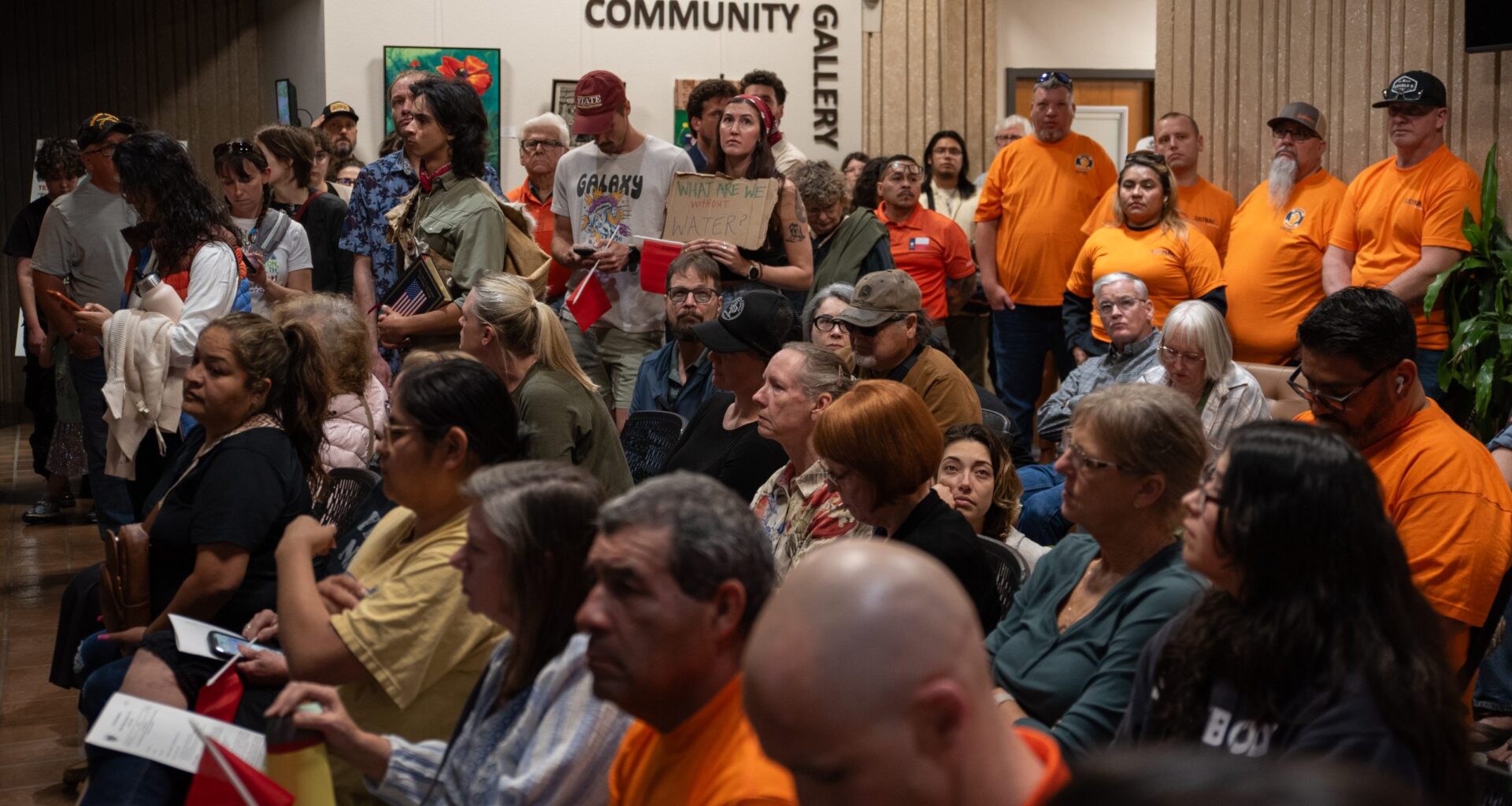
Cheers and sobs filled San Marcos City Hall early Wednesday as City Council voted 5-2 to deny a proposal for a nearly 200-acre data center campus on Francis Harris Lane.
The project was pitched as a roughly $1.5 billion complex with five buildings, each designed for about 76 megawatts near the Hays Energy Power Station and local farms – partially inside city limits at 904 Francis Harris Ln.
Council was not voting on a construction permit. The question was whether to approve the land use changes that would allow a project like this to move forward, including annexation and rezoning tied to the site request.
San Marcos, for now, drew a line.
Central Texas Is Becoming a Data Center Corridor
If the San Marcos vote feels like it belongs in a bigger story, it’s because it does. Data centers are popping up across Texas, but Central Texas is emerging as an even more concentrated hub. Developers keep picking the region for the same reasons they pick the state: relatively low energy costs, access to the power grid and a business climate designed to draw investment.
A Texas A&M Real Estate Research Center analysis shows how quickly this shifted from “a few projects” to “a market.” Between 2023 and 2024, it found Central Texas, specifically in the Austin and San Antonio areas, experienced a drastic increase in data center construction, totaling 463.5 megawatts (1 megawatt powers between 400 and 900 homes) of potential demand under development. The report points to marquee projects in Williamson County and Cedar Creek, stating that the boom has reshaped land markets by driving demand for sites with reliable power and fiber.
The scale shows up in basic counts, too. Texas has 408 data centers listed statewide, second most in the country, with the Austin market currently at 46.
Once these projects hit a city council agenda, the debate is usually the same: water, power, and whether residents have any leverage before a campus becomes a done deal.
For organizers watching the region, that leverage often comes down to zoning. “The biggest thing that I think that we were able to do with the San Marcos one was identify the one point where communities still have an ability to say ‘No,’ and that was zoning,” said Bobby Levinski of the Data Center Action Coalition.
In a Dec. 23 memo, Austin City Manager T.C. Broadnax and city staff wrote that “AI is challenging the definition of high growth” for Central Texas utilities. He has warned that AI-related demand is already creating an issue in planning for utilities.
Revived Data Center Fails in San Marcos
The proposal San Marcos rejected was a revived plan for a roughly 200-acre data center by Fort Worth-based Highlander SM One. The project stalled last summer, then returned to the city’s agenda this winter after the San Marcos Planning and Zoning Commission approved recommendations to annex and rezone the project on a 6-2 vote.
“The people do not want this,” said San Marcos River Foundation’s Executive Director Virginia Parker, who spoke during public comment. “But from a river’s perspective, we are out of water … ERCOT will be tasked to grow the grid for things like this and not for the residents.”
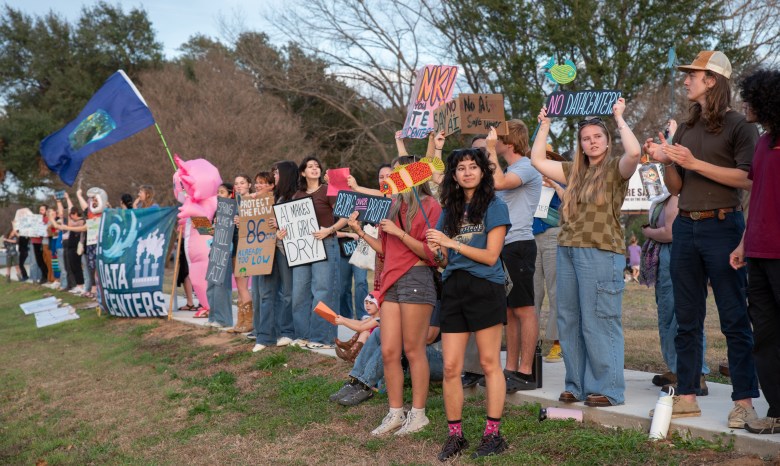 San Marcos residents stand outside City Hall to protest the proposal of a new data center on Feb. 17 Credit: Lauren Tourish
Her warning landed in a drought-strained Hays County, where water is the county’s defining pressure point. Hays County Judge Ruben Becerra has pushed for a temporary pause on new permits for high-water-use industrial projects and urged the strictest Stage 4 drought restrictions as aquifer levels drop to historic lows. ERCOT has also said Texas energy demand will be up 71% by 2031, partly due to data centers.
Supporters, including labor representatives, urged Council members to see the campus as new revenue and construction jobs. One speaker called it a chance to create “good-quality jobs.”
But even with the 5-2 denial, residents’ anxiety is not limited to one project. Along Francis Harris Lane, this proposal is part of a broader push to make the area workable for large-scale development. And under the city’s process, Highlander can bring the proposition back in six months.
Round Rock Approves Another Data Center
A similar debate played out Feb. 12 in Round Rock – this time with a different outcome. After hours of public pushback, City Council unanimously approved Skybox Datacenters’ request to rezone about 30 acres off East Old Settlers Boulevard for a single 75-megawatt building capped at about 250,000 square feet.
Taking water supply into consideration, the company said annual use would not exceed about 300,000 to 400,000 gallons annually, mostly tied to administrative needs and landscaping, which is about 2.7 to 3.7 households’ yearly at-home water use.
At the Feb. 12 Council meeting, Skybox Chief Development Officer Haynes Strader pitched Central Texas as a growth market – one that can bring investment and jobs. “Skybox believes very strongly that Central Texas, and Texas as a region, is incredibly important to the overall data center market,” he said.
The Round Rock facility will be one of three Skybox data centers in the area, alongside a 141,000-square-foot, 30-megawatt building in Pflugerville and a 1.28-million-square-foot, 600-megawatt campus in Hutto.
Opponents questioned whether the pitch matches the trade-offs. “Not all business ventures are business opportunities,” said Denisce Palacios, the Texas state lead for Climate Cabinet. “Without water, nothing else works: not growth, not jobs, not agriculture, not security, and certainly not data centers.”
With 17.9 million Texans in areas experiencing drought, the next wave of data center proposals around Austin comes as water availability becomes a central question for cities weighing new development.
“We’re stronger together,” Levinski said. “It’s going to take every community from Austin to San Antonio to really respond together to stop this.”
This article appears in February 27 • 2026.
A note to readers: Bold and uncensored, The Austin Chronicle has been Austin’s independent news source for over 40 years, expressing the community’s political and environmental concerns and supporting its active cultural scene. Now more than ever, we need your support to continue supplying Austin with independent, free press. If real news is important to you, please consider making a donation of $5, $10 or whatever you can afford, to help keep our journalism on stands.