
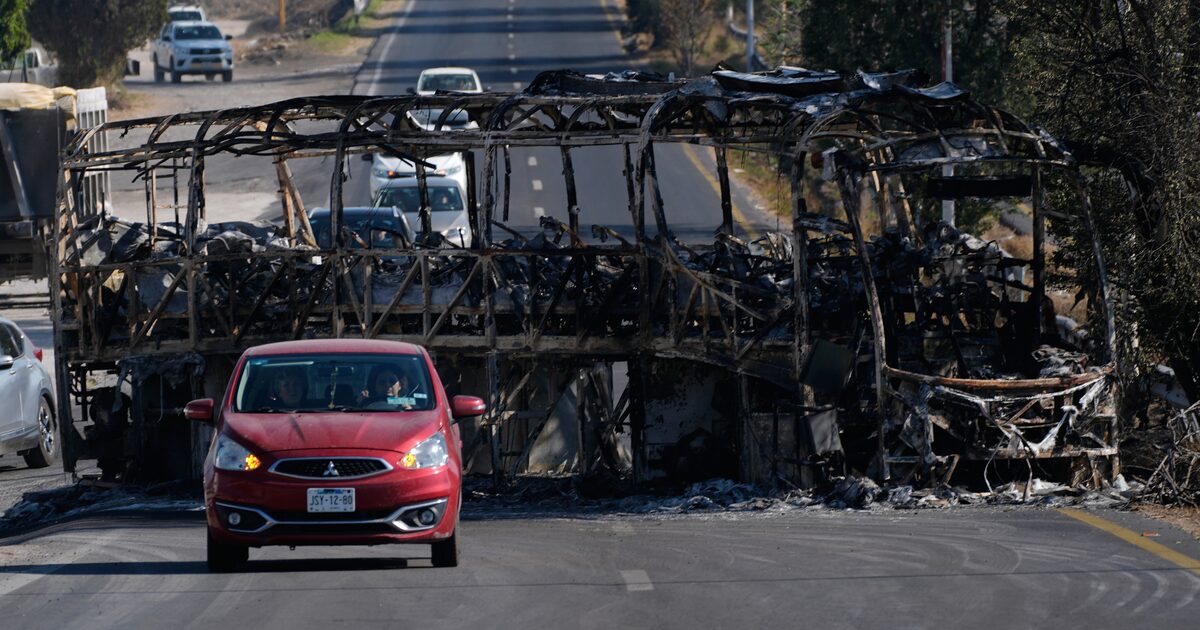
Mexico’s security forces did what presidents in Mexico and the United States have demanded for years. They found Nemesio Rubén Oseguera Cervantes, “El Mencho,” the leader of the Jalisco New Generation Cartel (CJNG), and they killed him in an operation in Jalisco on Sunday. The raid delivered a symbolic victory against one of the hemisphere’s most feared criminal bosses. It also triggered the predictable, ugly sequel: coordinated cartel violence, burned vehicles, blocked highways and a spike in fear that spread well beyond Jalisco.
For the Dallas region and for Texas border communities, this story is not just a “Mexico problem.” CJNG’s business model depends on U.S. demand, U.S. dollars and U.S. supply chains. When a kingpin falls, trafficking routes, debt collection and local alliances often shift fast. That is when violence and coercion can travel north. Not as cartel convoys but as higher fentanyl volumes moving through familiar corridors, more pressure on migrant smuggling networks and more competition among U.S.-based distribution cells that already operate in major metropolitan areas.
Here is what the public record shows about the operation. Mexican forces tracked Oseguera to a rural hideout and hit it with a concentrated raid. The team met heavy resistance. Oseguera suffered critical wounds and died during transport. Authorities also reported follow-on actions against CJNG figures and assets.
Public casualty figures suggest significant losses among security forces and civilians, along with a wave of retaliatory blockades and attacks across multiple states. CJNG demonstrated that it can still coordinate violence across a wide geographic footprint even after losing its top leader. That reality should shape what U.S. and Mexican officials do next. The cartel’s immediate goal is to project strength, reassure internal factions and deter rivals and the state.
Opinion
Credible accounts indicate that Mexico carried out the raid and that U.S. agencies provided intelligence support for the broader hunt. A U.S. military-led interagency task force reportedly supported intelligence collection and coordination. That signals a shift in the cooperation tactics, away from episodic information sharing and toward a more target-driven model that resembles counterterrorism practices.
In January 2025, President Donald Trump issued an executive order that set a pathway for designating major cartels as Foreign Terrorist Organizations or Specially Designated Global Terrorists. That framework pushes the U.S. government to treat cartel targeting as a national security mission, with wider legal tools and sharper political incentives. The “Trump Corollary,” as it has taken shape in practice, uses leverage first, demands visible results and treats cooperation as conditional. That approach can produce quick operational wins. It can also strain the foundation of trust that enables sustained cooperation.
Mexican President Claudia Sheinbaum now has to manage that tension. She has to show that Mexico can deliver results without ceding sovereignty. She also has to prevent a surge in violence from turning into a broader crisis of governability in western and central Mexico. Analysts close to Mexico’s security debate have argued that U.S. pressure has intensified and that Mexican leaders have moved to maintain structured, predictable cooperation, partly to reduce the risk of unilateral U.S. action.
In U.S.-Mexico relations, the death of El Mencho will test whether both governments can maintain close cooperation while preventing domestic politics from undermining it. Trump has already framed the moment as proof that Mexico must “step up.” Mexico will respond with its own nonnegotiable demand to reduce U.S. gun trafficking and choke off cartel finances in the United States. The main U.S.-Mexico security framework already treats the problem as shared, with responsibilities on both sides that include firearms, money laundering and demand reduction.
Evidence from Mexico’s drug war indicates that high-level takedowns and major enforcement shocks often produce short-term fragmentation and localized violence as criminal groups fight over routes, markets and protection rackets. Communities caught in contested corridors tend to pay the price first. That pattern fits what Mexico has lived through repeatedly since the mid-2000s, and it provides a sober warning about what may come next in CJNG strongholds.
So, what should policymakers do next, especially with Texas in mind?
First, treat the aftermath as the critical moment. Succession battles, splinter groups and franchise crews often turn to extortion, kidnapping and predation as they seek quick cash and local control. Texas law enforcement and federal agencies should plan for volatility in trafficking patterns and spillover intimidation inside U.S. distribution markets, not only at ports of entry.
Second, build the bilateral agenda around guns, money and courts. Official U.S. oversight work has repeatedly flagged the importance of weapons flows into Mexico and the need to measure progress beyond short-term operational outputs. Texas sits near major trafficking corridors and hosts large legal firearms markets. Any serious strategy that claims “shared responsibility” has to address that reality with targeted enforcement, better tracing and stronger penalties for straw purchasing and trafficking networks. Mexico, for its part, needs investigative capacity, witness protection and prosecutions that withstand political pressure.
Third, keep cooperation tied to transparent rules. Intelligence sharing can save lives when it helps target violent actors. When one side appears to be quietly making decisions, it becomes politically untenable. Sheinbaum will protect her domestic legitimacy. Trump will continue to maximize leverage. A durable partnership needs clear lines, clear accountability and public-facing goals that both governments can defend.
Finally, connect cartel policy to the realities of migration. CJNG and its rivals profit from migrant smuggling and prey on immigrants. Post-operation insecurity can push families to flee and empower smuggling networks. If Washington wants fewer chaotic border crossings, it has to treat cartel fragmentation and local violence as drivers of displacement.
El Mencho’s death is a major victory, but it does not eliminate the underlying threats. The question now is whether the United States and Mexico will use this moment to focus their strategy against what actually sustains cartels, or whether they will repeat a familiar cycle of headline victories followed by rapid criminal adaptation.
Orlando J. Pérez is a professor of political science at the University of North Texas at Dallas. Opinions reflect those of the author and not those of the university or its leadership.
We welcome your thoughts in a letter to the editor. See the guidelines and submit your letter here.
If you have problems with the form, you can submit via email at letters@dallasnews.com