
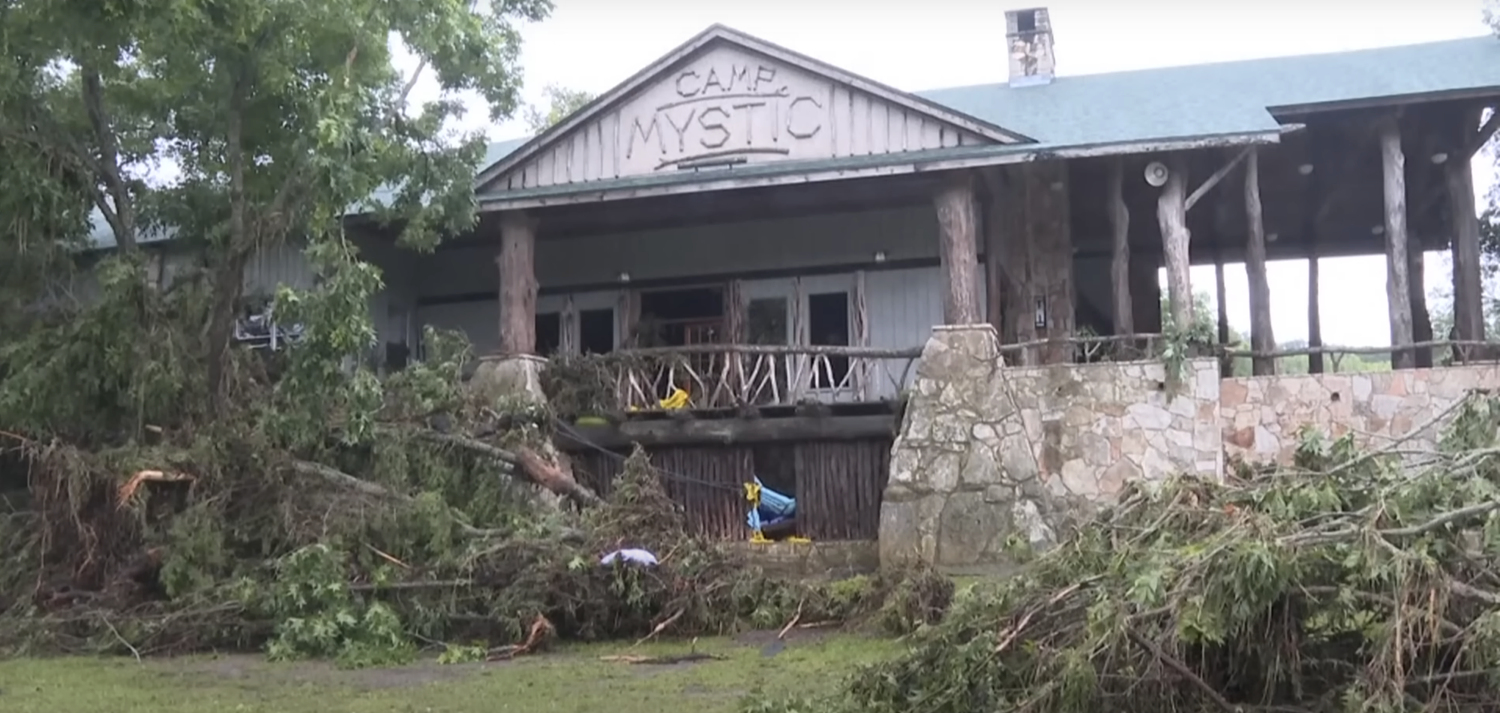
The repercussions continue from the terrible tragedy at Camp Mystic where 27 campers and counselors died in a flood along the Guadalupe River in Kerrville, Texas, last July.
Nine of the families who tragically lost their children are now suing state officials who led the Texas Department of State Health Services (DSHS) for licensing Camp Mystic despite its emergency instructions that campers stay in their cabins in case of a flood.
The lawsuit claims that the “stay put” instructions were not an evacuation plan as required by Texas law. The families allege that in addition to the camp’s responsibility, “state officials who helped create this inexcusable risk to life by directing and executing a policy of non-compliance with Texas law” are responsible for their children’s deaths.
Texas law required that youth camps comply with minimum safety standards and emergency planning, including having a plan for evacuating each occupied building, that the plan be posted in each building, and that camp employees be trained on it.
According to the lawsuit, DSHS officials admitted that “their established policy is not to confirm that an evacuation plan exists.” In fact, the lawsuit claims, “DSHS officials decided years ago to license a camp so long as it has any sort of ‘emergency plan,’ whether or not it calls for evacuation.”
The families claim this policy is exactly what was followed at Camp Mystic, where officials checked to see if there was an emergency plan, but not whether it included an evacuation plan.
By failing to verify an evacuation plan, the state officials “created a serious and known risk of injury or death to all girls at Camp Mystic, which inevitably resulted in an irreparable loss of young lives.”
Their federal lawsuit includes claims brought under the civil rights statute, 42 U.S.C. §1983, for violating substantive due process by creating a danger and depriving the victims of their right to bodily integrity, and for wrongful death.
Other states, in addition to Texas, are considering enacting state camp safety laws. Last year, Texas passed laws to increase campground safety requirements such as requiring rooftop access ladders and setting back cabins away from flood prone areas.
Alabama is considering a similar law in honor of Sarah Marsh, a Camp Mystic victim whose family lives in Mountain Brook, Alabama.
House Bill 381, authored by Rep. David Faulkner and supported by Alabama Gov. Kay Ivey, would create an emergency preparedness licensing plan for camps in the state.
The license requires the camp to show the following:
— A NOAA Weather Radio
— A protocol to alert camp staff about an emergency, without relying on cellular service
— An audible alarm system, not depending on the internet
— Designated sheltering places for campers and staff
— An emergency plan that contains evacuation procedures
— Safety orientation at the beginning of each camp session
— Background checks for all camp staff
Alabama does not currently have an emergency preparedness requirement for camps, according to the bill’s synopsis.
Missouri Rep. Cameron Parker has also filed House Bill 3142, the Summer and Day Camp Emergency Response Act, which requires camps to establish emergency response procedures similar to those in the Texas and Alabama bills.
The Campaign for Camp Safety, a coalition of parents whose children died at Camp Mystic, support the Alabama and Missouri bills.
“What happened in Texas devastated our families forever, but it also showed what’s possible when parents and policymakers work together to ensure this never happens again,” Patrick Marsh, Sarah’s father and a member of the Campaign for Camp Safety’s Advisory Council, said in a press release.
“These Alabama and Missouri bills reflect a growing understanding that clear safety standards and baseline regulations for summer camps can save lives. We commend these states for taking action and hope this momentum continues nationwide, so children may continue to enjoy the American tradition of summer camp as an experience that is first and foremost, safe,” he added.
Besides advocating for passage of safety laws to protect young campers, it has a grant fund to help youth camps implement needed safety reforms.
This article was originally published in The Roys Report.