
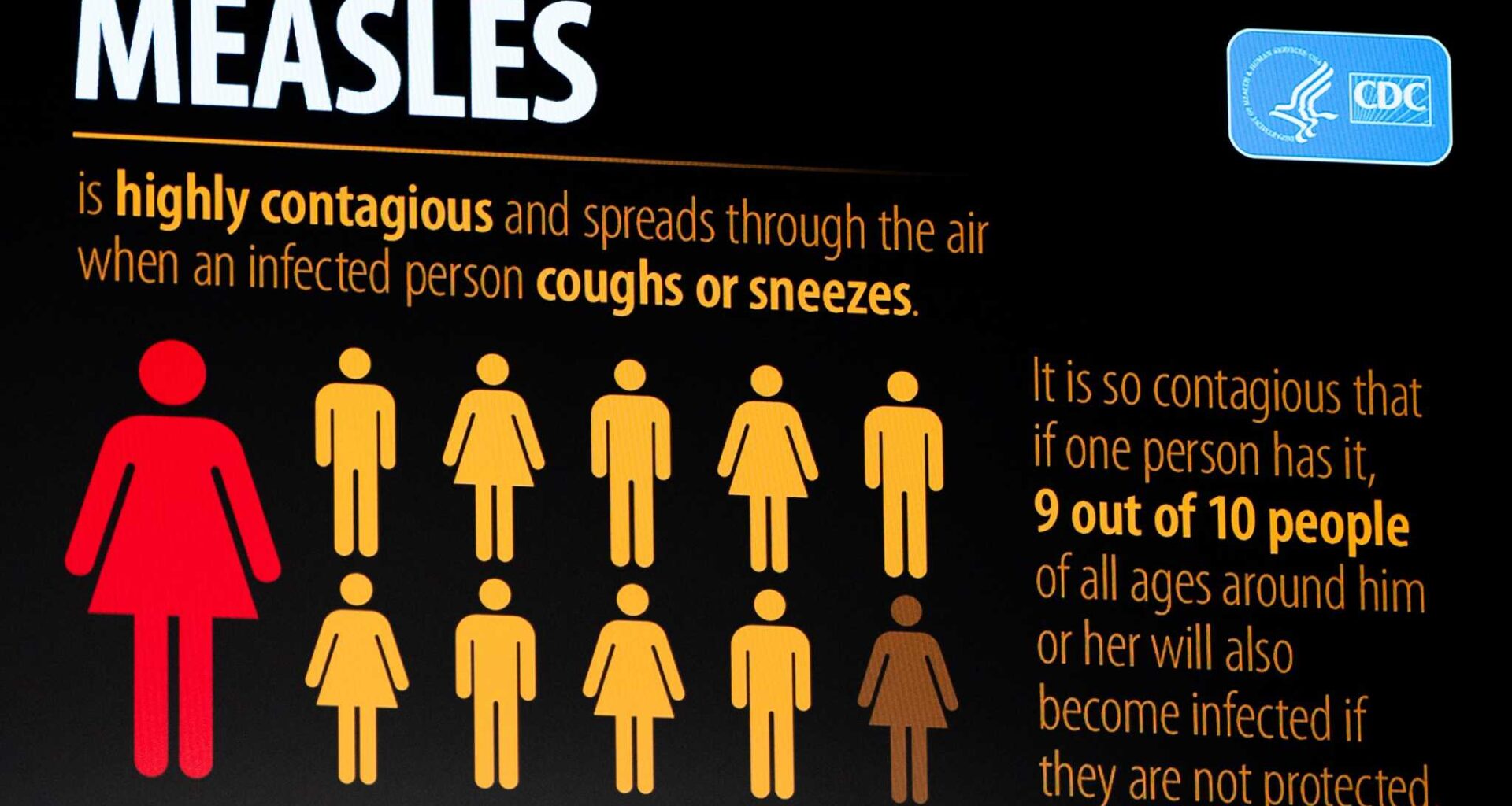
An infographic on the measles virus is displayed during a news conference at the Austin Public Health office after measles was discovered in Travis County last year.
Sara Diggins/American-Statesman
Measles returned to Texas in February. Last year, Texas led the resurgence of measles with more than 800 cases, mostly centered around West Texas. Currently the outbreak in the U.S. has been centered around South Carolina, and the U.S. already has reached more than 1,000 cases this year.

Article continues below this ad
2 in Frio County
5 in Bandera County
1 in Kendall County
1 in Lubbock County
Lubbock became the center of last year’s outbreak when people from surrounding counties with measles came to Lubbock for hospital care.
Frio, Bandera and Kendall counties are south, west and north of San Antonio, respectively.
No cases have been found in Central Texas. Locally, cases last year were mostly related to people who had traveled to West Texas.
Article continues below this ad
Measles is considered one of the most infectious diseases known. The virus is spread through the air when someone infected coughs or sneezes.
Austin American-Statesman
Why is measles so concerning?
Measles is one of the most contagious diseases. It spreads by airborne particles and has a 90% infection rate among unvaccinated people exposed to a person with measles. The virus can live on surfaces for two hours after exposure.
It also has long-term consequences.
Article continues below this ad
“Measles is not just an acute illness,” said Dr. Amesh Adalja of the Johns Hopkins Center for Health Security. It causes “immune amnesia,” which means people can lose their immune protection against other diseases. They also can develop swelling of the brain and other complications years later.
Outbreaks happen when less than 95% of the population in one area has been vaccinated. In Texas, only 93.24% of kindergartners are vaccinated for measles, mumps and rubella.
In 2000, measles was considered eradicated in the U.S. because of high vaccination rates, but as those rates fell, measles and other disease like polio and mumps returned.
What are the symptoms of measles?
Anywhere from seven to 14 days after exposure, initial symptoms may include:
Article continues below this ad
Cough
Runny nose
Conjunctivitis
Usually a fever of 103 to 104 degrees Fahrenheit
A rash that starts at the head and works its way down the body.
The rash can start as sore spots in the mouth.
Article continues below this ad
Inflammation of the lungs
Pneumonia from a secondary infection
Inflammation of the brain
The measles, mumps and rubella vaccine is stored at the Shots for Tots vaccination clinic at St. John’s Community Center.
Jay Janner/American-Statesman
Can I get vaccinated for measles?
Children typically are given the first dose of the vaccine for measles, mumps and rubella when they are 12 months old. They receive a second dose between ages 4 and 6.
Article continues below this ad
For vaccinations, contact your primary care provider or go through Austin Public Health or other public health authorities in your county. You can get vaccinated as an adult if you have not been vaccinated previously.
Austin Public Health offers vaccinations for free or reduced rates for children and adults who are uninsured or underinsured, or don’t have Medicaid. The typical cost is $13 for children and $25 for adults. You can call 512-972-5520 to make an appointment at the clinics at 405 W. Stassney Lane in South Austin or 7500 Blessing Ave. in Northeast Austin.
How do I know if I have immunity?
People born before 1957 are presumed to have immunity because of the amount of measles that was present during that time. People born after that time need to make sure they have been vaccinated with two doses. If you were born between 1957 and 1968, you might not have immunity because the vaccine at the time didn’t use a live virus.
Article continues below this ad