
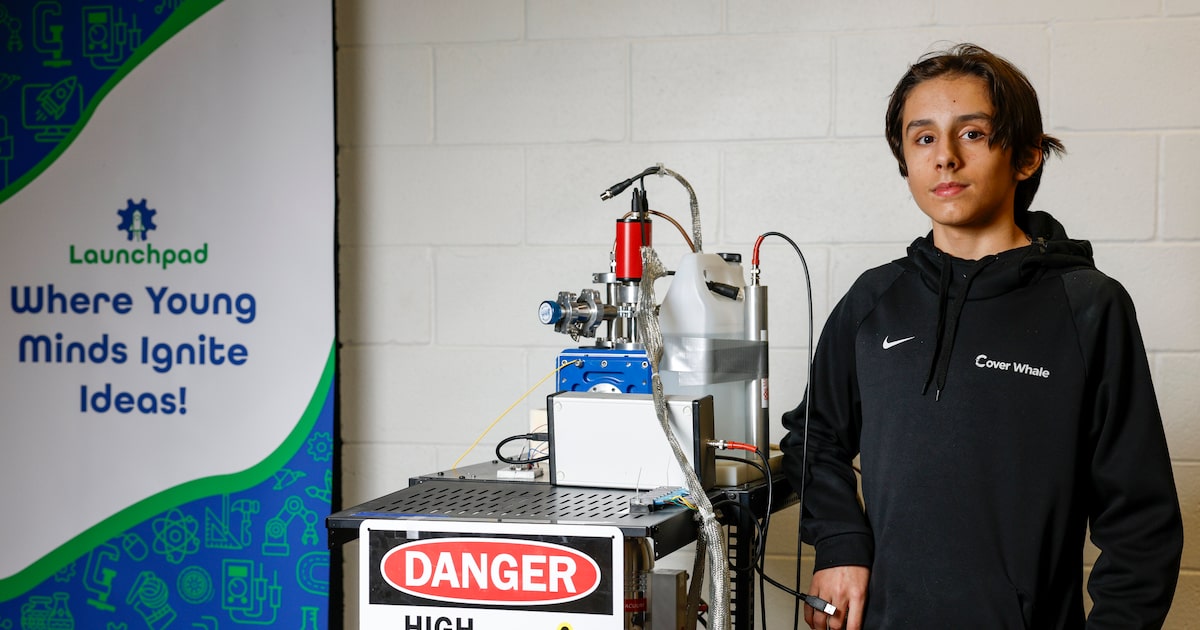
During the pandemic lockdown, while much of the world stalled, Aidan McMillan decided to build something. At 8 years old, he wasn’t interested in assembling Legos or constructing a tree house. He wanted to do science.
“My dad asked me, ‘What’s a cool project you want to do so you’re not sitting at home bored?’” said Aidan, now 13. “I was a very nerdy 8-year-old … I think I wanted to either do an electron microscope or nuclear fusion.”
Neither option sounds like something a young kid would do. But over the next four years, Aidan, a student at Dallas ISD, taught himself physics and coding to build a device that he says can produce nuclear fusion — the same process that powers stars, including the sun. What began as a way to stay busy may now earn him a spot in Guinness World Records as the youngest person to achieve nuclear fusion.
From e-book to makerspace
News Roundups
Not many people attempt nuclear fusion on their own. But there is a small global community of enthusiasts who do, often by building home versions of a Farnsworth fusion reactor, or fusor. That device was developed in the 1960s and uses high voltage and a vacuum chamber to conduct nuclear fusion. This phenomenon occurs when two tiny atoms slam together to become one bigger atom. In the process, they emit a burst of energy.
“The fact that this community exists pushes back on the notion that this is an ivory tower pursuit,” said Carl Willis, a professor of nuclear engineering at the University of New Mexico and one of Aidan’s specialist witnesses for his Guinness World Records attempt. Every Guinness record needs to be verified by at least two independent witnesses.
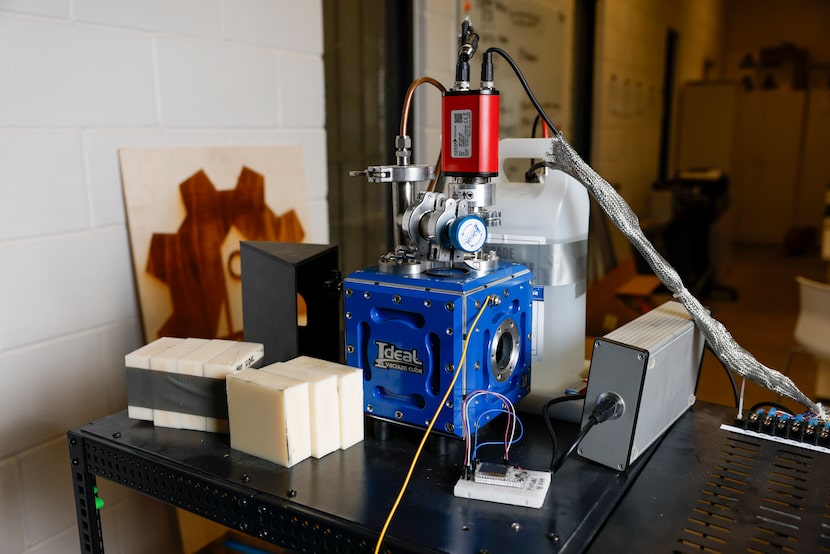
13-year-old Aidan McMillan’s nuclear fusor pictured at Launchpad Incubator, Friday, Feb. 20, 2026, in Dallas.
Elías Valverde II / Staff Photographer
Willis said hobbyists explore nuclear science across a wide spectrum, from building small particle accelerators to doing nuclear reactions. “It isn’t out of the realm of individuals to be able to do these things,” he added.
But how does an 8-year-old know where to start? Aidan began by teaching himself nuclear science from a 400-page e-book. He would have Google open on one computer screen and the book open on another, he said. “I’m Googling like three-fourths of the words in this book, and just kind of figuring it out.”
After two years of self-study on top of his regular schoolwork, Aidan and his father, Mark, got help building the fusor at the Dallas Makerspace in Carrollton. There they met members of the organization’s scientific committee, including Russell Crow, a retired laser engineer.
Crow, as the Dallas Makerspace’s safety officer, was game to mentor Aidan, showing him the ropes and keeping a close eye for safety. A fusor comes with real hazards, no matter who’s building it. Potentially lethal high voltages, dangerous ultraviolet and X-ray radiation and a high-vacuum apparatus that can implode if improperly handled.
“I gave him guidance here and there whenever he needed it,” said Crow, now 66. Since Aidan was too young to run the machine tools for building the device, “I would get him to show me his specifications, and then I would machine it for him.”
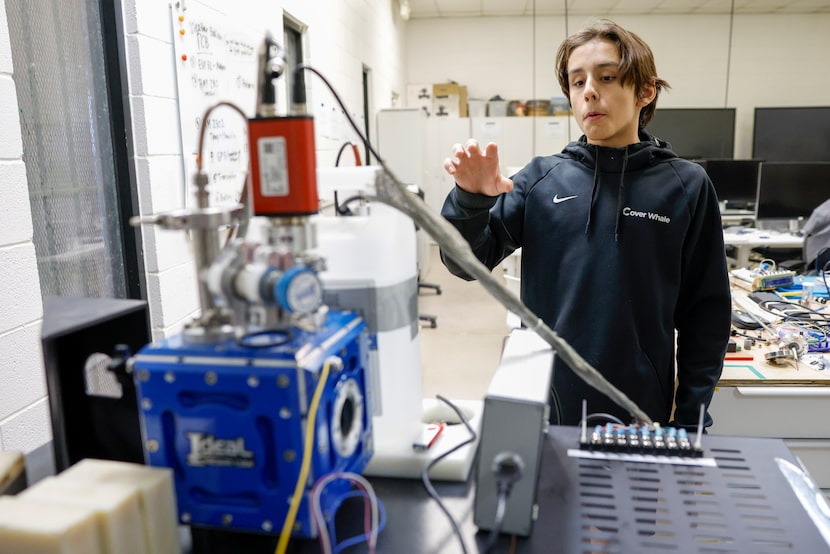
13-year-old Aidan McMillan talks about his nuclear fusor at Launchpad Incubator on Friday, Feb. 20, 2026, in Dallas. McMillan says he achieved nuclear fusion in late 2024 after spending four years working on the project.
Elías Valverde II / Staff Photographer
But Aidan mostly built the fusor himself. His father sourced some parts for it online and borrowed others from the Dallas Makerspace, where someone had built a fusor before him. In total, building the device cost around $20,000. The work took place at the Dallas Makerspace until last May, when Aidan’s parents helped open another makerspace in West Dallas geared toward children. Called Launchpad Incubator, it currently serves about eight students after school, during weekends and over school breaks and aims to eventually accommodate up to 40 kids. Launchpad leases the building from a nonprofit and has put about $100,000 toward it for renovations.
Skills over world record
It was late 2024, Crow said, when Aidan first achieved nuclear fusion. He reached the milestone around 1 a.m., shortly before his 12th birthday.
“Everybody was so fired up about it,” Crow said. “We did it over and over again the next few weeks.”
The process worked like this. Aidan hit a button that released a small amount of a kind of hydrogen gas called deuterium inside the fusor’s vacuum chamber. He then switched on a high voltage current that ran through the gas, causing it to become plasma. That, in turn, stripped electrons from the atoms, leaving positively charged particles. The electric field then pulled those charged particles toward the center of the chamber at high speeds of 750 cycles per second (or 90,000 revolutions per minute), crashing them together.
The achievement could have gone unnoticed by the public — and Aidan would have been fine with that. But he decided to pursue a place in Guinness World Records, he said, to bring attention to the makerspace his parents created and to show what a space like it can do for kids interested in science.
“A lot of people don’t have the means to do these projects,” Aidan said. “The idea behind the space is to help kids to do whatever they want to do and also have peers who are at the same level of ‘out there.’”
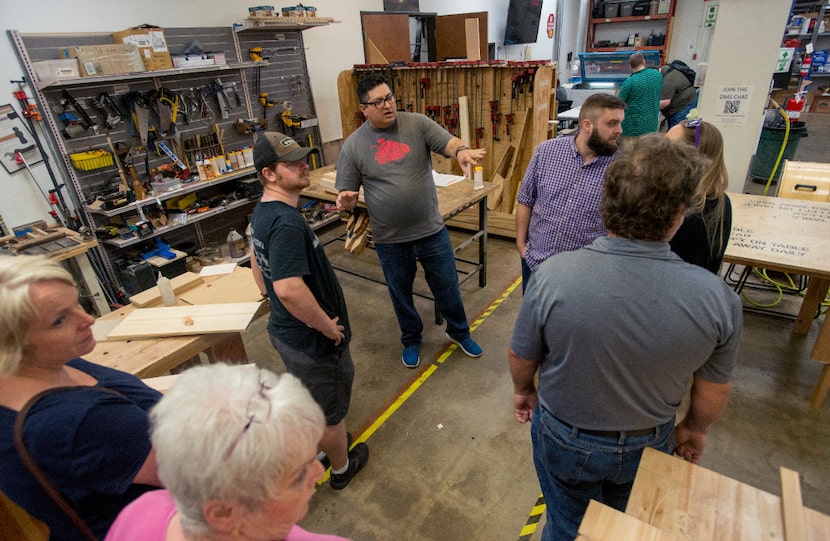
Open house at the Dallas Makerspace in Carrollton on June 1, 2017. (Robert W. Hart/Special Contributor)
Robert W. Hart / Special Contributor
Staying laser-focused on one project was difficult, but Aidan was motivated to keep going. “I spent a year trying to do nuclear fusion, and I’m not gonna let my past self down,” he said. “To be honest, it’s less about the fact that I did nuclear fusion and more about the fact that I learned a lot of skills.”
Aidan completed his Guinness World Records attempt in December, when he was 12. He plans to submit the documentation for recognition this spring. The current title holder for the world’s youngest person to achieve nuclear fusion is Jackson Oswalt, a Tennessean who achieved nuclear fusion in 2018, hours before his 13th birthday, according to Guinness World Records.
For Shirin Foroudi, Aidan’s mother, witnessing her son’s growth has been more rewarding than the pursuit of the record.
“It’s really fun when your kid laps you,” she said. “Like yes, please be smarter than me, please be more successful, please solve some big problems or do something meaningful that you’re really passionate about.”
Miriam Fauzia is a science reporting fellow at The Dallas Morning News. Her fellowship is supported by the University of Texas at Dallas. The News makes all editorial decisions.
 UT Dallas’ BrainHealth Week brings brain science to the public
Experts will share science-backed tips to strengthen brain performance at any age.
 What is ALS, the disease that killed actor Eric Dane?
Here’s what to know about amyotrophic lateral sclerosis, also known as Lou Gehrig’s disease.
 Alzheimer’s risk tied to air pollution. Here’s what you need to know in Dallas
A national study found long-term exposure to fine particle pollution is associated with a higher risk of Alzheimer’s disease in older adults.
 Texas AG sues another Dallas doctor over ban on gender-affirming care for minors
It’s the fourth lawsuit Paxton has filed over the transgender care ban. Three are against Dallas-area doctors.