

Sweden-based Ericsson has announced a successful demonstration of its ISAC (Integrated Sensing and Communication) drone-detection technology at the company’s U.S. headquarters in Plano.
The proof-of-concept test signals a major step forward in the evolution of networks that both connect and sense the world around them, Ericsson said. The technology detected drones using Ericsson’s massive-MIMO radios, showcasing the network’s ability to track unmanned aerial vehicles (UAVs) within surrounding airspace.
“Today, we showed how ISAC can unlock a new class of applications—from safer skies to smarter cities—by introducing a powerful new sensing platform as an added layer to the existing telecom network,” said Yossi Cohen, president and CEO of Ericsson Americas.
“By transforming deployed radio sites and spectrum to support both communications and sensing, we give networks the ability to truly perceive their surroundings,” he added in a statement. “We can introduce these capabilities efficiently and responsibly, accelerating time to value for operators and their customers.”
Leading ‘the race to 6G’
The demonstration shows that the U.S. is a global leader in ISAC technology, “which improves national security, optimizes spectrum use, and fuels economic growth,” the company said. ISAC is an innovative technology that can handle use cases across commercial, public safety, and defense scenarios, allowing speedier adoption of new emerging technologies like autonomous systems and drone delivery in commercial settings.
From a defense perspective, the technology bolsters national security, providing an additional layer of safety, Ericsson said.
Dr. Tom Rondeau, principal director for the FutureG Office at the Department of Defense, said ISAC “represents a transformative leap forward, merging advanced communications and sensing capabilities into a unified platform.”
“By using communication signals to sense the physical world in real-time,” he added, “ISAC gives wireless networks a new dimension of environmental awareness, enabling groundbreaking applications that advance both U.S. national security and commercial interests, and solidifying America’s leadership in the race to 6G.”
ISAC integrates sensing and spatial location of passive (not connected) objects into the mobile communication network—extending network functionality beyond connectivity by empowering the detection and characterization of objects and movement using existing infrastructure, Ericsson said.
The capability is progressing in 3GPP—a global collaboration that sets technical standards for mobile communications across 3G, 4G, LTE, and 5G networks—and is expected to form part of early 6G standardization, showing the foundation for broad, scalable sensing applications.
Future applications and the ability to ‘see around corners’
During the demonstration, Ericsson engineers showcased how network-based sensing supports use cases such as drone detection and airspace safety. The company said it’s also exploring how sensing can be used for automotive and transportation assistance; industrial automation, and worker protection—use cases that benefit from the network’s wide-area perspective and ability to “see around corners.”
Per Ericsson, the technology could lead to safer, smarter infrastructure, with network-based sensing supporting use cases by augmenting local sensors with wide-area network awareness. It could also lead to efficient path to scale, since ISAC is designed to reuse existing mobile network sites, spectrum, and hardware, enabling pragmatic introduction and coverage at scale.
And with 3GPP studies already begun, ISAC is poised to become “a foundational capability in the 6G era,” Ericsson said.
The demonstration highlights Ericsson’s commitment to advancing 6G-era capabilities and collaborating with the broader ecosystem to test out real-world scenarios and deployment approaches across sites, spectrum, and hardware integration levels, the company added.
Don’t miss what’s next. Subscribe to Dallas Innovates.
Track Dallas-Fort Worth’s business and innovation landscape with our curated news in your inbox Tuesday-Thursday.
R E A D N E X T

Toronto-based Realbotix is pioneering “human-centric robotics” with patented technologies that enable lifelike expressions, vision, and social interaction. The robot model being deployed in Plano will serve as “a dynamic, adaptable human–robot interface” for workforce and visitor applications, the company said.
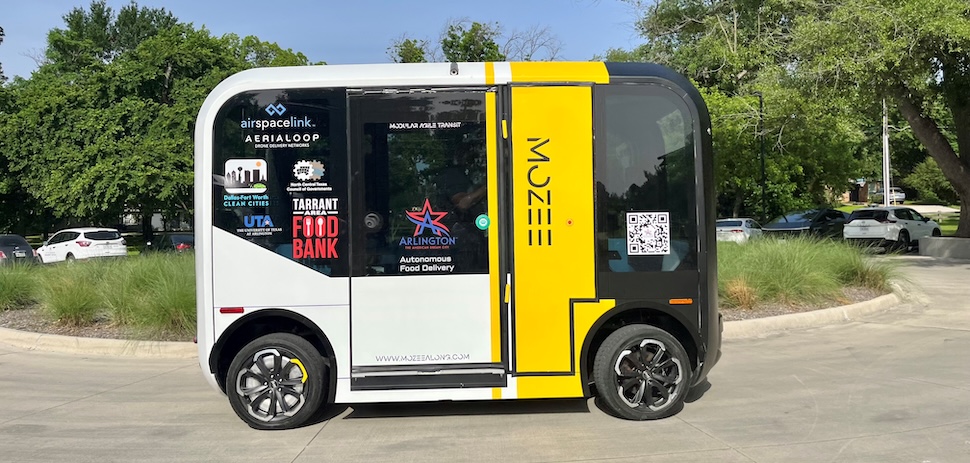
Autonomous ground vehicles from Arlington-based Mozee and delivery drones from Miami’s Aerialoop are fanning out across Arlington this week, delivering around 150 boxes of nonperishable food from the Tarrant Area Food Bank to participating Arlington households.

Robert Johnson will manage the performance and operations of CyrusOne’s U.S data centers, overseeing the company’s growing portfolio of facilities as they become fully operational.
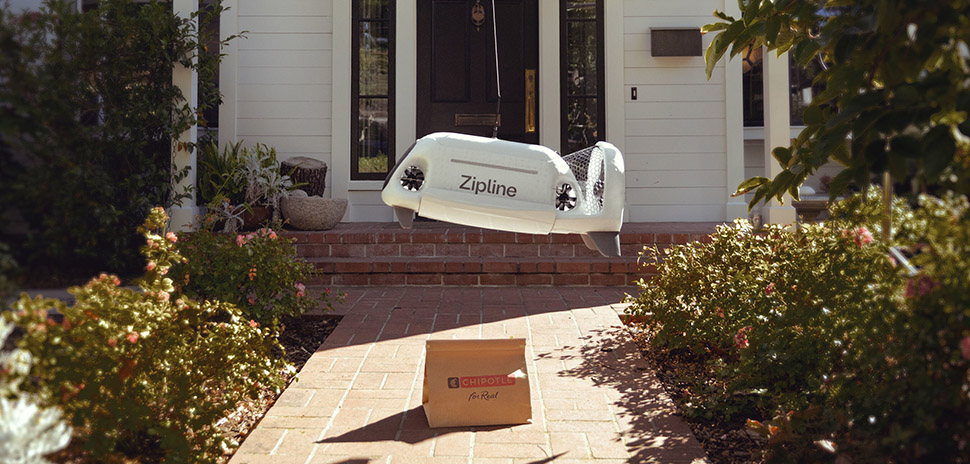
Burrito bowls by drone? Oh, it’s a thing—and it launched today in North Texas. California-based Chipotle has begun flying out its full-menu in a new drone delivery service called Zipotle, starting with a single Chipotle location at 3109 Lakeview Parkway in Rowlett, northeast of Dallas. Partnering with the drone company Zipline, Chipotle “Zip” drones will travel directly to customers’ houses, delivering digital orders in just a few minutes of flying time.

The global provider of wireless network solutions said its new Plano headquarters will employ up to 150 people in R&D, engineering, customer support, sales, and corporate functions. Airspan has 11 offices worldwide, including four in the U.S.