
The Texas Education Agency must correct roughly 4,200 errors in its elementary and middle school curriculum, the State Board of Education ruled Feb. 25.
The changes to the Bluebonnet Learning materials, a set of state-developed textbooks approved by the SBOE in late 2024, include replacing improperly licensed images, fixing formatting errors or typos and correcting factual errors.
What’s happening
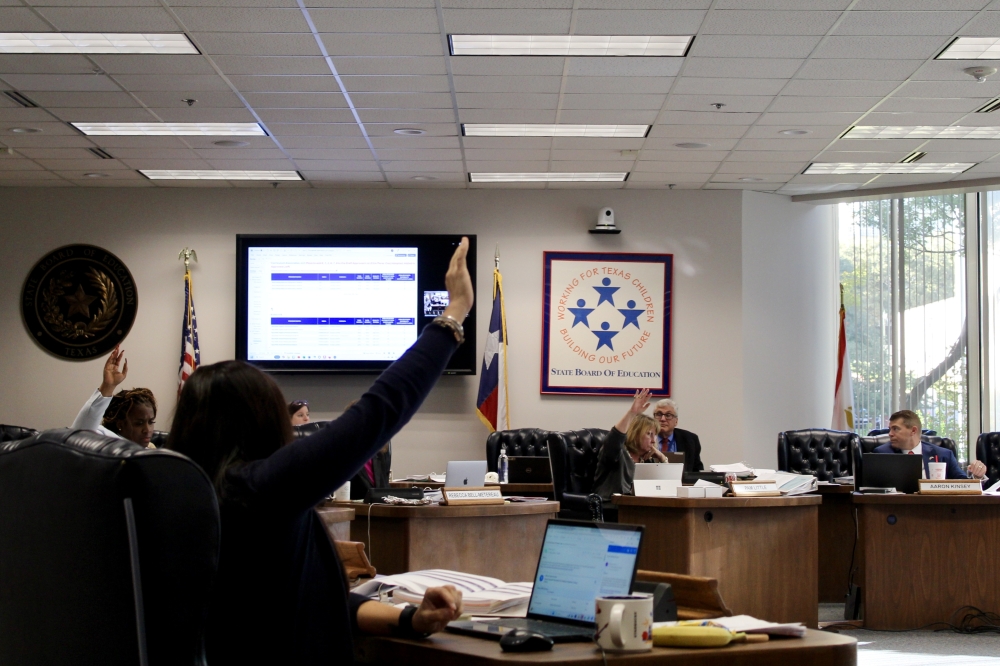
During a Feb. 25 specially called meeting, SBOE members voted 9-6 to require the TEA’s publishing division to update its digital curriculum materials within 30 days. The agency will also replace textbooks, teacher guides and other physical materials purchased by school districts.
Before approving the changes, several board members expressed concerns about the “unprecedented” number of issues with the state-developed textbooks, telling TEA staff that the errors should have been caught before the materials were approved for classroom use. Board members also noted that Texas taxpayers will cover the costs of reprinting the updated materials, as they were developed with state funds.
“I’m very concerned about our review process. I feel like we’ve done something wrong, that we have high-quality instructional materials that were approved by us, but then it’s coming back with 4,200-plus corrections,” said SBOE member Will Hickman, R-Houston.
The SBOE approved the Bluebonnet materials in November 2024 under House Bill 1605, a 2023 state law that overhauled Texas’ public school curriculum standards and authorized the TEA to create its first state-owned textbooks. The curriculum includes elementary school reading and language arts; kindergarten- through eighth-grade math; and Algebra 1 materials.
Use of the state textbooks, which became available ahead of the 2025-26 school year, is optional, but districts that do so receive $60 per student to purchase and print them. The Bluebonnet curriculum has been criticized for frequent biblical references in the reading materials, which critics have said are inappropriate for public schools and could isolate students with different religious beliefs. Proponents of the materials have said they will help close student achievement gaps and reduce teacher workloads, Community Impact previously reported.
SBOE member Tiffany Clark, D-DeSoto, said state education officials had “failed” students by giving schools erroneous materials.
“If this is a product they’ve been using because they believe it was a high-quality instructional material, we have failed our students this school year,” she said. “If we’ve been teaching incorrectly, this is going to have an impact.”
Zooming in
During the Feb. 25 meeting, the TEA downplayed the severity of the requested corrections. Colin Dempsey, a TEA official who helps lead the SBOE’s annual instructional materials review process, described factual errors in the Bluebonnet materials as “minimal” and said about one-fourth of the changes would update URLs in the digital materials, while others address typos, formatting issues or duplicated content.
SBOE member Pam Little, R-Fairview, noted that the TEA will replace over 1,000 images across the math and reading textbooks due to licensing issues.
“That’s going to cause big reprints,” she said. “Because this is the agency’s product, that means the taxpayers will cover that expense, and that’s concerning to me.”
Dempsey did not provide an estimate of costs to taxpayers, telling board members that the TEA planned to calculate reprinting costs after the changes were approved.
“I’m very concerned that, as a board, we have set a precedent for sloppy publishing. Many times, even if it’s a typo, it could become an error of fact,” Little said.
More details
Some board members asked to hear directly from TEA officials involved in the production and publication of the Bluebonnet materials. Nicholas Keith, who leads the agency’s publishing division, was present at the Feb. 25 meeting, although he did not testify. The SBOE does not have the authority to require any publisher, including state employees, to testify, board chair Aaron Kinsey, R-Midland, said.
“I will be voting to approve the changes so that our schools can continue using them, but … I’d like to see us really tighten up this process,” SBOE member Brandon Hall, R-Aledo, told TEA staff. “I think that when we have mistakes, that kind of undercuts the trust that we’re building with our local trustees and our local administrators, and it kind of puts pressure on them.”
Dempsey said the TEA has increased the number of staff who review proposed instructional materials since the first review cycle in 2024, when the state textbooks were approved. The TEA and SBOE complete the review process annually, with dozens of publishers submitting new materials.
While publishers can be fined for errors found during the review process, Dempsey said SBOE policies do not specify consequences if errors are found in state-developed materials.
“The rules do not currently consider a product that’s developed by the state,” Dempsey told board members. “We haven’t quite ironed that out, and clearly it’s something that we need to address.”
Little said that in past years, some publishers were fined “as much as $200,000” for errors identified by the SBOE.
“Many times, they weren’t approved because of the number of errors that they had,” Little said. “Next year, if a publisher comes to us and they have 3,000 errors, are we going to say, ‘That’s too many errors?’ Well, here we’ve approved one that had 4,200.”