
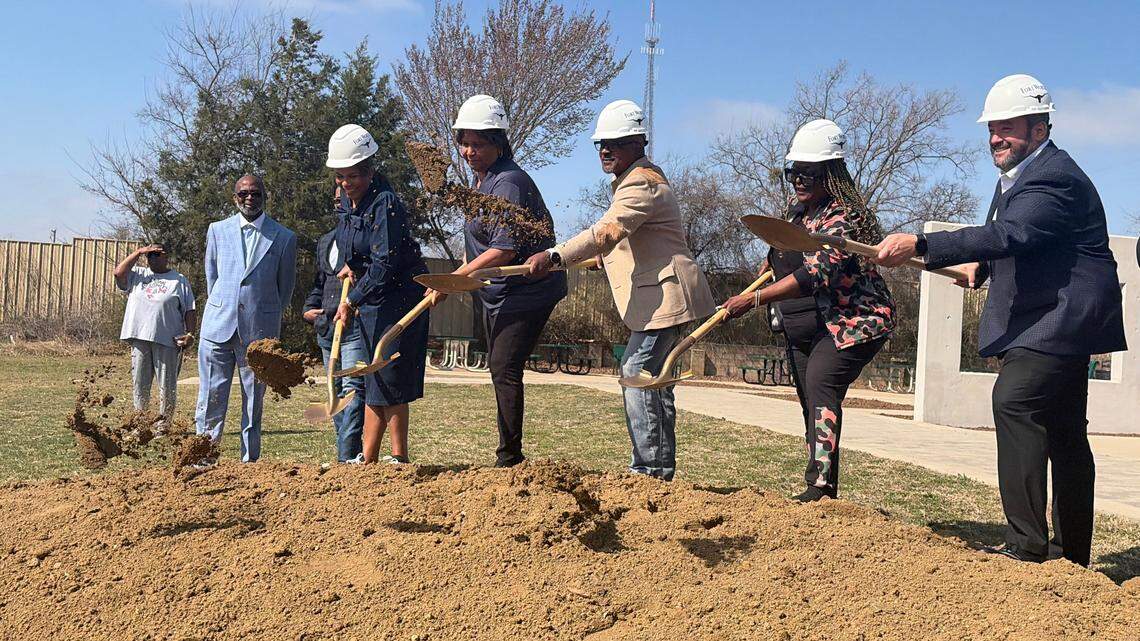
Mosier Valley Park had its groundbreaking on Thursday after over a decade of waiting. It will include a multisport court, trail, exercise stations, playground and an expanded parking lot. The project is anticipated to be completed by December.
Kamal Morgan
One of the oldest Black communities, which has waited over a decade for a park to be built at the site of its segregated schoolhouse, will see it come to fruition.
A groundbreaking ceremony was held at Mosier Valley Park, 11220 Mosier Valley Road, on Thursday morning, as residents celebrated the legacy of Mosier Valley.
Mosier Valley, northeast of downtown Fort Worth, off West Euless Boulevard, and south of Euless, is a freedmen settlement built by formerly enslaved people after the Civil War. The community was promised a park in 2014 that would be built on the site of Mosier Valley School.
Councilwoman Deborah Peoples thanked her predecessor, Councilwoman Gyna Bivens, who died this month, for working with the community in 2013 to ensure it was cleaned up and for creating a committee to offer ideas for developing a master plan. Bivens then helped to secure money and land for the park, which Peoples said deserves preservation for its deep cultural and historical significance.
“I am excited about what is to come, I am excited about the fact that soon we will see children playing and our elders gathering and passing on the history of what Mosier Valley was and the exciting future of what Mosier Valley is going to be,” Peoples said.
The park will include a multi-sport court, trail, exercise stations, playground and an expanded parking lot. The project is expected to be completed by December.
Jeffrey Pointer, president of the Mosier Valley Neighborhood Association, said his grandmother, Beatrice Parker-Green, who was a longtime Mosier Valley resident, told him before she passed away in 2009, “Make sure you take care of Mosier Valley.” Now it was time to tell his ancestors they could rest.
“When I leave here, I’m going to the cemetery, and I’m going talk to them and let them know we’re on it, it’s done,” Pointer said.
The construction of the park was supposed to have started in January 2025, but was delayed due to the city’s decision to bundle projects to attract competitive bids from better contractors. One park project paired with Mosier Valley encountered an unforeseen engineering issue; another park was added to the project package, pushing the schedule back by two months, according to Joel McElhany, Fort Worth’s assistant director of parks planning and resource management.
Mosier Valley was founded in 1870 by Robert and Dilsie Johnson and 10 other emancipated slave families. It reached its peak population in the early 20th century as the population grew to 300. The schoolhouse, Mosier Valley School, was established in 1924. In 1949, it became part of the Euless school district.
In 1950, Mosier Valley parents, with the help of the NAACP, blocked the Euless superintendent’s plan to bus students in the neighborhood to Fort Worth, after a federal judge ruled that Mosier Valley students had the right to be educated and equally funded as their white counterparts in the district.
Segregation laws prevented Black students from integrating into Euless schools in 1950. The Hurst-Euless-Bedford school district was integrated in 1968, 10 years after it formed, and the Mosier Valley school was closed. The Texas Historical Commission placed a historical marker at the site. Fort Worth annexed Mosier Valley in 1963, but residents did not receive street lights, garbage collection or water and sewer lines until the late 1990s.
In February 2014, the city acquired four acres of the old school site from the Hurst-Euless-Bedford school district to create Mosier Valley Park. In December 2017, it acquired an additional acre.
The first phase, completed in May 2019, included a parking lot, walkways and construction of a concrete cap on what was the school’s foundation that will be used for a plaza.
Related Stories from Fort Worth Star-Telegram

Fort Worth Star-Telegram
Kamal Morgan covers racial equity issues for the Fort Worth Star-Telegram. He came to Texas from the Pensacola News Journal in Florida. Send tips to his email or Twitter.