
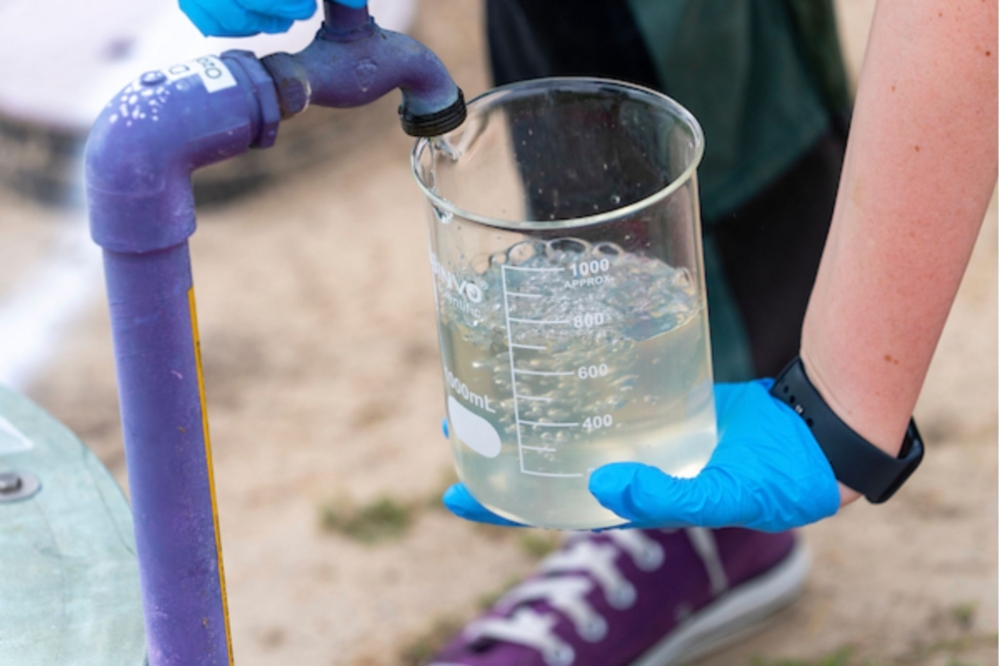
Hays County household well owners will soon have the opportunity to test for contaminants when the Texas Well Owner Network, or TWON, hosts a private water well screening March 4, followed by a meeting to go over results March 5.
What you need to know
The screenings, presented by the Texas A&M AgriLife Extension and Texas Water Resources Institute, will test water samples for contaminants, including:
Total coliform bacteriaE. coliNitrate-nitrogenSalinityThough there are no regulations requiring private well owners test their water, experts recommend testing annually, said Joel Pigg, Texas A&M AgriLife Extension Service program specialist and TWON coordinator.
“All of the bacterias and things we are screening for in this program are colorless, odorless and tasteless, so we don’t know that they’re there until we start testing for them,” Pigg said.
Residents who live on a public water supply have their source tested regularly to ensure it meets standards for consumption, Pigg said. It is crucial for well owners to do the same to catch any harmful bacteria.
“One of the first questions I ask the people that come to the program is, ‘When was the last time you had your water tested?’” Pigg said. “The number one answer that I always get is, ‘I’ve never had it tested.’”
About the program
Each water sample submitted for screening will cost $15. Residents may submit as many samples as they would like.
Water samples should be dropped off March 4 at one of the following four designated locations:
“>
AgriLife Extension office for Hays County, 200 Stillwater Road, Wimberley, from 8:30 a.m. to 10:30 a.m.Barton Springs/Edwards Aquifer Conservation District, 1124 Regal Row, Austin, from 8:30 a.m. to 11:30 a.m.Hays Trinity Groundwater Conservation District, 14101 Hwy. 290 W., Building 100, Ste. 212, Austin, from 8:30 a.m. to 10:30 a.m.Southwestern Travis County Groundwater Conservation District, 8656 W. Hwy. 71, Building A, Ste. 224, Austin, from 8:30 a.m. to 10:30 a.m.A results and interpretation meeting will take place from 11 a.m. to noon March 5 at the Wimberley Village Library, 400 FM 2325, Wimberley. It is important for residents who submit samples to attend the meeting so they may receive their results, learn how to correct identified problems and better understand private well management, Pigg said.
The specifics
Well owners should take their sample from the spigot or hose bib closest to the well head. If there is a water hose attached, it should be removed prior to collecting the water.
“We want to make sure that we are not taking samples out of a water hose,” Pigg said. “Things crawl up in water hoses. Birds are around [and] pets that could be licking on that water hose.”
If the sample is taken from an inside faucet, the aerator must be removed prior to collection. If possible, residents should collect the water on the day of the workshop.
The sample should be kept cool, out of direct sunlight and collected within 24 hours of the March 4 workshop to ensure accurate results, according to TWON water sampling instructions.
What you need to know
TWON recommends residents submit a sample from all wells on their property. Residents who have water treatment equipment may choose to take samples before and after treatment to ensure the equipment is functioning properly, according to Texas A&M AgriLife.