
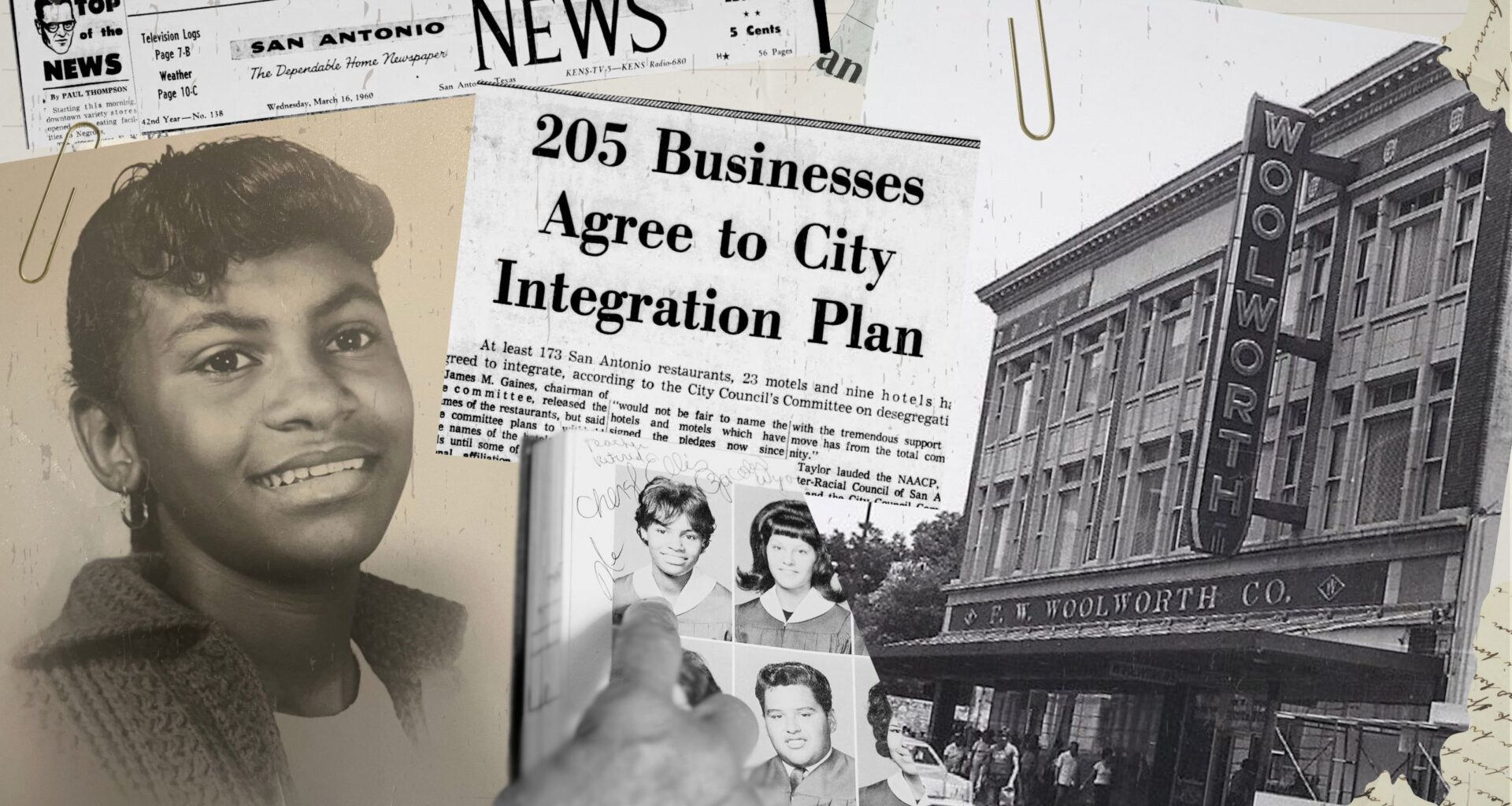
On the morning of March 16, 1960, a 12-year-old Black girl took a seat at a lunch counter with white patrons. Cheryl Ellis had skipped school and hopped a bus to reach the corner of East Houston Street and Alamo Plaza. Inside F.W. Woolworth, a five-and-dime store, she spotted an open stool.
A girlfriend she had brought told her, “No, don’t go!” But Ellis moved through the crowd, past tables and chairs, until she reached the lunch counter. Ellis took in her surroundings: a case of large donuts beside her, a soda fountain in front of her, a crush of people shuffling around her.
Her heart tightened with apprehension. Her limbs felt a strange tingle of excitement. Would she be served? Would she be ignored? Would there be a clash over the color of her skin?
One certainty cut through the questions: Her pastor, the Rev. Claude Black, and other religious leaders had threatened sit-ins across San Antonio if store lunch counters did not integrate by March 17. The threat came with risk. At a sit-in weeks earlier in Shelby, North Carolina, three white men grabbed a picket sign from a Black teenager and assaulted him with it. At other North Carolina sit-ins, Black people were pelted with eggs and spat on. One person had his coat set on fire.
The U.S. was marching through epic, transformative change. Inside her home on Perez Street, two miles from Woolworth’s, Ellis watched images of social revolution unfold on her family’s black and white television set: bombings of Black churches in Alabama, beatings of Black school children in Arkansas, mob violence against Black people across the South.
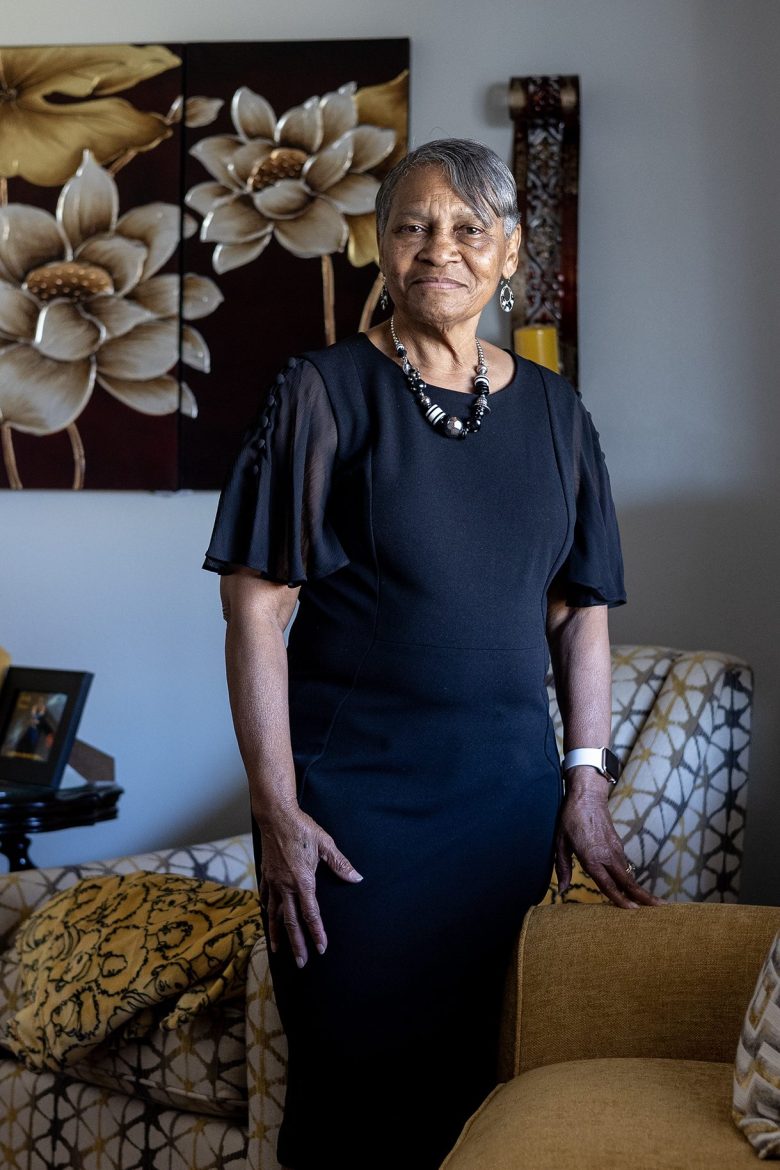 At age 12, Cheryl Wyatt witnessed a white waitress serving a Black patron for the first time at Woolworth’s in San Antonio in 1960.
Would San Antonio become another flashpoint for integration?
Ellis did not believe so. One year earlier, she had taken a seat at the same Woolworth lunch counter. She thought, “What are they going to do to a little girl?” Her defiance sparked no violence. However, a white waitress behind the counter told her to move or she would call the police.
Undeterred, Ellis returned to the lunch counter weeks later. She again was asked to leave. On a third visit, her sister, Montyne, pleaded with her not to take a seat. Ellis sat beside a white man, who told her, “Get your a- – outta here, you ni- – – -.” The man rose to leave as Herpel Ellis, her brother, arrived. He yanked her off the stool and took her outside.
“He chewed me up one side and down the other,” she recalled. “He said, ‘Don’t let me ever see you do that again. Or I’m gonna tell mom and dad and you’re gonna get another whippin’ when you get home.’”
Unmoved by rejection and racism, Ellis marched into Woolworth’s a fourth time and sat beside another white customer. She could swim at public pools. She could play tennis at municipal courts. She could attend integrated schools of her choice. So why couldn’t she eat at a lunch counter?
Conviction propelled her forward. As she waited, a Black gentleman approached and kindly asked for her seat. Ellis stepped down and watched to see if he would be served. A waitress took his order and returned with a soda.
“Now, I can order a hamburger,” Ellis thought. In that moment, she spotted an aunt in the crowd. Ellis ducked, slipped through a mass of adults and fled, not realizing what she had seen. Across the street from the Alamo, on ground once stained with blood, a battle had been won without a skirmish. Ellis caught a bus down the block and rode away, an eyewitness to history.
A new era
On the far West Side of San Antonio, 17 miles from the old Woolworth building, a Black chef and restaurant owner prepares Caribbean fare for whites, Hispanics, Asians and African Americans. Nicola Blaque created a concept, The Jerk Shack, that draws patrons of all races and ethnicities to her tables.
“Food is a universal language,” she explains.
A delectable menu of chicken, oxtail and shrimp has turned The Jerk Shack into a must-eat destination — with two Michelin Bib Gourmands — and Blaque into a culinary rock star. She’s earned a plethora of awards, including a James Beard semifinalist nod for Best Chef: Texas.
Across town at Pullman Market, a Black pastry chef from the South American country of Guyana dazzles critics and customers at Nicosi Dessert Bar. Tavel Bristol-Joseph creates art on a plate with drizzle, crunch and coconut foam. In October, Nicosi earned a Michelin star. In January, Bristol-Joseph earned a James Beard nomination for Outstanding Pastry Chef or Baker.
Almost 66 years after Woolworth’s integrated its lunch counter, two Black chefs are elevating San Antonio’s culinary profile. Blaque brings the heat: Jamaican spice. Bristol-Joseph delivers the sweet: white chocolate rocks.
“I think Tavel and I are just the tipping point that is bringing eyes to some of the great creatives we have within the city,” Blaque says.
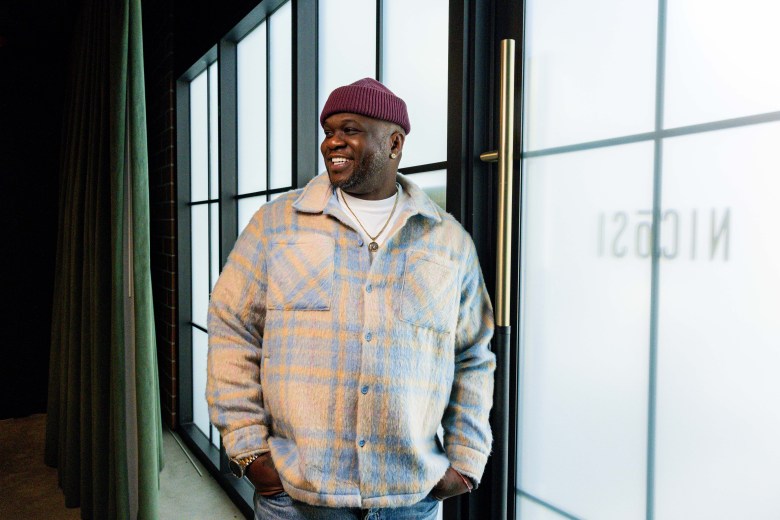 Chef Tavel Bristol-Joseph was a co-owner of the successful Emmer & Rye group before creating Nicosi. Credit: Amber Esparza / San Antonio Report
Among those creatives are African Americans helming top-flight eateries. Dwayne Price’s chicken at Wayne’s Wings regularly wins “Best in San Antonio” and sometimes “Best in Texas” recognition. Alice Martinez’s legendary East Side spot, Ma Harper’s Creole Kitchen, drew a five star rating from The Food Network. Mark Outing’s self-named joint impressed Texas Monthly, which once ranked his burgers No. 18 in the state.
The climb from lunch counter service to mainstream and Michelin acclaim took more than six decades. It took courage and bold leadership from a small community of color. It took resolve and cooperation from white business and political leaders.
How it began
An East Coast sit-in caught the attention of 17-year-old Mary Lillian Andrews. On Feb. 1, 1960, four Black college students took seats at a segregated Woolworth’s lunch counter in Greensboro, North Carolina. Denied service, the students refused to leave until the store closed.
Inspired by the Greensboro Four, student sit-ins spread across the country. Andrews, a Black freshman at Our Lady of the Lake College, took a different approach. As president of the local NAACP Youth Council, she wrote letters to the owners of downtown lunch counters, urging them to integrate.
On March 7, she mailed them. “Youth of all races in San Antonio go to school, ride the buses (and) enjoy municipal recreational facilities together, but they cannot sit down and eat together in your store,” Andrews wrote.
“Help the youth of San Antonio realize that the principles stated in the Holy Bible and the Constitution of the United States can be a living reality in San Antonio by abolishing this discriminatory practice in your store. We feel that the citizens of San Antonio are intelligent enough to accept such change.”
One week later, Andrews and the NAACP Youth Council issued a deadline: Send a favorable response by March 17 or face mass sit-ins. Under growing pressure, business leaders met with the San Antonio Council of Churches. On the evening of March 15, an agreement was reached to integrate quietly.
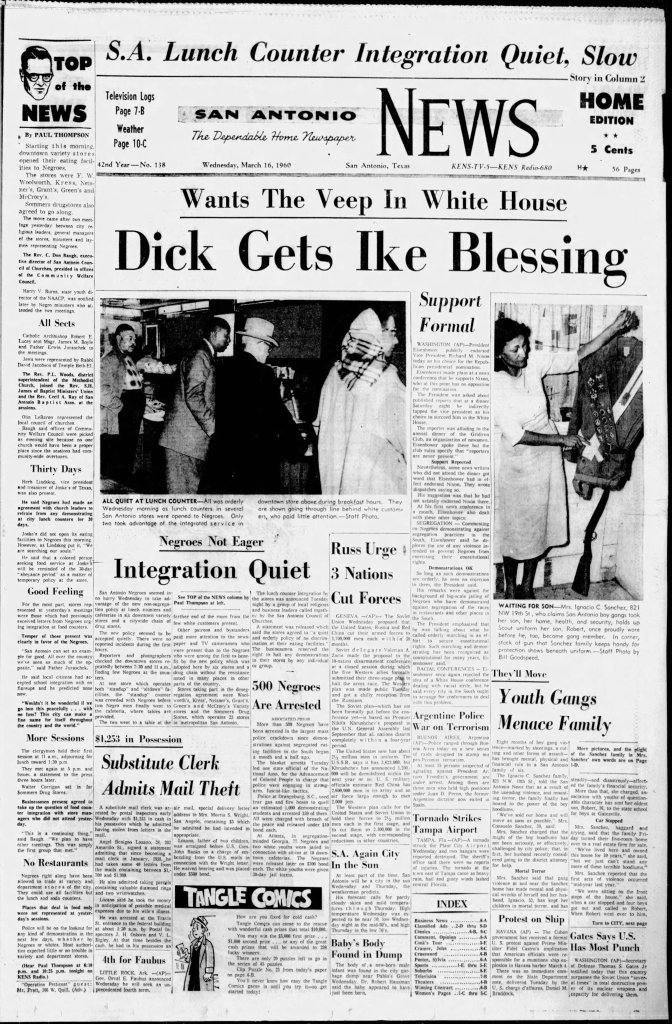 A newspaper clipping shows headlines and a story about the lunch counter integration in San Antonio published on Wednesday, March 16, 1960. Credit: Screengrab / Newspapers.com
Cheryl Ellis arrived at Woolworth’s the following morning, unaware of the agreement but cognizant of the letters. Andrews’ father, Charles Andrews, was her family’s doctor. Rising tension and possible violence could not keep the young girl away.
Time has not diminished the memories. Images and emotions remain vivid for a woman now known as Cheryl Wyatt. “I was hoping everything would be all right,” said Wyatt, 79. “They didn’t do anything to me when I sat down the first three times. They just said, ‘Get away.’ But I wanted to be there to see what they would do if a Black adult sat down.”
Later that afternoon, the San Antonio News stripped a small headline across the top of page A1: “S.A. Lunch Counter Integration, Quiet, Slow.” The newspaper reported, “San Antonio Negroes seemed in no hurry Wednesday to take advantage of the new non-segregation policy at lunch counters and cafeterias in six downtown variety stores and a citywide chain of drug stores. … There were no reported incidents during the first hours.”
Wyatt did not stay long enough to see other Blacks served. She and her friend ran from Woolworth’s to catch a bus down the street at Joske’s. Once at school, she explained her tardiness with a tale. “I told them my alarm clock didn’t go off,” she said, “and they didn’t say anything.”
Desegregation spreads
Lunch counters at S.H. Kress, H.L. Green’s, W.T. Grant’s, Neisner’s and McCory’s desegregated on March 16, 1960, along with those at 23 local drug stores in the Sommers chain. The news made the front page of The New York Times.
The newspaper described the desegregation as “peaceful” and quoted former Brooklyn Dodgers star Jackie Robinson, who integrated Major League Baseball in 1947. “This is a story,” Robinson said while visiting San Antonio on March 19, “that should be told around the world.”
Thirty days after lunch counters opened, the upscale Camellia Room at Joske’s Department Store remained closed to Blacks. Inspired by her daughter Mary Lillian, Smithie Andrews picketed and strategized to integrate the city’s largest department store.
Due to the light color of her skin, Smithie was sometimes mistaken for a white woman. One incident of color deeply wounded her son, Charles Clifton Andrews, Jr. In 1948, a police officer pulled the family over as they drove through a Texas town that greeted visitors with a sign: “Greenville Welcome. The Blackest Land. The Whitest People.”
In a 2021 interview with the San Antonio African American Community Archive and Museum, Charles Jr. recalled: “The officer said, ‘I stopped you because it looks like a Black man is driving a white woman.’ … My mother did not have any negroid characteristics.”
Charles Sr. tried to explain that his wife was Black. Refusing to believe him, the officer pulled father and son out of the car, handcuffed them together and made them walk to a city limits marker.
“When we got to the edge of town where the sign was, he unhandcuffed us and told us never to come through Greenville, Texas again,” Charles Jr. said. “It was the first and only time in my life I ever saw my father cry. I saw tears coming from my father’s eyes because there was nothing he could do about it if he wanted to live.”
Twelve years later, Smithie accompanied a white friend from the League of Women Voters to the Camellia Room. Soon after, Smithie’s brother, G.J. Sutton, arrived. A prominent lawyer, Sutton asked to be seated. Told the Camellia Room did not serve “colored,” Sutton protested: “You’re serving coloreds right now.”
“What do you mean,” he was asked.
“My sister’s in there eating right now,” Charles Jr. recalled his uncle saying. “‘Who is your sister?’ And he pointed to my mother. They said, ‘Just a minute.’ So they went over to my mother and said, ‘Excuse me. But there’s a man at the front who says he’s your brother. And he wants to join you.’ And my mother looked over and said, ‘Yeah, that’s my brother, G.J. Let him in.’”
Desegregation spread slowly after the Camellia Room integrated. Restaurateurs who believed in integration feared civil unrest and loss of business. Images of disruption and violence shook them. A sit-in on May 28, 1963 in Jackson, Mississippi underscored the risk. A white mob inside Woolworth’s attacked students and faculty from Tougaloo College as FBI agents stood by, refusing to intervene.
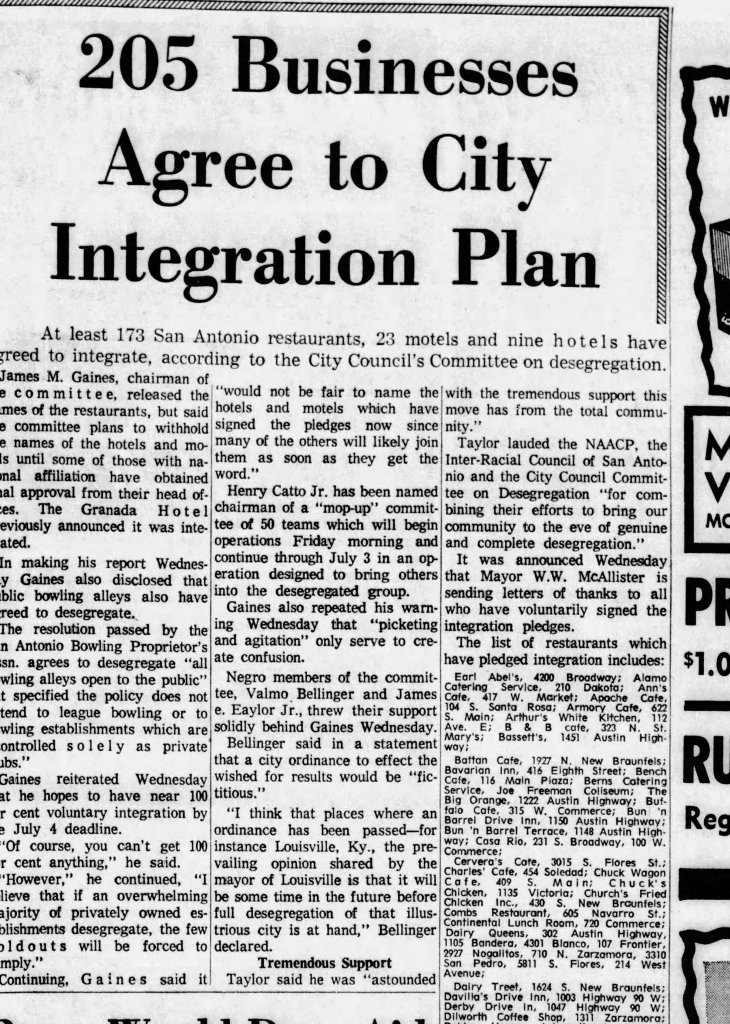 A newspaper clipping shows a story about the 205 businesses in San Antonio agreeing to integrate which included restaurants like Earl Abel’s, Bun ‘N’ Barrel, Casa Rio and Church’s Fried Chicken, originally published in the San Antonio Evening News on Thursday, June 27 in 1963. Credit: Screengrab / Newspapers.com
John Salter, a self-described ”half Native American, half white” professor, supported Blacks at the lunch counter. “They cut my face with sharp brass knuckles,” Salter told The Guardian in 2015. “Someone cut the back of my head with the jagged edge of a broken sugar container. There was a good deal of blood. They dumped slop on us. I was burned with cigarettes, hit and had pepper thrown in my eyes.”
Despite violent resistance across the South, the NAACP and San Antonio political and religious leaders pressured restaurant owners to integrate. On June 27, 1963 — two months before Martin Luther King, Jr. delivered his “I Have A Dream” speech and more than a year before the passage of the Civil Right Acts — the San Antonio Evening News reported a stunning development.
“At least 173 San Antonio restaurants, 23 motels and nine hotels have agreed to integrate, according to the City Council’s committee on desegregation,” an unbylined story began.
One African American committee member, James Taylor, said the community support “astounded” him. He applauded city leaders “for combining their efforts to bring our community to the eve of genuine and complete desegregation.”
The newspaper published a long list of restaurants that agreed to integrate. Some of the more prominent names included Earl Abel’s, Casa Rio, Church’s Fried Chicken, Dairy Queen, La Fonda, Mi Tierra Cafe and Bakery and the Manhattan Cafe.
On July 4, the Evening News reported that nearly all restaurants, hotels, motels, theaters and bowling alleys had desegregated. According to a story on page C12, “only three motels and 11 drive-ins, cafes and restaurants have refused to integrate voluntarily.”
In the spring of 1965, Cheryl Wyatt gathered with friends from Brackenridge High School for a graduation party at Earl Abel’s. Inside the popular restaurant, Wyatt enjoyed a cheeseburger, french fries and a Dr. Pepper. She shared German chocolate cake with friends, a mix of Blacks, whites and Mexican Americans.
A few years earlier, Wyatt had to enter the Majestic Theater through a back door. She had to watch movies from a “colored balcony” while whites sat below. She had to cover her face and wince as the stench of urine rose from the floor. Now she was celebrating in a welcoming venue.
“I just looked around,” Wyatt recalled, “and I said, ‘Wow, we’re really in Earl Abel’s.”
Today and beyond
The old Woolworth building is a gutted, hollowed-out wreck, a shell of a once prominent store that opened in 1921 and closed in 1997. Construction crews are integrating the bones of the structure — and a partial replica of the lunch counter — along with nearby historic buildings into the Alamo Visitor Center and Museum.
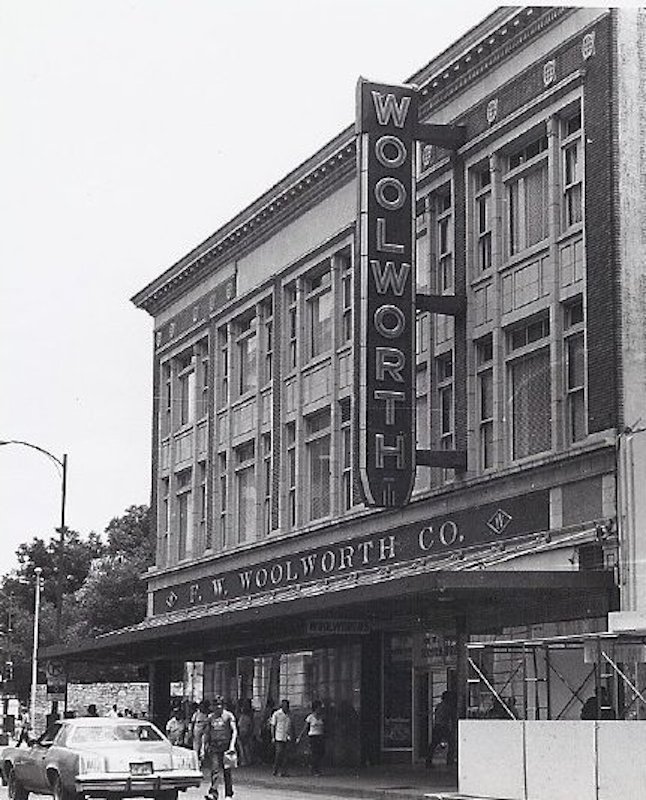 View of Woolworth’s from Houston Street, looking towards Alamo Plaza, c. 1981. The Alamo Plaza location of the national discount store operated from 1921 to 1997. Credit: Courtesy / San Antonio Conservation Society Foundation
When completed, possibly in spring 2028, the museum will tell a story, unspooling details that mark the city’s history. In 1836, a slave named Joe emerged as the only male survivor from the Battle of the Alamo. More than 120 years later, a descendant of slaves walked into Woolworth’s across from the Alamo and sat at a lunch counter once reserved for whites.
Many believe the late Richard Hunt was the first Black patron served at Woolworth’s. Hunt’s slave ancestors came to the U.S. through a port in Georgia. The son of a barber and librarian, Hunt grew up on the South Side of Chicago. At 19, he witnessed the open casket funeral of Emmett Till, a 14-year-old Black teen who was lynched in Mississippi.
In 1958, Hunt joined the U.S. Army and came to San Antonio. Two years later, he left Fort Sam Houston in uniform and went with a white couple to Woolworth’s. He ate without incident. “It was a ham sandwich,” he told the Conservation Society of San Antonio in 2021. “And probably a Coke. … There weren’t people coming in and pouring things on our head.”
From the living room of her East Side home, Cheryl Wyatt remembers: She is standing in Woolworth’s, watching a white waitress serve a Black man. He is not wearing a uniform. The waitress handing him a soda is not condescending or rude. She is treating him with respect. A sense of wonder fills the air. “I just felt warmth come all over my body,” Wyatt said.
The warmth grew. She felt it three years later when she was able to order enchiladas, Spanish rice and sweet tea at Luby’s Cafeteria. She felt it again in 1965 when she dined with a mix of races and ethnicities at Earl Abel’s. She feels it today nearly 70 years after Woolworth’s.
“If you just reach out your hand to somebody instead of with a fist, more people will take your hand,” Wyatt said. “And they will get to know you and you will get to know them. We are more alike than we are different.”
Hands join around a table, connecting people. Nicola Blaque understands. She retired from the Army, moved to San Antonio and started The Jerk Shack. Her first place was a 600-square-foot, hole-in-the-wall in low-income, high-crime 78207. In a neighborhood teeming with Tex-Mex and taquerias, Blaque’s Caribbean-infused cooking found an audience. Within a year, it was named one of America’s 16 best new restaurants.
“First we had to get to a point where we could all eat in the same room,” Blaque, 41, said of an era that preceded the birth of her own mother. “And then it was getting people to eat at our restaurants. That was a huge step.”
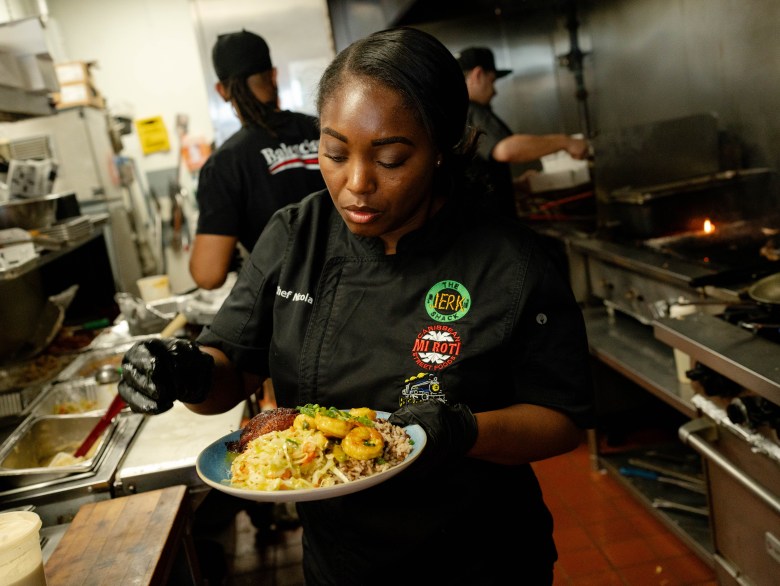 Chef Nicola Blaque gives the finishing touches to a dish at The Jerk Shack. Credit: Brenda Bazán / San Antonio Report
Progress gained. Progress still needed. While San Antonio is burgeoning with James Beard nominated chefs and Michelin-recognized restaurants, Black-run eateries continue to struggle. One challenge is the racial and ethnic composition of the city. African Americans comprise 6.9% of San Antonio’s population.
“When I started in 2018,” Blaque said, “that was one of my biggest fears. The Black community is such a small percentage of San Antonio. I had to be able to market myself to all demographics to come to my restaurant. A lot of people don’t understand what that’s like. I did know I had to have a marketing team. I don’t think a lot of businesses that are Black-owned are privy to that.”
Blaque learned her craft under an acclaimed chef, Geronimo Lopez, at a prestigious school, The Culinary Institute of America at Pearl. Blaque and her husband used savings to launch The Jerk Shack. To maximize opportunity, she changed her name. Lattoia Massey became Nicola Blaque.
“One thing I found out in San Antonio is that people have a hard time saying ‘Lattoia,’” said Blaque, whose current restaurant is more than four times larger than her first. “So I chose to go by Nicola, which is my middle name. And ‘Black’ is part of my business, so I combined the two. If someone introduces you and mispronounces your name, it almost takes away from what you are bringing to the table. I appreciate a strong introduction.”
Blaque brings strong attention to San Antonio. Her cuisine has been featured on The Food Network and in the pages of GQ, Texas Monthly and Southern Living. The Michelin Guide says she offers “some of the best Caribbean/Jamaican fare in the city.” Blaque’s customer base, however, extends far beyond San Antonio. The Jerk Shack draws visitors from outside the U.S.
“Recently, I had this young man and young woman come in from Mexico,” Blaque said. “They said they eat at Jerk Shack every time they come into San Antonio. I was like, ‘This is crazy.’ Because we don’t have to speak the same language. We don’t have to have the same traditions. We don’t even have to have the same political views.”
Glasses clink at the table. Food cuts across race and culture. In San Antonio, it carries history, advances unity and forges legacy.