
The crowds had grown ecstatic by the last leg of the monks’ 2,300-mile journey. Thousands lined streets in the nation’s capital, eager for some small role in a pilgrimage that had become a beacon of hope in a grim news cycle. The Dalai Lama and Martin Luther King Jr.’s son expressed their solidarity, while a global audience trailed the monks across livestreams and social-media posts and news segments, turning the gentle monks into media darlings.
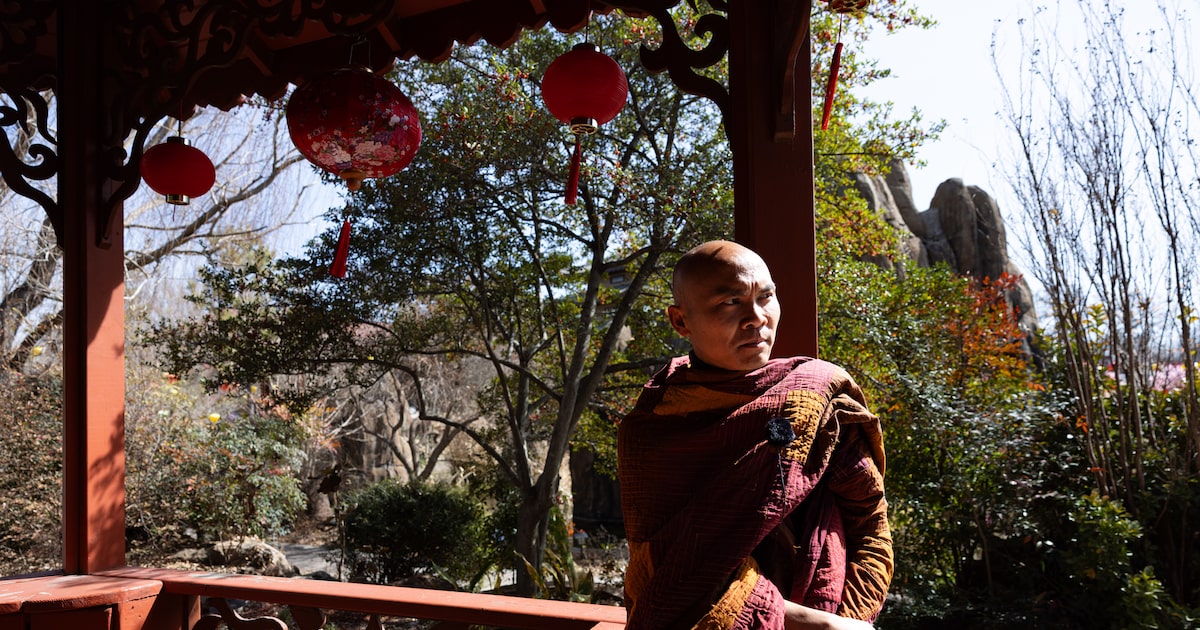
“Back at the temple, nothing’s changed,” said Bhikkhu Pannakara, about a week after his return, as we sat in a gazebo on the serene grounds of Huong Dao Vipassana Bhavana Center, where he launched the Walk for Peace on Oct. 26, 2025. The venerable monk was draped in his maroon and saffron robe, his bare feet looking ashen with dust, a few of his toes still blackened from his arduous walk.
It was a quiet Tuesday afternoon at the temple, an oasis of calm tucked away on a drab stretch in southeastern Fort Worth. Water trickled along a stone in a nearby pond, and trees were sprouting buds of peach and cherry blossoms. But a handful of curious visitors poked around the premises, phones in their hands, a reminder that the soft-spoken 44-year-old man across from me had done something extraordinary: captured the world’s attention without saying a word.
The Walk for Peace stretched across 15 weeks and much of the South, from Texas to Washington, D.C. Media coverage was modest at first, but people found the monks online, where the Walk for Peace Facebook and Instagram pages gained millions of followers, delighting at the simple but profound sight of 19 monks (sometimes more, sometimes less) walking across a divided country. This was not a protest. The only agenda was to spread hope, love, kindness. Crowds grew larger as they neared their final stop in February, while Aloka, the sandy brown and white dog accompanying them (his name means “light” in Sanskrit), became a crowd favorite. This was the kind of epic journey that books are written about. Fortunately, Pannakara is working on one.
News Roundups
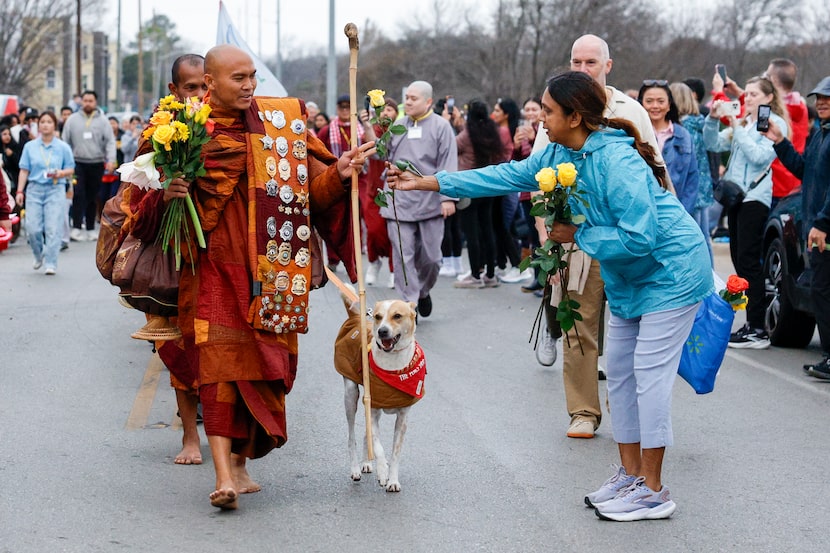
A woman hands a flower to Bhikkhu Pannakara as he walks with their dog Aloka as they head back to their temple, Saturday, Feb. 14, 2026, in Fort Worth.
Elías Valverde II / Staff Photographer
As the leader of the walk, Pannakara became the figure easily identified amid the procession of earth-toned robes and shaved heads. He kept a brisk pace out front, and his robe grew decorated with pins offered by sheriffs, EMS workers, police and fire department officers who protected the monks on their journey.
By the time the monks crossed into the nation’s capital, Pannakara started using his voice. He addressed a massive crowd from the steps of the Lincoln Memorial. “Loving kindness does not need power, money or a title,” he said. He led a mindfulness meditation, thousands of people dropping into silence and closing their eyes to take deep breaths in unison. The only shouting at that event was a line Pannakara often repeated in interviews and speeches, and he asked the crowd to chant it back to him: “Today is going to be my peaceful day.”
If monks can be rock stars, he was one then, although the phrase isn’t right; ego and fame are not conducive to the humble work of monkhood. Since coming back on Feb. 14 to the temple, where the monks received a hero’s welcome, Pannakara has returned to his modest cottage a short walk from the temple. Lately, he has been teaching himself to sleep in a seated position.
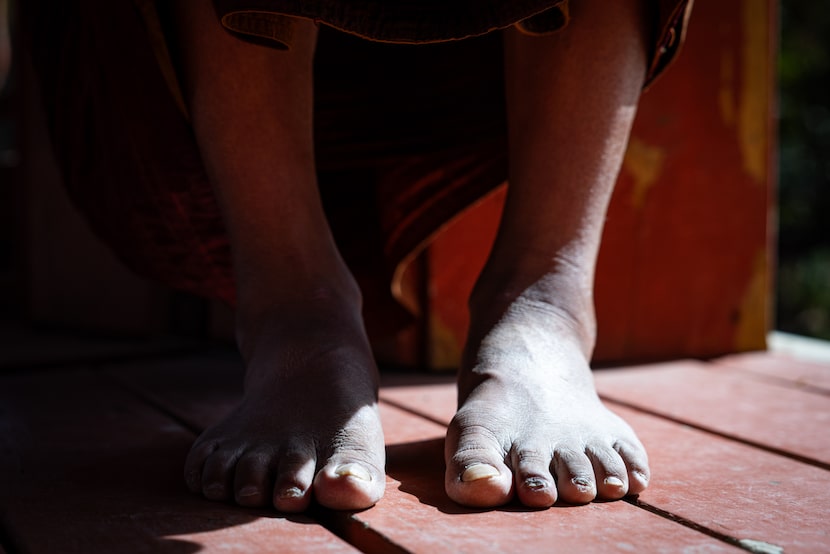
The feet of Bhikkhu Pannakara, a Buddhist monk, who led a 2,300-mile trek from Fort Worth to Washington, D.C.
Angela Piazza / Staff Photographer
On a breezy and sun-dappled afternoon, we spoke about the joy, perils and logistics of his uncommon adventure and how a University of Texas at Arlington grad ended up a monk. As one of the curious strangers wandered to the edge of the gazebo, hoping for a better view or perhaps a small hello, his attention did not stray. He has proved to be a master of focus, but also compassion.
“People are coming to visit us, which is nice,” he told me, with a warm smile. “We get to learn more about each other.”
I can’t remember the last time I saw so many people — different beliefs, ages, ethnicities — coming together for one cause. Why do you think the Walk for Peace resonated so deeply with people?
Because our movement is not about politics. It’s not about religion. It’s purely about peace. This is something that people have been looking for. People have had enough of the problems around the world. This movement touched their hearts, and for that reason, everybody came out, regardless of their backgrounds.
How did you come up with the idea for the walk?
I saw so much suffering around me in this temple, just during the pandemic. We helped a lot of communities with food, but still, so much suffering. Wherever I traveled, people asking for help, trying to find their way. I asked myself, What could a Buddhist monk do to help? I thought about it for three years. I wanted to let people know peace was possible.
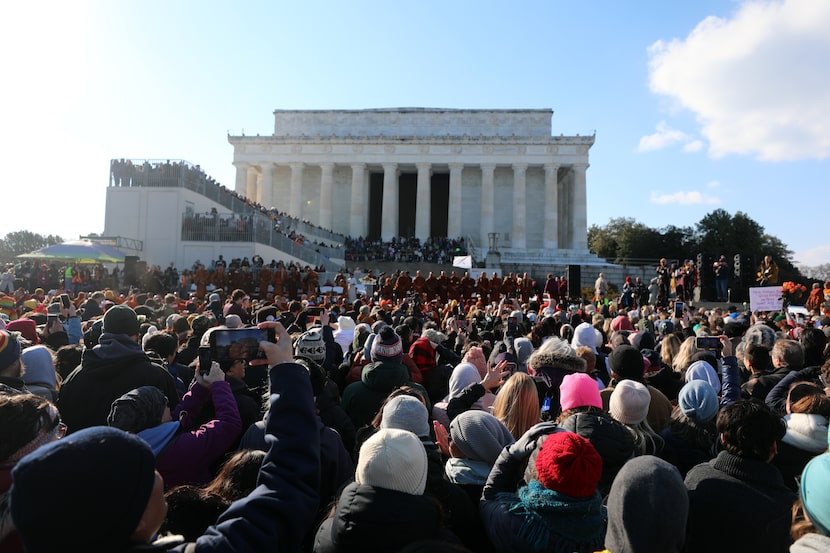
Thousands gathered at the Lincoln Memorial to see the Buddhist monks complete their Walk for Peace, Wednesday, Feb. 11, 2026, in Washington.
Rahmat Gul / AP
Can you talk about the physical hardships of walking 20 to 30 miles a day?
In the beginning, it was very difficult for most of our monks. Blisters, bleeding. But after a month, those blisters were gone. Of course, then we ran into different problems, like knee pain. Then the ice and snow. Virginia was freezing. Our fingers and feet were really bad. But due to the vow that we made, we continued our walk. None of the monks ever thought of giving up.
By the end of your journey, thousands of people were coming to cheer you on. But at the start, when you’re quietly walking, and there’s no one around — how do you keep up your spirits?
We focused on our own practice of mindfulness. I thought, the more we practice mindfulness, the more people will notice it and slow down and pause, just to look at the monks, and that is when they will feel the peace inside them. We had that in our thoughts. We are just doing what we’re supposed to do, and one day, people will notice us, and they will join this mission. We saw the crowds grow in Louisiana. And when we came to Georgia, the crowd was so large. It was overwhelming.
There was an accident near Houston that resulted in one of the monks having to get his leg amputated. [He later joined the monks in a wheelchair to end the journey in Washington D.C.] What happened?
It was about 6 p.m. The sun was going down. We were walking. We had on our reflection vests, and there was an escort van behind us with its yellow lights spinning. Luckily I walk fast, so I was out ahead, but a few of the monks were close to the van. Somehow a pickup truck going very fast hit the van, and then the van hit the monks. It was like everything slowed down. We were grateful to have police escort us every day after that. Moving on those roads is very dangerous.
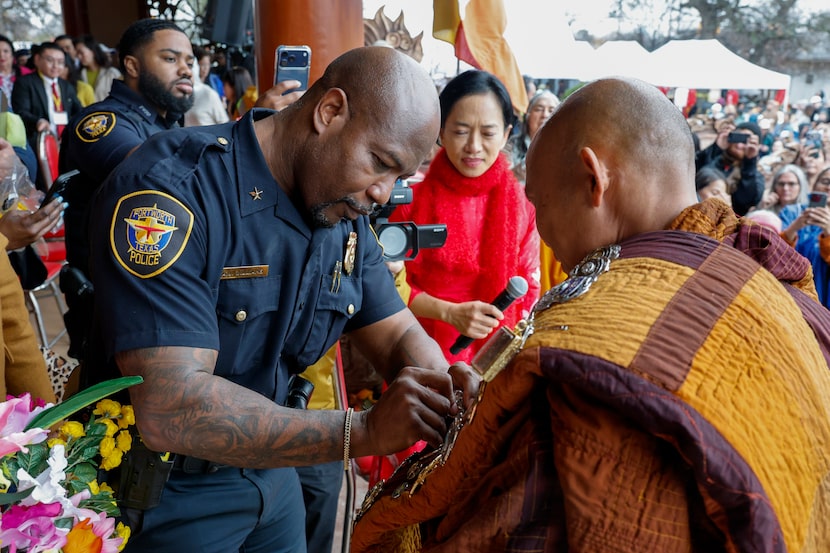
Fort Worth police commander A.J. Williams pins a badge to Bhikkhu Pannakara during a homecoming ceremony for the Buddhist monks after they completed their Walk for Peace, Saturday, Feb. 14, 2026, in Fort Worth.
Elías Valverde II / Staff Photographer
I have a question about logistics. Where did you sleep? How did you eat?
We started moving each morning at 5:30 a.m. or 6 a.m., and there’s a coordinator that goes ahead to look for the lunch location. If I said, today we are walking 20 miles, then the coordinator goes 10 miles down the road to see if there’s a place for us to eat. A park, the side of the road, a parking lot.
You were making your own lunches?
We had a team of volunteers in the RV. Because here in America, people don’t know our tradition. In India or an Asian country, we can go for alms rounds. We carry our bowl, and people offer us food. But here, we have to prepare the food.
And you slept outside?
Yes, for over a month. Each monk has their own tent. We slept right beside the highway, we slept in parking lots, in the forest, anywhere that allowed us to sleep. A few places, the people didn’t want us there, so we had to continue moving. It was tough in the beginning. After that, churches, schools, businesses and regular residents opened their doors, when the crowds got larger. There would be a big room, and we would have our own sleeping bags and sleep on the floor.
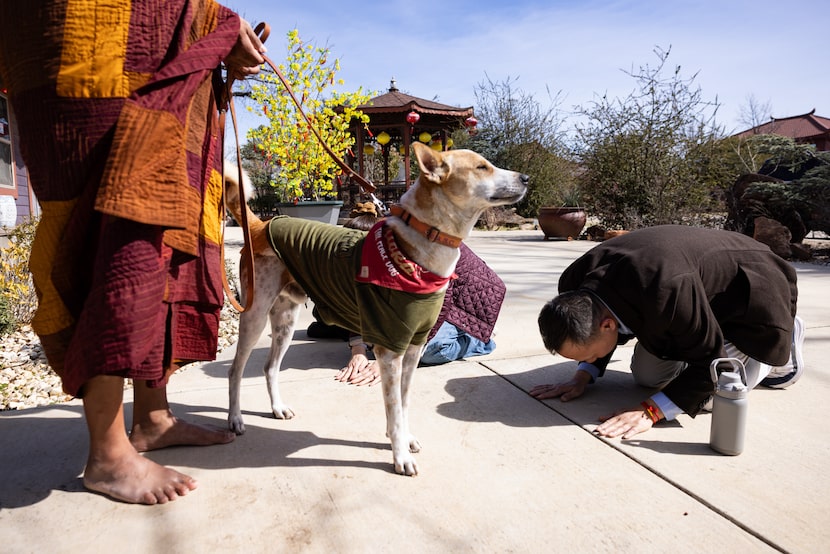
Aloka the dog soaks up sunshine while visitors Dung Ton and My Tran bow to Venerable Bhikkhu Pannakara, a Buddhist monk, at the Huong Dao Vipassana Bhavana Center on Tuesday, Feb. 24, 2026, in Fort Worth. Aloka’s shirt says, “Legend.”
Angela Piazza / Staff Photographer
Your dog Aloka became a global symbol of faithful companionship. Will you tell the story of how you met Aloka?
Aloka is from India. In 2022, I was walking in India for 112 days with about 100 monks. Aloka was a stray dog, and on day six, he just joined and followed us all the way to the end. During that time, he got hit by a car, he also got sick, he almost died. Many times I had to carry him. Finally, he recovered, and after the journey, I decided to bring him here. I thought he deserved better than life as a stray. He played a big role with this journey. Everybody loves him. They say he’s like a king. [Laughs.] People have sent him so many treats. He’s spoiled. A magazine about animals is coming to write about him tomorrow. They want him to be on the cover. But I’m also in the process of opening a foundation for him to support animals around the world.
I wanted to ask about your background. You grew up in Vietnam. When did you come to America?
I was 15. My father, who served in the military, was able to move to the United States, so I came here with my parents. I went to high school in North Dallas. After that I went to university and then worked for about two years.
You went to the University of Texas at Arlington. And I read online that you worked at Motorola?
No, I didn’t work at Motorola. I don’t know how people get these ideas. But I worked [as an engineer] for two years, and then I came to this temple one day. I lived in Dallas at the time. I was going to the temple in Irving, Liên Hoa, and I was one of the leaders in the youth group. But we had come to this temple [Huong Dao] to do the dragon dance and things like that, so I drove here one day. I was thinking about leaving my workplace.
That’s when I saw the man who would become my teacher. I never talked to him. I just bowed down to him, that’s it. He was walking, and I was walking behind him, and then he turned around and asked me, “What do you want?” and I said, “I want to become a monk.”
Why did you want to become a monk?
It was because of work, because of family, because of friendships. I could see that things were not real. Everything was just fake. So I asked myself, is this the path I want, or is there something else?
I actually asked him if I could be a temporary monk at first. I said, give me two weeks to arrange my work. Then after two weeks, I stayed here for two years, and I was ordained as a monk.
One message you repeated in speeches was, “Do not multitask. Try to stay away from your phone as much as you can.” Can you talk a bit about what our phones are doing to us?
There’s so much distraction. We know about many things going on in this world, but we don’t even know our breath. That’s why I say, try to stay away from the phone as much as possible. That is the way to help us to come back to ourselves, use our head, try to live mindfully. The more we use the phone, the more those things pull us off track.
But it’s tricky, right? Because the phone is how many people learned about your journey. We need it to connect, but how do we keep from giving it control?
I know. Let’s say in the morning, when you wake up for the first hour, you shouldn’t touch your phone. Because that is when your mind is fresh and pure. Give your mind something better to do. Then at night, when we have so many thoughts, and it’s difficult for us to go to sleep, leave your phone alone for an hour before bed. Try to cultivate your breathing. That is how we practice mindfulness. I know it’s not possible for people to get rid of their phones, but at least give yourself two hours. Just try.
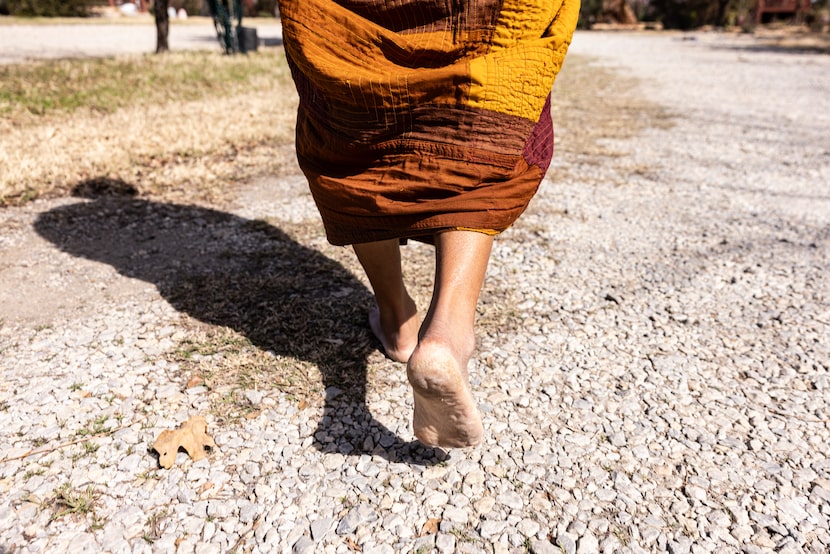
Bhikkhu Pannakara, a Buddhist monk, walks over gravel to cottages at the Huong Dao Vipassana Bhavana Center on Tuesday, Feb. 24, 2026, in Fort Worth.
Angela Piazza / Staff Photographer
For those of us in North Texas who are curious about you and your work, what are the opportunities to come to the Huong Dao temple? What are some of the events you hold?
The temple is open to the public. Anybody can come. The most important event is coming up May 2-10. International Vesak Day celebrates the birth, enlightenment and passing of the Buddha. We will have several events, and the last night, we light 24,000 candles and pray for world peace. We will also host the global loving kindness meditation again.
The Walk for Peace ended, but how can people keep its spirit going?
It’s ended, but for us, it’s just started. My plan is to have monthly global loving kindness meditations. And maybe in the future, we might continue this walk. I don’t know yet. But for right now, people have promised they will keep walking with us. Every day, people practice that statement, “Today is going to be my peaceful day.” It’s simple but powerful. When we remind ourselves that if anything bad happens, we can stop that thought, that speech, that action. That is how we find peace.
 Cece Cox, one of Dallas’ most influential LGBTQ leaders, announces her retirement
The head of Resource Center on leaving the nonprofit she transformed and the challenges facing her successor.
 The Dallas late-night talk show host who’s not afraid to be fed pudding on-air
Steve Noviello of Fox 4 brings a playful spirit to the button-down world of local TV news.