
As Dallas-Fort Worth becomes more of a draw for domestic and international companies, Taiwan is planting its flag in the ground by actively recruiting for talent in the area.
Last Sunday, Dallas hosted its first Taiwanese job fair, which in part was designed to strengthen the tech and economic ties between the island and the United States.
The island is also the U.S.’s fourth-largest trading partner, according to the Council on Foreign Relations. As relations between Taiwan and the U.S. expand, Texas is playing an increasingly visible role.
Related

The recruitment drive featured over 20 high-tech Taiwanese industry leaders, including Foxconn, the world’s largest electronics contract manufacturer known for making Apple iPhones and iPads. The company has also started producing Smart electric vehicles (EVs), according to Forbes.
Business Briefing
Other featured corporations offered services such as CPU coolers (Cooler Master), corporate banking (E.Sun Bank), and U.S. visa and green card services (Green Maple Law Group), providing a “2.0 Trump Guide” for companies.
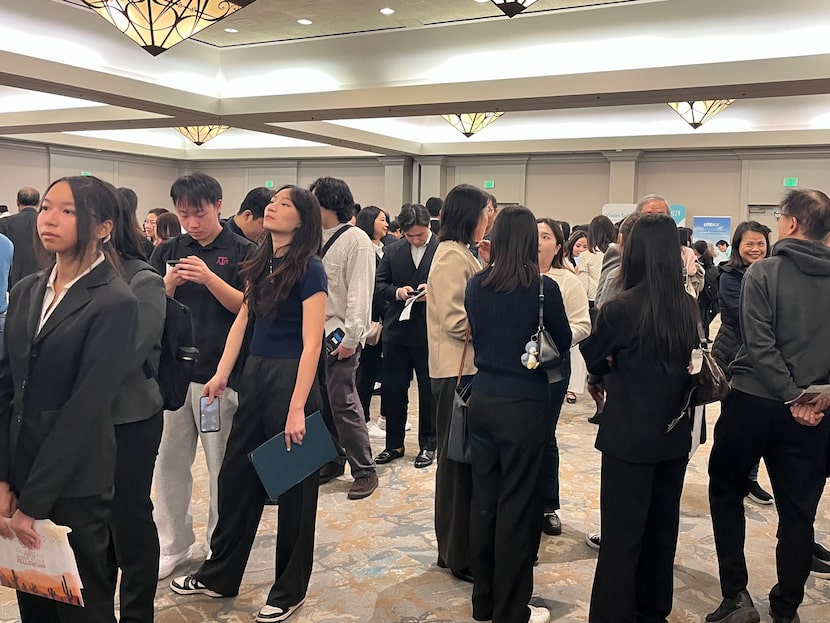
Attendees gathered at the Taiwan jobs fair, held on Feb. 22nd at Hilton Richardson Dallas Hotel.
Victoria Baeza Garcia
The Greater Dallas Taiwanese Chamber of Commerce (GDTCC) was one of the event sponsors. Its President, Laurence Chiang, called it a priority, even as U.S. trade policies create friction between America and its international counterparts.
“For 35 years, we hosted our Lunar Gala at this same period, but this event was more important to us,” Chiang said. “We wanted to help Taiwanese tech companies find the right talent.”
Along with the GDTCC, the Taiwanese Chamber of Commerce of North America (TCCNA), the Greater Taiwanese Chamber of Commerce Junior Chapter, and the city of Richardson also sponsored the event.
Richardson’s Mayor Amir Omar said he was excited to support these efforts, as they benefit both the U.S. and Taiwan’s economies – and help talent enter the workforce. Nationally, the jobs market has stagnated but D-FW unemployment is lower than the U.S. rate.
Data centers are expanding across the region, and the growing presence of Taiwanese AI, semiconductor, and manufacturing industries were a reflection of the trend. Those sectors attracted more than 600 job seekers, who connected with industry leaders, explored internship and job opportunities, and learned how Taiwanese tech ecosystems operate in the U.S.
Some were looking for full- or part-time jobs, while international students sought CPT and OPT internships.
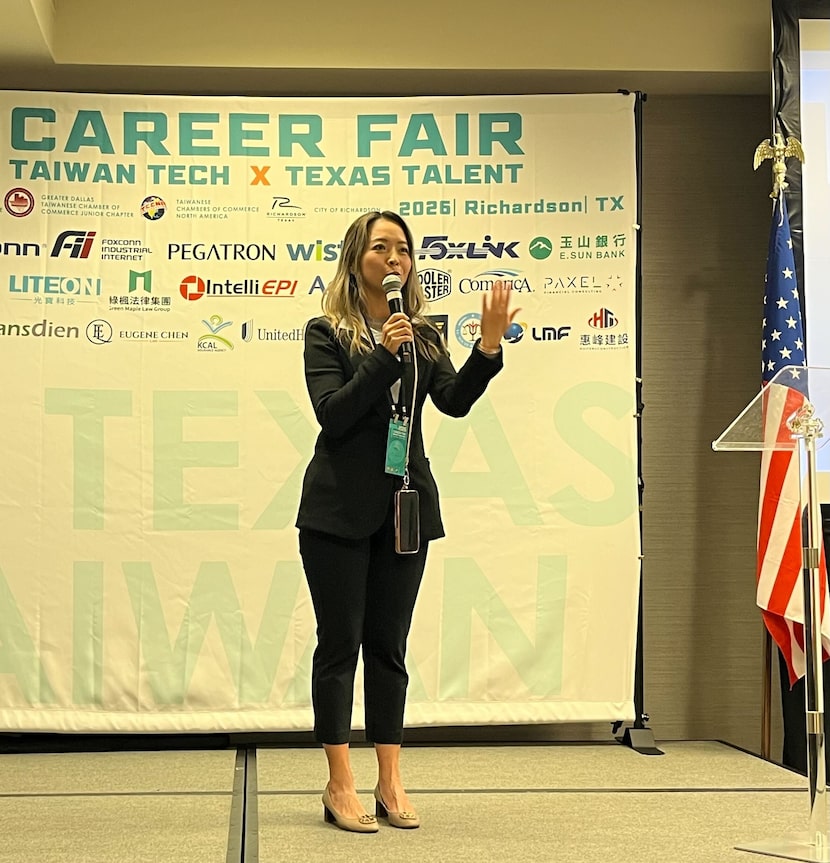
Katy Chung, sales manager at KCAL Insurance Agency, speaks to attendees of the Taiwan jobs fair, held on Feb. 22nd at Hilton Richardson Dallas Hotel.
Victoria Baeza Garcia
Prospective employees like Wellson Huang, who recently completed his master’s in electrical engineering at Texas A&M, targeted all sorts of opportunities.
“I am primarily looking for a full-time job in the semiconductor industry, as it is one of our country’s strengths,” Huang said. “This fair offers great opportunities for local and Taiwanese people.”
Taiwan produces 90% of the world’s high-end computer chips, according to data, and Taiwan Semiconductor Manufacturing Company (TSMC) is one of the leading companies in the industry.
Another emerging industry that’s central to U.S.-Taiwan relations is the financial sector, which is blossoming in the D-FW with the emergence of “Y’all Street.” One of the reasons is the launch of the Texas Stock Exchange (TXSE), a thriving AI server industry, and a surge of capital from Asia, with trading slated for 2026.
And Taiwan is a rapidly growing source of foreign investment for the Lone Star State.
Companies like GlobalWafers, Wistron, and Inventec are investing billions, with energy resources, strong talent pools supported by robust education systems, and proximity to tech hubs as the main reasons.
Henry Lee, who works in business development at Sysgration — a firm with 48 years of operations — identified Texas as a strategic growth opportunity.
“We opened our first location in Plano, TX, last year,” Lee said. “Our main reasons to open facilities in Texas were its distinguished talent in the electronics industry and incredible infrastructure.”
Samuel Yuan, an event attendee, listed low taxes, cheap land, and low labor costs as reasons why expanding in Texas works well for Taiwanese companies.
Other firms aim to strengthen relationships with their U.S. and its neighboring countries’ customers. So said Wistron’s Senior Vice President, Jackie Lai.
“We have a significant and expanding manufacturing presence in Mexico and a tight relationship with Texas,” Lai said. “Its high-performing workforce and proximity to the Mexican border bring us closer to our clients.”
Dallas-Fort Worth is also firmly on the expansion roadmap for these companies.
E.Sun Bank opened the first Taiwanese bank in Dallas. For Chairman Joseph Huang, this represented a beneficial economic investment.
“Our Dallas office is a strategic bridge connecting Taiwan’s financial strength with America’s next-generation growth.”
IntelliEPI Inc., another showcased company, has its headquarters in Richardson, TX.
As Texas–Taiwan semiconductor trade expands, a potential conflict between China and the island could disrupt global supply chains.
China’s assertion of sovereignty over the self-governed territory adds further uncertainty to the semiconductor market. For companies reliant on those products, geopolitical risk remains a critical concern.