
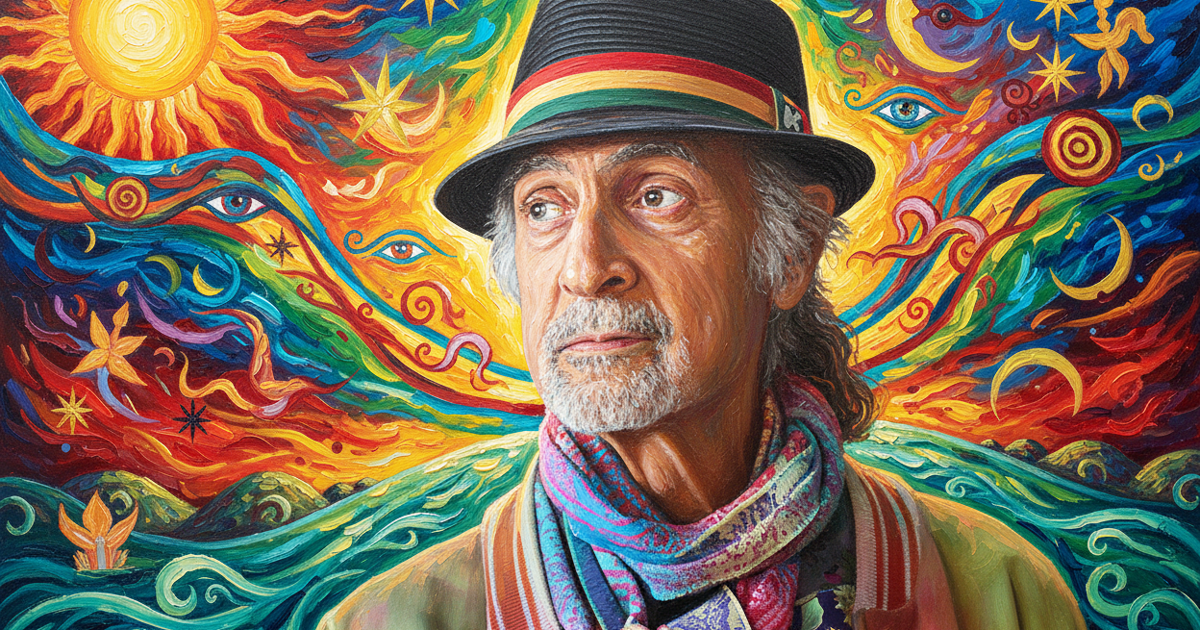
El Paso artist Hal Marcus has never been big on following orders.
And he has no plans to do so now — not even after a terminal cancer prognosis.
“I’m living life to its fullest,” Marcus said from the second floor of his studio on Oregon Street. “My wife (Patricia Medici) and I have been going to San Diego. We have our favorite little hotel room that we’ve been going to for 25 years. We hang out on the beach for a week.”
Marcus, 74, was diagnosed with pancreatic cancer on Aug. 12, seven months ago.

Marcus has created a new series of art using angels as his inspiration.
Photo by Ruben R. Ramirez
“I went to MD Anderson, with the best doctors in the world and they said, ‘This is what you have, this is how long you have to live and you need chemo.’ I said, ‘No, I’m not doing chemo.’”
Instead, Marcus leaned on his creative energy and spirituality as his medicine.
“I’m enjoying life every day,” he said, his dark, sunken eyes contrasted by his brightly tie-dyed linen shirt and vibrant colorful paisley scarf. “I put in 10-12 hours a day in my studio, wake up in the middle of the night, eat whatever I want. I call my own shots. That’s what’s keeping me so inspired. This is my medicine.”
Marcus, a self-taught folk-art artist known for his vibrant, colorful, and often cubist-influenced depictions of the Borderland, chose the treatment that was right for him.
“Oncology told me they wanted to put a port in and that I would have a 30% chance of living. It would extend my life another six months,” he said. “I wasn’t going to put poison in my heart, no way, José. They had the wrong guy. They were very respectful, but I wasn’t going to do that to my body.”
His medicine is his brushes, paints and palettes.
“When people go to chemo, I go to my art because it’s full of love,” he said. “That’s powerful. That’s why we’re here. Lots of times we don’t understand it or don’t ever think about it. The more we give, the more we help each other, the more enriched your life is, the healthier your life is, the more spiritual you become.”
Prognosis inspires creativity
Since the start of the 2026, Marcus has created 12 works of art using pieces of his old shirts with paint, on a canvas.
“I started a whole new type of art,” Marcus said. “I’ve been saving my old shirts for 25 years. When they start to wear out, I just sew them up. I couldn’t throw them away so I put them in a box, thinking one day I would make art out of them. After I was diagnosed, one day might be sooner than expected, so I brought them all out.”
He’s never felt so motivated.
“I’ve been inspired my whole life, not to the degree that time might be running out, but all of a sudden, death is knocking at my door,” he said. “When you are in the state of creativity and doing something new, it becomes the medicine that helps you heal. Lots of people, when they get diagnosed, they go into a depression. Not me. I say, I’m going to live life to the fullest, every day.”
Marcus takes a short break, walking around the studio, drinking coconut water. He stops as a thought pops in his head.
“There are statistics for people with cancer who go through treatment, 22% live, some of them get sick,” he said, pausing before sitting down again. “But I’m not a statistic. I am outside the box.”
His positive outlook on life has not only improved, it has increased his life satisfaction.
“My doctors say that they don’t know what’s happening, but they wish more of their patients would do what I’m doing,” said Marcus, whose gastroenterologist is Dr. Jesus Guzman.
His new series of art includes angels.
“I’ve been thinking a lot about angels,” he said. “Angels are God’s helpers. I’m being helped a lot by angels right now because so many people are praying for me and thinking about me and wishing me well. They are guiding me, which is why I’m so healthy today.”
Marcus’ work has traditionally featured themes of peace, love and community heavily influenced by his childhood experiences in Juárez, Mexico.
“I’ve become more spiritual because in my belief that the world was created by love; if I love you and I love my fellow man, and I love the universe and I love creation and I have gratitude, those are all things that make me healthier,” he said. “Those are things that I’m grateful for. I have been working on this even before the diagnosis, so I have a lot to be proud of. I was on the right track.”
Marcus was born into a working-class family in Kern Place.
“My dad had a little grocery store on Mesa and Robinson; we all worked there,” he said. “Our family has been around since the early 1900s. We are Jewish and Arabic, we were merchants and immigrants.”
He watched his father, Morris Marcus, build the business and that motivated him to exert more effort in his love of art.
“I’ve been painting almost every day since I was 16,” he said. “People say that I’m talented but it’s 10% talent and 90% hard work. Everybody is talented, but do they do anything with it? Do they dedicate their life to it? Do they spend time doing it? Not many. If you have talent but you don’t work, nothing is going to happen.”
Work ethic is generational, a trait that Marcus has passed down to his three children.
His son, Marco Marcus, aka Dr. Flaw, is a comic book publisher; daughter Adelaide is an artist and dancer who owns Full Moon Ranch in California; and Leilainia is a wellness expert and co-owner of Sunset Parlor, an event and wellness venue.
“I call him the eternal optimist, that’s how he has always been my entire life,” Leilainia said. “Now, facing the hardest challenge he has ever had, it is still there. It’s really ingrained into who he is; it’s not just a façade, he really is an eternal optimist. He looks at the bright side of everything. It’s not like this toxic optimism; it really is going in looking at the situation and figuring out the opportunity within it.”
Refusing chemotherapy, Marcus credits his art and spirituality as his medicine.
Photo by Ruben R.Ramirez
Looking outside his second-floor window, Marcus can see Downtown El Paso, Hueco Tanks, El Paso High and Mt. Cristo Rey.
That’s where he draws his inspiration.
“As a young man, I went to Dallas, San Antonio, Houston and Fort Worth, but I couldn’t get an art show,” he said. “And then when I did, they took it down early, they disrespected my art, I didn’t sell anything. Nobody showed up. That broke my heart. As a young man I dropped out, turned on and tuned in, as we used to say in the ’60s and ’70s.”
He returned to El Paso and rented a studio in Canutillo for $100 a month.
“I worked and I worked and I worked,” he said. “I said ‘screw the establishment.’ I knew one day I would own an art gallery and I was going to treat artists the way they should be treated. I was going to respect them and compensate them. I was going to be a good art dealer.”
He has represented between 200 to 300 artists in the past 30 years.
“It’s been wonderful,” Marcus said. “I have mentored a lot of them, I’ve exhibited their work. They have a lot of respect for me, and I have tremendous respect for them. We are the only art gallery in town that sells early El Paso and early Texas art. I’ve had artists who have worked with me for all 30 years. It’s been gratifying.”
There are no plans of closing.
“I have over 350 works of art,” he said. “If I should pass away, my kids are going to take over the gallery and I’ll turn my home into a museum. It’s in my legacy.”
Sunset Parlor, the Marcus studio and the Hal Marcus Gallery are all within a few feet of each other on North Oregon Street.
Leilainia Marcus said her father’s unwavering, resilient belief that positive outcomes are possible, regardless of challenges, setbacks or hardships, has been empowering.
“None of us really know what our deadline is,” she said. “But when someone tells you it might be sooner than expected, it really helps you to either amp up your game or just give up.”
Her father choose to amp up his game.
“He is doing what he loves every minute,” she said. “I can only imagine what he is going through and the struggle of it. But he looks around and he loves the people in his life, he loves the life he has created and what he has surrounded himself in. He lived it his way and he is doing it his way, still.”
Hal Marcus takes another deep breath, looking around the studio, reflecting on the life lessons he has learned, searching for the silver linings in this difficult situation.
“When someone tells you you’re going to die, you’re going to start thinking real seriously about living,” he said. “How do you live the fullest? You’re kind to others, you think about your life. People have heard about what is happening to me, and they are reaching out and praying for me.”
He pauses again, reflecting on how his circumstance can inspire others with a hopeful, forward-looking perspective.
“Every single day there are blessing in my life, every single day. I have so many friends in the right places. I have a good name, I have a good reputation,” he said. “If someone finds themselves in a similar situation that I’m in, I hope they follow the same path. I hope they find something they love and pursue it. If they always wanted to garden, do it. Maybe that will help them live longer and happier.”
For Marcus, it’s his art that has kept him going.
“I don’t suffer any side effects from what I’m doing,” he said. “I have a lot that I can complain about, but it’s kept me alive. I may walk a little bit slower, but I’m able to come to the studio and work 10 to 12 hours a day. This whole thing might be a blessing. Everything that happens to you is some sort of blessing, even when you don’t realize it. All of this has given me energy. All of a sudden life is condensed, and the attention is on me because I’m going to die.”