
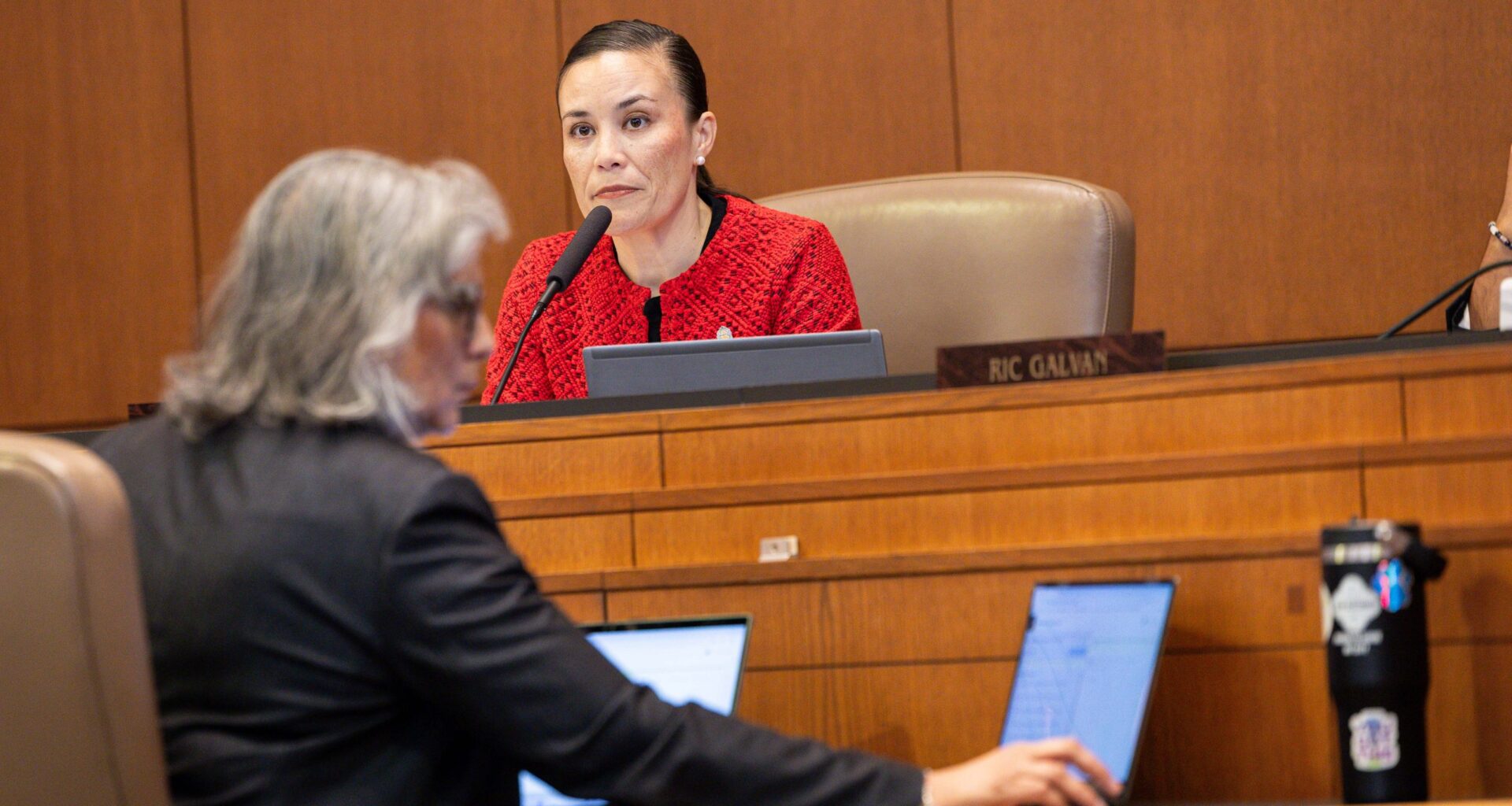
After a week of mounting tension and closed-door deliberations, the San Antonio City Council on 8-1 on Friday to formally censure Mayor Gina Ortiz Jones, concluding that her conduct during a Feb. 5 confrontation with Councilwoman Sukh Kaur (D1) violated the city’s Code of Conduct and workplace policies.
In a surprise twist, District 9 Councilwoman Misty Spears, one of the council’s most conservative members, cast the lone vote against the resolution, saying she did not believe the incident rose to the level of workplace violence.
Members of the council were allowed to watch a video of the Feb. 5 disagreement, which has not been released to the public.
The vote caps months of escalating friction between Jones and several council members over both her leadership style and the Feb. 5 breakroom exchange that prompted an independent investigation.
While a censure vote is largely symbolic, the resolution adopted Friday carries practical consequences. It calls on Jones to step aside as chair of the Governance Committee for three months and to complete in-person leadership training focused on civility, de-escalation and conflict resolution. It also calls for a written apology addressed to Kaur.
“In the interest of moving forward and focusing on the people’s work, I agree to step aside from the Governance Committee for a period of three months starting today,” Jones said in a prepared statement. She added that she would participate in an in-person leadership training next week.
Jones’ decision marks a sharp change in tenure from her comments earlier in the week, when she said she had no plans to do either of those things.
Since then rumors have swirled that the council might escalate the censure to a vote of no confidence — a move that would be tougher for Jones to bounce back from.
San Antonio City Council has censured plenty of their own members, but typically not the mayor, whose agenda-setting authority could be used to squash their policy proposals.
Before Jones arrived, however, the council rolled back some of those powers. They amended the city code to make sure their ideas move through the committee process whether the mayor wants them to or not. They also dusted off a little-used tool that allows them to put items on the agenda without the mayor’s support.
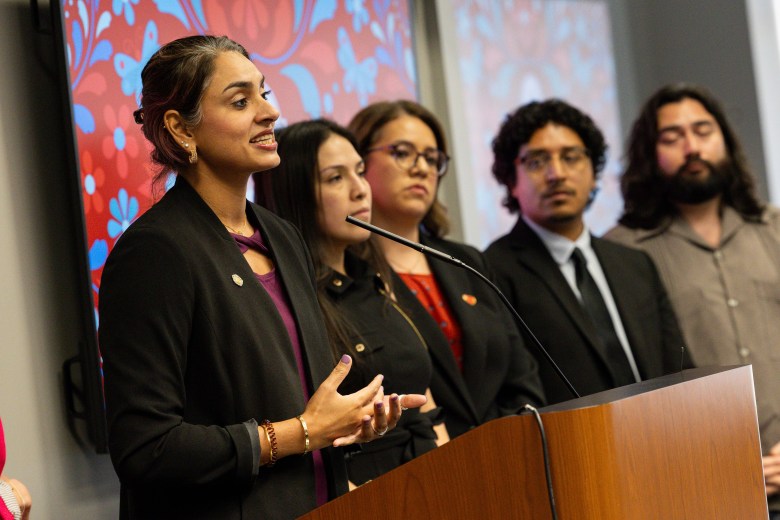 District 1 Councilwoman Sukh Kaur held a press conference with other members of the council after their vote to censure San Antonio Mayor Gina Ortiz Jones during a special session meeting on Feb. 27, 2026. Credit: Amber Esparza / San Antonio Report
The Feb. 5 confrontation
The dispute centered on whether the Bonham Exchange — a downtown LGBTQ+ nightclub operating in a 19th-century building — should be allowed to continue operating at its full 650-person capacity without installing a legally required fire sprinkler system. San Antonio adopted a fire code in 2018 requiring large nightclubs and bars to install automatic sprinklers by Oct. 1, 2023.
While several establishments signed compliance agreements allowing reduced occupancy while working toward installation, the Bonham Exchange declined to sign an agreement that would have capped capacity at 300 people. Fire officials determined the club’s occupancy should be reduced unless additional life-safety upgrades were completed, setting up a policy clash among council members over whether to grant more time.
Jones said she supported the fire department’s recommendation to reduce occupancy in the interest of public safety. During the exchange, she acknowledged raising her voice and using profanity toward Kaur in a council breakroom ahead of that day’s meeting.
“I became passionate that morning because I firmly believe public safety is our number one responsibility. I should not have raised my voice at my colleague, and I should not have used profanity,” Jones said. “I apologize for doing so.”
The city hired an outside employment law investigator, who concluded that Jones was verbally abusive and that her conduct violated the council’s Code of Conduct as well as city administrative directives governing equal employment opportunity and workplace violence.
In a press conference following the decision, Kaur publicly addressed the incident for the first time. She said the censure vote was not about policy disputes, politics, wasting time or hurt feelings.
“This was, as the investigation found, an incident of workplace harassment that was unacceptable and unbecoming of our mayor,” Kaur said. “The mayor has tried to diminish this incident as a single ‘F-bomb’ that was thrown.”
Kaur said political disagreements are part of the job but that “a toxic work environment will continue to weaken” the council’s work. She also pushed back on suggestions that Jones’ military background or leadership style justified the tone of the exchange.
“Our lived experiences do not justify or excuse our behavior,” she added.
 Former Councilman Mario Bravo speaks to the council during a city council special session meeting to discuss the censure of San Antonio Mayor Gina Ortiz Jones on Feb. 27, 2026. Credit: Amber Esparza / San Antonio Report
Public comment and discussion
During public comment, several speakers urged the council not to move forward with the censure, calling it a distraction from pressing issues facing the city. Others defended Jones and characterized the vote as petty or unnecessary amid larger policy challenges.
Former District 1 Councilman Mario Bravo questioned the fairness of the investigative process, noting that the same outside investigator conducted his 2022 censure investigation and argued that the city’s process lacks transparency.
During council discussion, Spears echoed some of those concerns, and said she sympathized with her colleague but did not believe the incident rose to the level of workplace violence. She also expressed concerns about the transparency of the investigative process and the findings presented privately to the council.
“I have serious concerns about the investigative process itself. The findings do not accurately reflect the facts as presented, and the process appears one-sided,” Spears said. “Without an opportunity for testimony or for the mayor to present a defense in an impartial setting, it raises serious concerns about basic due process.”
The report is subject to attorney-client privilege and has not been released publicly, a point Spears said further raised transparency concerns. After the vote, McKee-Rodriguez said the council had no plans to release the report out of concern that the three witnesses involved could be easily identified even with redactions.
McKee-Rodriguez described the situation as “incredibly embarrassing” and acknowledged that the process had been a distraction. But he emphasized that regular council business continued during the investigation and that the findings required action.
Councilwoman Teri Castillo (D5) said she had been “disheartened and disturbed” by what she described as a pattern of behavior from a mayor she had previously endorsed, adding that when a line is crossed, accountability is necessary.
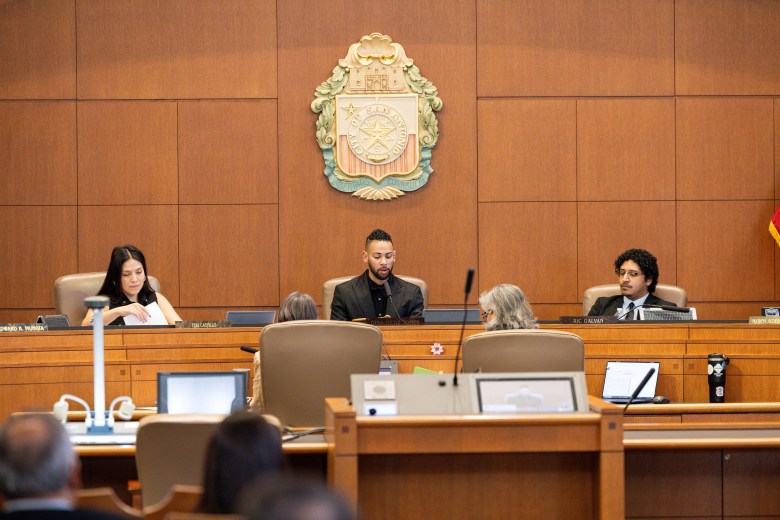 Councilmembers Terri Castillo, Jalen McKee-Rodriguez and Rick Galvan each spoke on the censure of San Antonio Mayor Gina Ortiz Jones at a city council special session meeting on Feb. 27, 2026. Credit: Amber Esparza / San Antonio Report
“In retrospect, knowing what I know now, I would not have endorsed Mayor Jones,” Castillo said. “Over the last nine months, I’ve heard stories and witnessed interactions with Mayor Jones and my colleagues, community members and city staff that demonstrate a pattern of unprofessional interactions.”
Councilman Marc Whyte (D10) said the investigation’s findings left the council with little choice but expressed hope that the vote could mark a reset.
“It’s my hope that this will set the mayor’s office on a different course, one that pushes her towards respect for her colleagues and increased collaboration with the other 10 of us here to get the work done for the people of San Antonio,” Whyte said. “This could be a chapter of division or a reset.”
The council adopted its Code of Conduct in 2024 to establish formal standards governing how elected officials interact with one another, city staff and the public. Under the City Charter, the council does not have the authority to remove the mayor through censure. Removal is only permitted upon conviction of a crime involving “moral turpitude.”
Reporter Andrea Drusch contributed to this story.