
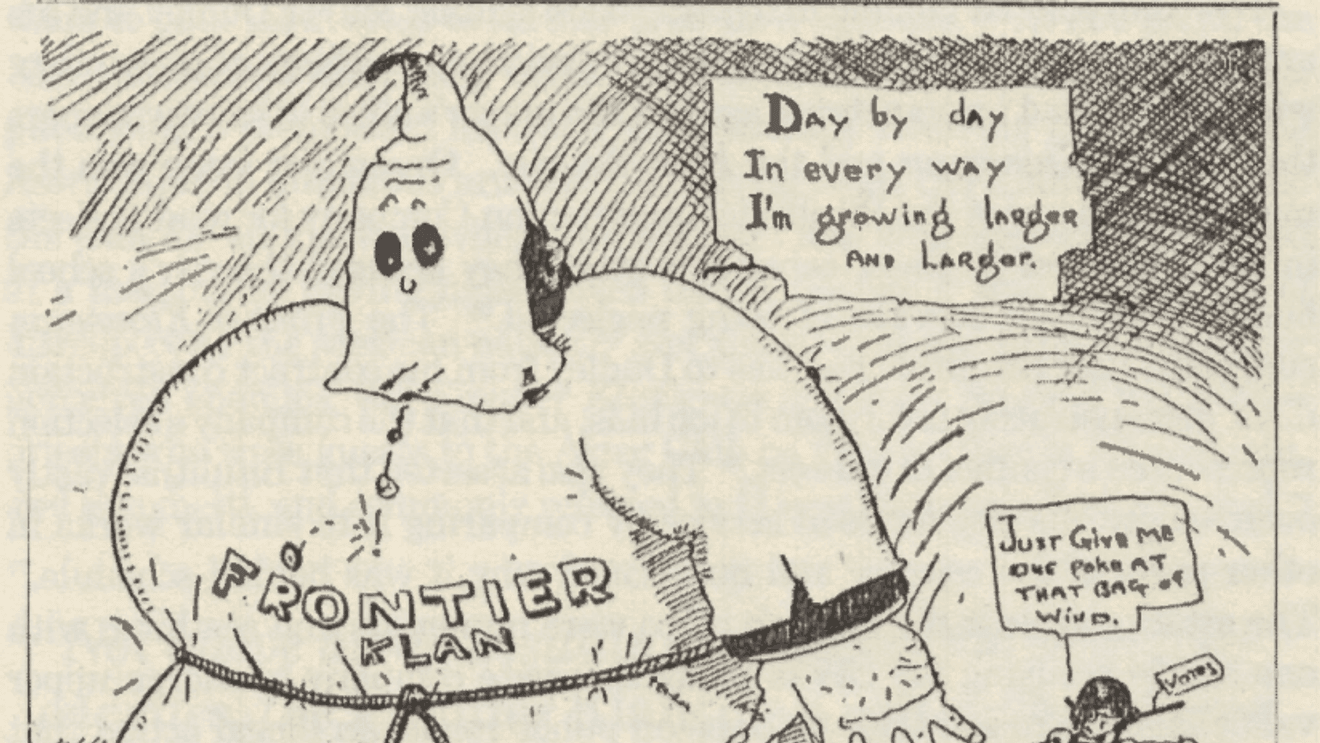
El Paso, TX (KFOX14/CBS4) — The Ku Klux Klan’s presence in El Paso in the early 1920s came amid a push to reshape the city’s image as it grew into a regional business hub, according to local history enthusiast Caleb Lara.
ARC El Paso spoke to him at Tom Lea Park, and he went into detail about the brief but significant history of the Ku Klux Klan in El Paso. All of Lara’s findings were indeed consistent with this full report published by the El Paso County Historical Society.
The KKK started in El Paso in 1921, Lara said, placing it in the broader context of the city’s development after El Paso “really broke off in 1881 when the railroad started here.” In the years that followed, Lara said, there was “a real big effort to try to get rid of the wild, wild west,” including efforts to eliminate gambling and prostitution.
Lara described El Paso during Prohibition as especially unruly, saying that in the Roaring Twenties “El Paso was off the hook,” with “all kinds of bootlegging going high.” Lara said there were buildings near the center of town where people could drive into a garage, load up on alcohol and drive out without being seen.
Against that backdrop, Lara said the KKK movement that arrived in El Paso in the 1920s was different from the original Klan that began in the 1800s. Lara described it as “a much more well-funded movement,” a “revival of the original,” that became “more of a political, well-organized, multimillion dollar movement.”
KKK era reshaped El Paso, leaving Confederate school names that still remain today
In El Paso, Lara said, the KKK’s effort “was actually not so much about blacks,” but “actually about anti-Catholic.” Lara also emphasized the Klan’s local influence was brief: “This only happened for one year.”
By 1923, Lara said, Richard Dudley — who had been reelected in Austin for Congress — gave up his seat to return to El Paso and run for mayor. Dudley ran in an anti-KKK party and “won by a landslide,” Lara said.
Lara said the era also left a lasting mark on local institutions, including school names. “A lot of the schools they renamed are still kept that name,” Lara said, adding that schools were renamed for “Confederate patriarchs.”
Bowie High School, Austin High School, and Crockett Elementary School are among the schools renamed during the KKK era of El Paso that still go by those names today.
I asked Lara why it is important to discuss the KKK during Black History Month. He said it is a conversation that should extend beyond the Klan to “any other aspect of history,” arguing that understanding the past can help people recognize patterns that can repeat. “The archetype of the situation and in that historical context is undoubtedly going to repeat itself,” Lara said. “And our job is to pick up on it.”
RECOMMENDED: El Paso’s first black mayor reflects on historic role during Black History Month
RECOMMENDED: El Pasoan Ron Stallworth recounts infiltrating Ku Klux Klan as Colorado Springs detective
Sign up to receive the top interesting stories from in and around our community once daily in your inbox.